

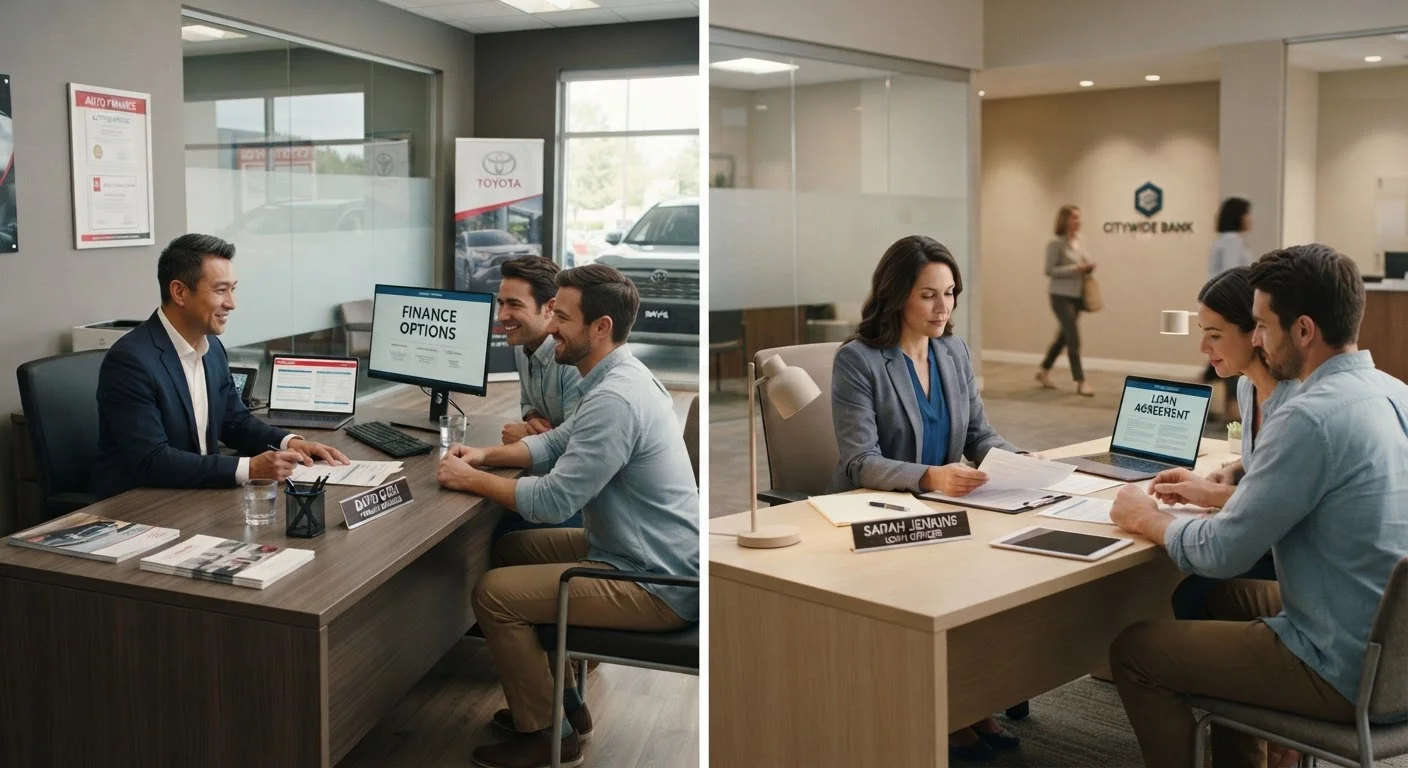
Key Takeaways
- Dealers act as intermediaries and can mark up the interest rate they receive from lenders.
- Pre-arranging financing through your own bank gives you a concrete rate to compare against dealer offers.
- Manufacturer-backed promotional rates through dealers can be genuinely competitive for qualified buyers.
- Credit unions often offer lower auto loan rates than traditional banks, making them worth checking.
- Focusing only on monthly payments rather than total loan cost is a common and costly mistake.
Option A
Dealer Financing
The convenient, one-stop-shop option built into the purchase process.
Best for: Buyers who want a streamlined transaction and may qualify for manufacturer-backed promotional rates.
Option B
Direct Bank or Credit Union Loan
The independent route that puts rate shopping in the buyer's hands.
Best for: Buyers who want to compare rates beforehand and enter the dealership with financing already secured.
If you want the simplest, fastest transaction at the dealership
Dealer Financing
Dealer financing handles everything in one sitting. If a manufacturer promotional rate applies to your purchase, it may also beat what you'd find independently.
If you want the strongest negotiating position on price and rate
Direct Bank or Credit Union Loan
Walking in with a pre-approval forces the dealer to compete on rate. You're negotiating from information rather than convenience.
If you have a limited or rebuilt credit history
Direct Bank or Credit Union Loan
Your own bank or credit union already has a relationship with you and may offer more favorable terms than indirect lenders routed through a dealer.
If a manufacturer 0% or low-APR promotion is available and you qualify
Dealer Financing
Manufacturer-subsidized rates are only available through dealer financing channels and can be meaningfully lower than market rates for well-qualified buyers.
How Each Financing Path Actually Works
When you finance through a dealership, the dealer submits your application to one or more lending partners - banks, captive finance arms (lenders owned by the automaker), or other institutions. The lender approves a rate, and the dealer may add a markup, called a dealer reserve, before presenting the rate to you. That spread is compensation to the dealer for arranging the loan.
Direct financing works differently. You apply to a bank, credit union, or online lender before visiting the dealership. If approved, you receive a pre-approval letter specifying the loan amount and interest rate you qualify for. You then use that as a spending ceiling and a benchmark - if the dealer can beat it, fine; if not, you use your own financing. Understanding how auto loans are secured against the vehicle is worth reviewing; see our piece on how collateral changes the borrowing equation for context.
| Criterion | Dealer Financing | Direct Bank / Credit Union Loan |
|---|---|---|
| Application process | Handled at the dealership | Applied for before visiting dealer |
| Rate transparency | Buy rate may be marked up | Rate quoted directly to you |
| Speed of approval | Often same day | Typically 1-3 business days |
| Promotional rate access | Yes, if manufacturer offers apply | No access to captive-rate promos |
| Negotiating leverage | Lower - rate is presented post-negotiation | Higher - pre-approval is a benchmark |
| Credit union eligibility | Not applicable | Requires membership |
Where Each Option Can Hurt You
With dealer financing, the primary risk is the rate markup. Because you may not know the lender's buy rate (the rate the lender actually approved), it's hard to tell whether you're being offered a fair deal. Dealers are also skilled at shifting the conversation to monthly payments rather than total cost - a dynamic that first-time car buyers frequently fall into.
With direct financing, the risk is mainly logistical. Pre-approvals expire, typically within 30 to 60 days. Your pre-approved amount may not cover add-ons or a last-minute vehicle upgrade. And applying to multiple lenders within a short window - generally 14 to 45 days, depending on the scoring model - usually counts as a single hard inquiry, so rate shopping doesn't have to damage your credit significantly. Lenders evaluate more than just your score; factors like debt-to-income ratio and employment history matter too, as detailed in our guide on what lenders weigh beyond your credit score.
Credit Unions Often Deserve a Closer Look
Credit unions are member-owned, nonprofit financial institutions that frequently offer auto loan rates below those of traditional banks. If you belong to one - through an employer, community group, or other affiliation - it's worth requesting a rate quote before approaching any lender. Many credit unions also allow you to join specifically to access their loan products, though eligibility criteria vary by institution.
Making the Two Options Work Together
Experienced buyers often use both paths simultaneously. Get a pre-approval from your bank or credit union first - it's free, sets a baseline rate, and gives you something to walk in with. Then let the dealer's finance office try to beat it. This approach turns dealer financing into a competing bid rather than a default. If the dealer offers a lower rate or a manufacturer promotion applies, you can take it. If not, you use your own loan.
Before signing anything, confirm the total loan cost - not just the monthly payment - and check whether the deal bundles in extras like extended warranties or gap insurance that inflate the financed amount. Our pre-purchase checklist covers what to verify in the paperwork before you commit. If you're also navigating a trade-in as part of the deal, keep that negotiation separate from financing; mixing them makes it harder to evaluate either clearly.