

Key Takeaways
- A car battery typically lasts three to five years, depending on climate and driving habits.
- Slow engine cranking, dim lights, and frequent jump-starts are early signs of a weakening battery.
- Short trips, extreme temperatures, and parasitic drains are among the most common causes of premature battery failure.
- Regular voltage testing - especially before winter - can help you replace a battery on your schedule, not the road's.
- Simple habits like securing connections and limiting accessory use when idling can meaningfully extend battery life.
Why Your Battery Deserves More Attention
A car battery rarely fails dramatically. More often, it fades slowly over months - starting a little harder each morning, recovering a little less after a cold night - until one day it simply doesn't start at all. By then, you're already stranded.
Understanding how batteries age, what drains them prematurely, and how to read the warning signs puts you back in control. The good news: most battery problems are preventable or at least predictable with minimal effort. See our seasonal maintenance checklist for a broader look at what to inspect before extreme weather arrives.
How Long Should a Battery Last?
Most conventional lead-acid car batteries have a typical service life of three to five years, though this varies with climate, vehicle type, and driving patterns. Batteries in hot climates often wear out closer to the three-year mark, while those in moderate climates may reach five or more years. Age alone isn't a reliable indicator - a load test gives a far more accurate picture of remaining capacity than the date on the sticker.
Warning Signs and Habits That Make a Difference
Slow or labored engine cranking
When you turn the key or press the start button and the engine turns over sluggishly - taking longer than usual to fire - that hesitation is often the battery struggling to deliver the current the starter motor needs. It's one of the earliest and most reliable signals that battery capacity is declining.
Don't dismiss a single slow start as a fluke, especially on a mild-weather day. Repeated sluggish cranking means it's time to have the battery tested, not just recharged.
Repeated sluggish cranking is a reliable early signal - don't dismiss it as a fluke.
Dimming headlights and interior lights
A healthy battery holds voltage steady whether the engine is running or not. If you notice headlights that seem dimmer at idle than at speed, or interior lights that flicker when you run the blower or rear defroster, the battery may no longer be buffering electrical demand the way it should.
This symptom can also point to a failing alternator, which charges the battery while you drive - so a proper diagnostic test is worth doing to identify which component is the problem.
Flickering lights under load may indicate the battery can no longer buffer electrical demand.
Frequent need for jump-starts
Needing a jump-start once after accidentally leaving lights on is understandable. Needing one repeatedly - especially after normal use - means the battery is no longer holding a charge adequately. A battery that can't sustain itself between drives has likely lost significant capacity and is near the end of its serviceable life.
Continuing to jump-start a failing battery rather than replacing it also puts stress on the alternator, which has to work overtime to recharge a deeply discharged unit.
Repeatedly needing jump-starts signals the battery can no longer sustain a charge between drives.
Corrosion on the terminals
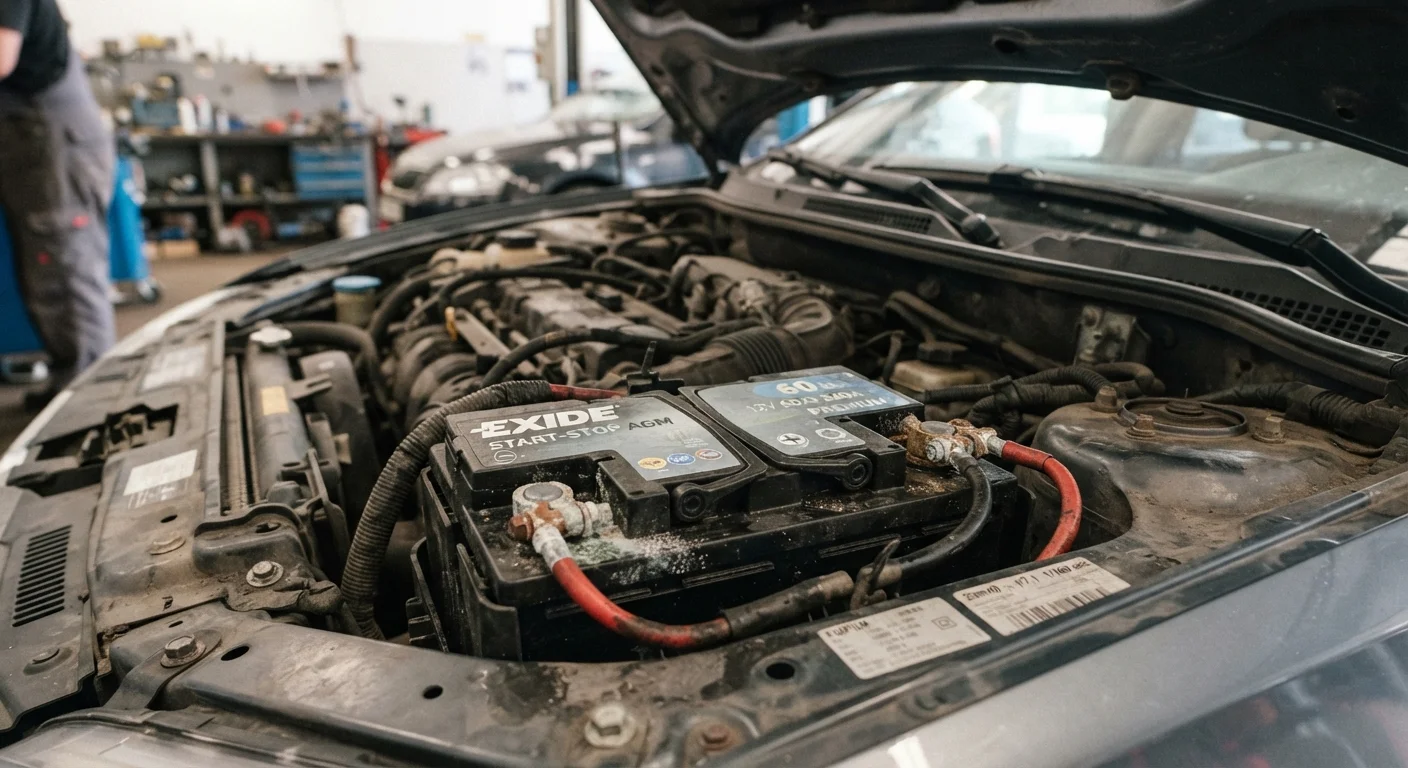
A white, blue, or greenish powder building up around the battery terminals is a sign of chemical reaction between battery acid vapors and the metal connectors. Minor corrosion is common, but heavy buildup increases electrical resistance, which makes the battery work harder and can eventually prevent the car from starting.
Terminals can be cleaned carefully with a mixture of baking soda and water using a stiff brush - but if corrosion keeps returning rapidly, it may indicate the battery casing is venting excessively, which warrants professional inspection.
Heavy terminal corrosion increases resistance and can prevent starting if left unaddressed.
Short trips that don't let the battery recharge
Every time you start your car, the battery expends a significant burst of energy. The alternator replenishes that charge while the engine runs - but it needs time, typically at least 15-20 minutes of driving, to do so fully. Drivers who make frequent short hops - a mile to the grocery store, five minutes to school - may be drawing down battery reserves faster than they're being restored.
If your driving is mostly short-distance, consider occasionally taking a longer highway drive to give the alternator time to bring the battery back to a full state of charge. This is especially relevant to the driving habits that extend a car's life overall.
Short trips draw battery reserves faster than the alternator can replenish them.
Extreme temperatures accelerate battery wear
Heat is actually harder on batteries than cold - it accelerates internal chemical reactions that degrade battery plates over time. Cold weather then exposes that weakened capacity because lower temperatures reduce the battery's ability to deliver current. A battery that handles summer fine may fail its first serious cold morning.
In climates with significant seasonal swings, having the battery load-tested in the fall - before temperatures drop - gives you an accurate picture of remaining capacity while you still have time to replace it on your own terms.
Heat degrades battery plates; cold then exposes that weakened capacity at the worst moment.
Parasitic drains from accessories and electronics
Modern vehicles draw a small, continuous current even when parked - for clocks, memory systems, and security modules. This is normal. What's not normal is an excessive parasitic drain caused by a faulty module, an aftermarket accessory wired incorrectly, or a door latch that doesn't signal the car to fully power down.
If your battery regularly goes flat overnight or after a few days of not driving, a mechanic can perform a parasitic draw test to identify the culprit. Catching an abnormal drain early protects both the battery and the electrical system.
An excessive parasitic drain can silently flatten a battery within days - a mechanic can test for it.
Test Before You're Stranded
Many auto parts stores offer free battery load testing, which measures actual capacity under real-world conditions - more informative than a simple voltage reading. If your battery is three years old or older, getting it tested annually is a straightforward way to know where you stand. A load test takes only a few minutes and can prevent a breakdown that doesn't.
Keeping Your Battery - and Your Car - Going Longer
Battery care is a small investment of attention that pays off in reliability. Most of the habits listed above cost nothing and take minutes. When a battery does reach the end of its useful life, replacing it proactively - rather than waiting for a failure - keeps you on your own schedule.
For drivers managing older vehicles, battery health becomes even more critical. Our guide on high-mileage vehicles covers the broader maintenance mindset needed to keep an aging car dependable. And if a dashboard warning light has you wondering whether your battery or charging system is flagging an issue, our warning lights guide can help you decode what you're seeing before it escalates.