
Budgeting Methods Compared: Envelope, Zero-Based, Pay-Yourself-First, and More

Key Takeaways
- No single budgeting method works for everyone - effectiveness depends on your habits, income, and goals.
- Zero-based budgeting demands the most time but offers the most granular control over every dollar.
- The Pay-Yourself-First method prioritizes saving automatically before discretionary spending begins.
- Envelope budgeting works best for people who overspend in specific categories like dining or entertainment.
- The 50/30/20 rule provides a simple percentage framework that requires minimal tracking effort.
Our Verdict
Each budgeting method offers a different trade-off between structure, effort, and flexibility. Zero-based budgeting rewards those willing to invest time in detail; Pay-Yourself-First suits consistent savers; and envelope budgeting helps those who respond well to physical spending limits. The method you'll actually stick with is the one that works best for your situation.
| Best for | Recommended |
|---|---|
| Those who want maximum control over every dollar | Zero-Based Budgeting |
| Those who want saving to happen automatically | Pay-Yourself-First |
| Those prone to overspending in specific categories | Envelope Budgeting |
| Those who want a low-effort, flexible framework | 50/30/20 Rule |
Why Your Budgeting Method Matters
A budget is only as useful as the system behind it. Most people know they should budget, but stall when faced with how to actually structure one. The good news: several well-tested methods exist, each designed for a different type of spender, saver, or planner.
If you're brand new to budgeting, start with the fundamentals before comparing systems. Once you understand your income and basic expenses, you're ready to choose a framework. Below, we break down four of the most widely used approaches so you can identify which fits your financial life.
| Zero-Based | Pay-Yourself-First | Envelope | 50/30/20 Rule | |
|---|---|---|---|---|
| Effort level | High - monthly setup required | Low - automate and go | Medium - cash allocation each cycle | Low - three categories only |
| Best for | Detail-oriented planners | Consistent savers | Overspenders in key areas | Simple, flexible structure |
| Savings emphasis | Explicit savings line item | Savings come first, always | Savings envelope set aside | 20% target for savings/debt |
| Flexibility | Low - all dollars assigned | Medium - spend remainder freely | Low - envelopes are firm limits | High - broad category buckets |
| Works with variable income | Yes - recalibrate monthly | Yes - adjust savings amount | Moderate - requires reallocation | Moderate - percentages shift |
| Tracking requirement | Detailed, ongoing | Minimal | Category-level cash tracking | Minimal, three categories |
Zero-Based Budgeting: Every Dollar Has a Job
Zero-based budgeting (ZBB) means assigning every dollar of income to a specific category - expenses, savings, or debt repayment - until your budget balance reaches zero. You're not spending everything; you're allocating everything, including transfers to savings accounts.
How it works: Each month, start from scratch. List your total income, then assign amounts to each category until nothing is unaccounted for. If income changes month to month, you recalibrate each cycle.
Who it suits: People with variable spending patterns, those paying down debt aggressively, or anyone who wants deep visibility into where money goes. It requires consistent time investment - typically 30-60 minutes per month to set up, plus check-ins.
Trade-off: The upfront effort is significant. Missing a category means your numbers won't balance, which can be discouraging early on.
Start Simple, Then Add Detail
If zero-based budgeting feels overwhelming at first, begin by tracking just your top five spending categories for one month. Once you see where money actually goes, filling in a full zero-based budget becomes much more intuitive. You can always layer in more categories as the habit solidifies. For tool options to support any method, compare paper, spreadsheet, and app-based tracking.
Pay-Yourself-First: Save Before You Spend
Pay-Yourself-First (PYF) flips conventional logic: instead of saving whatever remains after expenses, you move a predetermined amount into savings or investments the moment your paycheck arrives - then live on what's left.
How it works: Decide a savings target (a flat dollar amount or a percentage of income). Set up an automatic transfer on payday so the money moves before you have a chance to spend it. The remainder covers all living costs.
Who it suits: People who struggle to save consistently, those building an emergency fund, or anyone with stable monthly expenses. It pairs especially well with automatic retirement contributions like a 401(k). Learn how an emergency fund and a monthly budget reinforce each other.
Trade-off: If your remaining income doesn't comfortably cover fixed costs, you'll need to adjust the savings amount or reduce expenses first.
Envelope Budgeting: Tangible Spending Limits
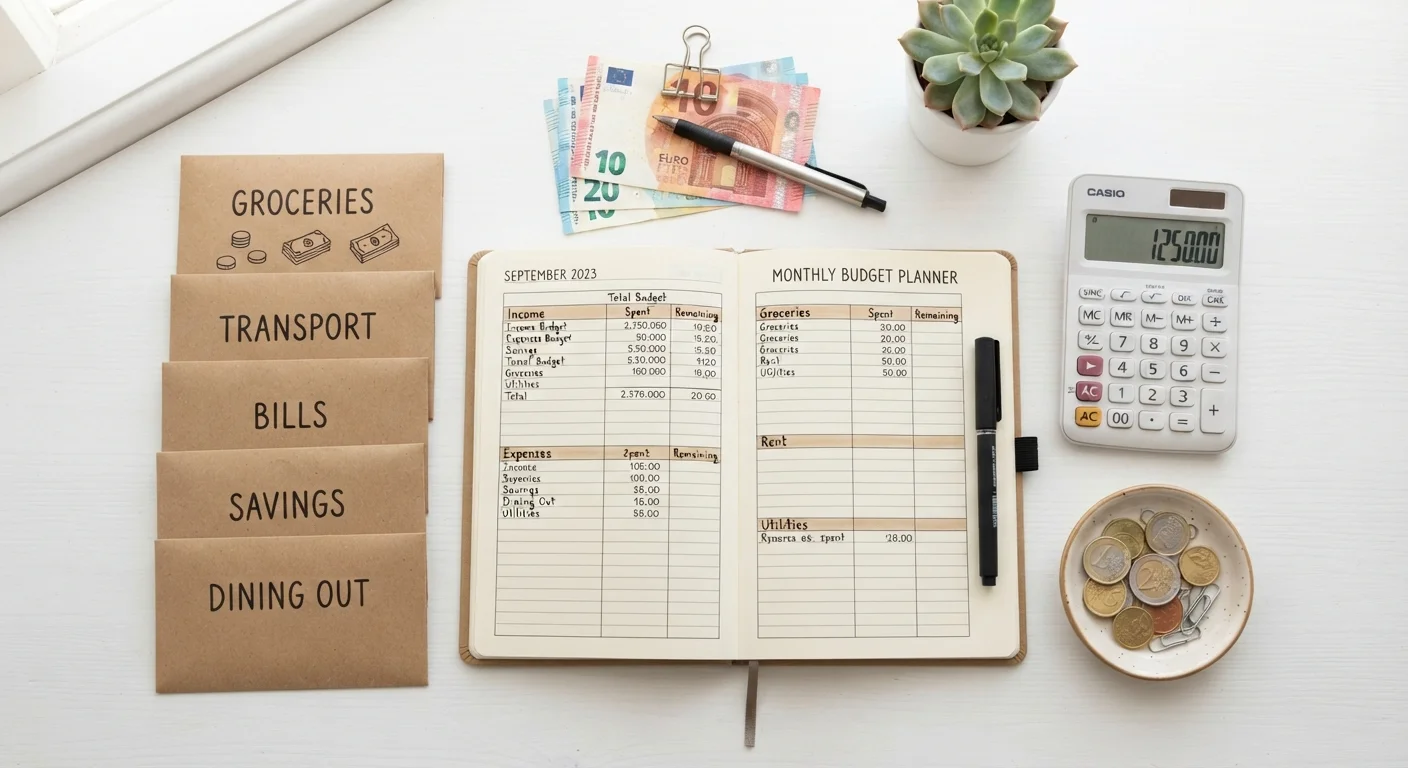
Envelope budgeting divides cash into physical (or virtual) envelopes labeled by spending category - groceries, gas, dining out, entertainment. When an envelope is empty, spending in that category stops for the month.
How it works: After identifying your spending categories, you withdraw or allocate the budgeted cash at the start of each pay period. Spending only from each labeled envelope creates a hard, visible limit.
Who it suits: Anyone who tends to overspend in predictable areas, people who respond well to concrete limits, or those who find digital tracking abstract. For a direct comparison of physical envelopes versus app-based spending limits, see this deeper breakdown.
Trade-off: Carrying cash isn't practical for everyone, and the system requires discipline to avoid borrowing between envelopes. Digital envelope apps can replicate the structure without physical cash.
The 50/30/20 Rule: A Simple Percentage Framework
The 50/30/20 rule divides after-tax income into three broad buckets: 50% toward needs (housing, utilities, groceries), 30% toward wants (dining out, subscriptions, entertainment), and 20% toward savings and debt repayment.
How it works: Calculate your monthly take-home pay, apply the three percentages, and use those figures as your spending caps. Tracking is minimal - you only monitor three categories rather than dozens.
Who it suits: People who want a simple, low-maintenance framework. It's an accessible starting point for first-time budgeters and those with stable income and expenses. For a comparison of this rule against similar frameworks, see The 50/30/20 Rule and Its Alternatives.
Trade-off: The percentages are guidelines, not universal rules. High-cost-of-living areas may make the 50% needs allocation impossible. The broad categories also obscure overspending within them.
This article is for general informational purposes only and does not constitute personalized financial or investment advice. Consider consulting a licensed financial professional for guidance tailored to your circumstances.