

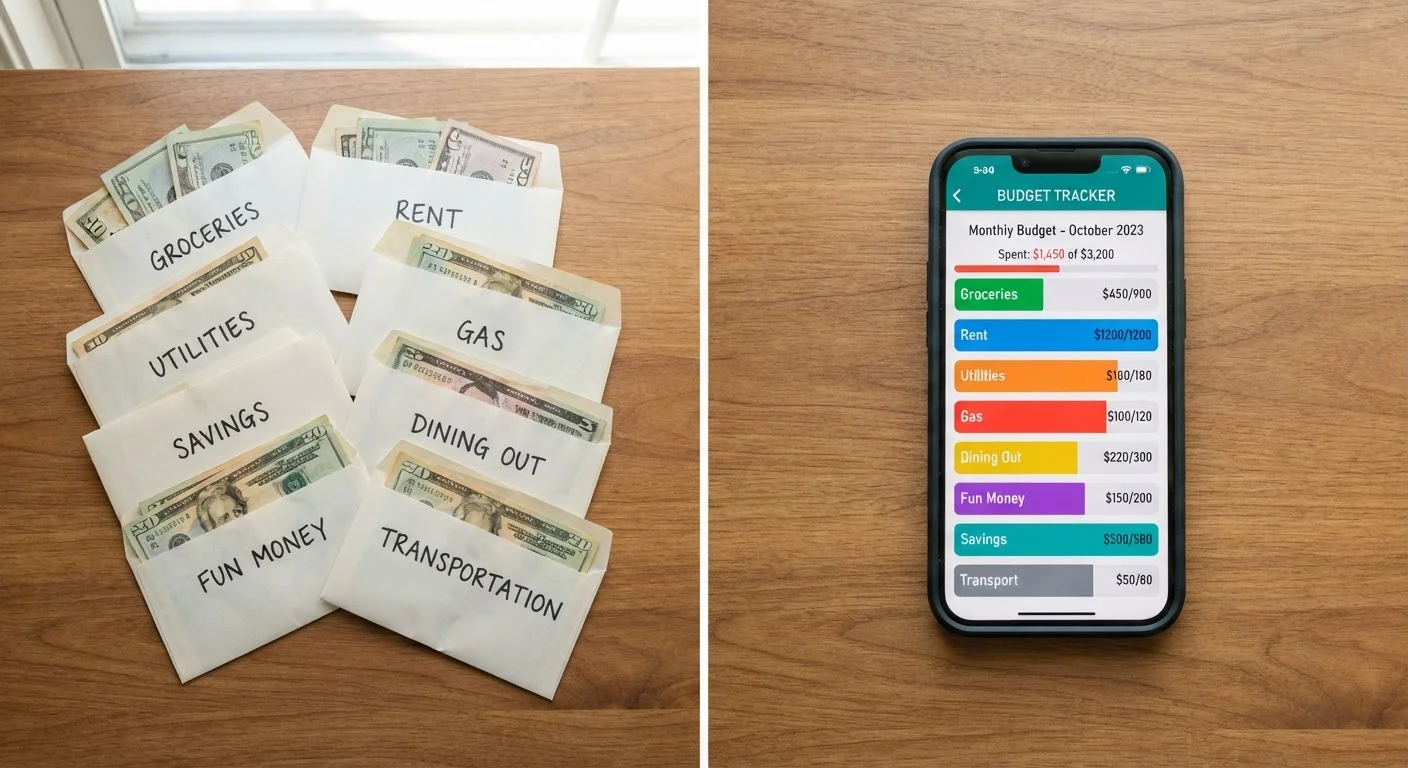
Key Takeaways
- Envelope budgeting uses physical cash to enforce hard spending limits by category.
- Digital spending limits use app alerts and card controls to replicate the same guardrails electronically.
- Neither method is inherently superior - the right choice depends on your spending habits and lifestyle.
- Both methods work best when categories and limits are set before the month begins.
- Combining elements of both approaches is a valid and often effective strategy.
Option A
Envelope Budgeting
The tactile, commitment-driven cash system.
Best for: People who overspend on cards and benefit from a physical, hard-stop approach to category limits.
Option B
Digital Spending Limits
The flexible, automated alternative for card-based spenders.
Best for: People who primarily pay digitally and want real-time alerts without handling physical cash.
If you consistently overspend on discretionary categories like dining or entertainment
Envelope Budgeting
Physical cash creates a hard stop - when the envelope is empty, spending stops. There is no equivalent friction with a card swipe.
If most of your transactions are digital, online, or subscription-based
Digital Spending Limits
Cash envelopes cannot govern card transactions or auto-renewals; app-based limits are better suited to how modern spending actually works.
If you are new to budgeting and want to build awareness of your spending patterns
Envelope Budgeting
Handling physical money tends to make spending feel more concrete, which many beginners find useful when calibrating what different budget amounts feel like.
If you travel frequently or prefer not to carry cash
Digital Spending Limits
Managing physical envelopes while traveling is impractical; digital controls work anywhere you have connectivity.
If you want to share budget oversight with a partner or household
Digital Spending Limits
Many budgeting apps allow shared accounts or synced views, making it easier for two people to monitor the same category limits in real time.
How Each Method Works
Envelope budgeting is a cash-based system with a straightforward mechanic: at the start of each pay period, you withdraw your discretionary budget in cash and physically divide it into labeled envelopes - one per spending category. Groceries, dining, gas, entertainment. When an envelope is empty, spending in that category stops until the next cycle. No exceptions, no borrowing from tomorrow.
Digital spending limits replicate this logic electronically. Using a budgeting app or a bank's built-in tools, you assign a monetary ceiling to each category. As you spend, the app tracks transactions against those ceilings and sends alerts - or in some cases, declines charges - when a limit is approached or reached. The categories mirror the envelopes; the difference is that everything runs through cards and accounts rather than physical cash.
If you are new to either approach, this ground-up budgeting guide covers how to identify spending categories and set realistic limits before you pick a delivery method.
| Criterion | Envelope Budgeting | Digital Spending Limits |
|---|---|---|
| Spending medium | Cash only | Cards, digital, online |
| Enforcement mechanism | Hard stop (empty envelope) | Alerts or soft declines |
| Setup effort | Moderate (cash withdrawal, labeling) | Low to moderate (app configuration) |
| Covers subscriptions | No | Yes |
| Portability | Limited; cash must be carried | High; works anywhere with a device |
| Transaction record | Manual tracking required | Automatic via linked accounts |
| Shared household use | Requires coordination | Easier with shared app access |
| Psychological friction | High (cash feels real) | Low (alerts are easy to dismiss) |
Strengths and Weaknesses Side by Side
Envelope budgeting's primary strength is psychological. Research in behavioral economics consistently finds that spending cash feels more tangible than swiping a card, which tends to reduce discretionary overspending for many people. Its weakness is equally practical: it does not work for rent paid online, subscriptions, or any digital transaction. Carrying cash also introduces security concerns.
Digital limits offer convenience and coverage - they govern every transaction type, update automatically, and generate a data trail you can review at month's end. The weakness is friction, or rather the lack of it. An alert that says "you are near your dining limit" is easy to dismiss. The budget does not stop you; it informs you. For some people, that gap between awareness and action is where overspending lives.
77%
Americans who report using some form of budget
According to a Gallup survey, the vast majority of U.S. adults track spending in some form, though methods vary widely.
~$300
Average monthly discretionary overspend reported
Consumer financial surveys have found that individuals without hard spending controls frequently exceed their discretionary targets by meaningful amounts.
For a broader look at how these methods fit within wider budgeting philosophies, this comparison of popular budgeting systems is a useful reference.
Practical Considerations Before You Choose
Before committing to either method, it helps to do a spending audit so your category limits reflect reality rather than aspiration. A monthly spending audit gives you the raw data to set limits that are actually workable.
Consider these factors when deciding:
- Your transaction mix: If the majority of your spending is on cards - including online purchases and subscriptions - a cash-only system will leave large portions of your budget unmanaged.
- Your relationship with friction: Do you need a hard stop, or is a warning sufficient to change your behavior? Honest self-assessment here matters more than any general rule.
- Household complexity: Shared finances with a partner introduce coordination challenges that digital tools handle more gracefully than physical envelopes.
- Your comfort with technology: Budgeting apps require consistent engagement. If you know you will not check an app regularly, passive digital limits may not outperform cash envelopes.
It is also worth noting that these approaches are not mutually exclusive. Some people use cash envelopes for high-friction categories like dining and entertainment while relying on digital limits for fixed expenses. This overview of budgeting tools explores the trade-offs further if you are weighing a hybrid approach.
A Note on Hybrid Approaches
Many people find that neither method works perfectly in isolation. Using cash envelopes for a few high-risk categories - such as dining, entertainment, or impulse purchases - while relying on digital tools for everything else is a legitimate strategy. The goal is behavior change, not methodological purity. Start with whichever method addresses your biggest overspending category first, then refine from there.
This article is for general informational purposes only and does not constitute personalised financial advice. For guidance specific to your financial situation, consider consulting a qualified financial adviser.