
Budgeting on Paper vs. Using a Spreadsheet vs. Going Digital: What the Trade-Offs Look Like

Key Takeaways
- Paper budgeting builds awareness and deliberate habits, but requires manual updating and offers no automation.
- Spreadsheets offer flexibility and full control, but demand consistent effort and some technical comfort.
- Digital apps automate tracking and provide real-time data, but raise valid privacy and over-reliance concerns.
- The most effective budgeting tool is the one you will actually use consistently over time.
- Many people combine approaches - such as paper planning with app-based tracking - to suit their needs.
Our Verdict
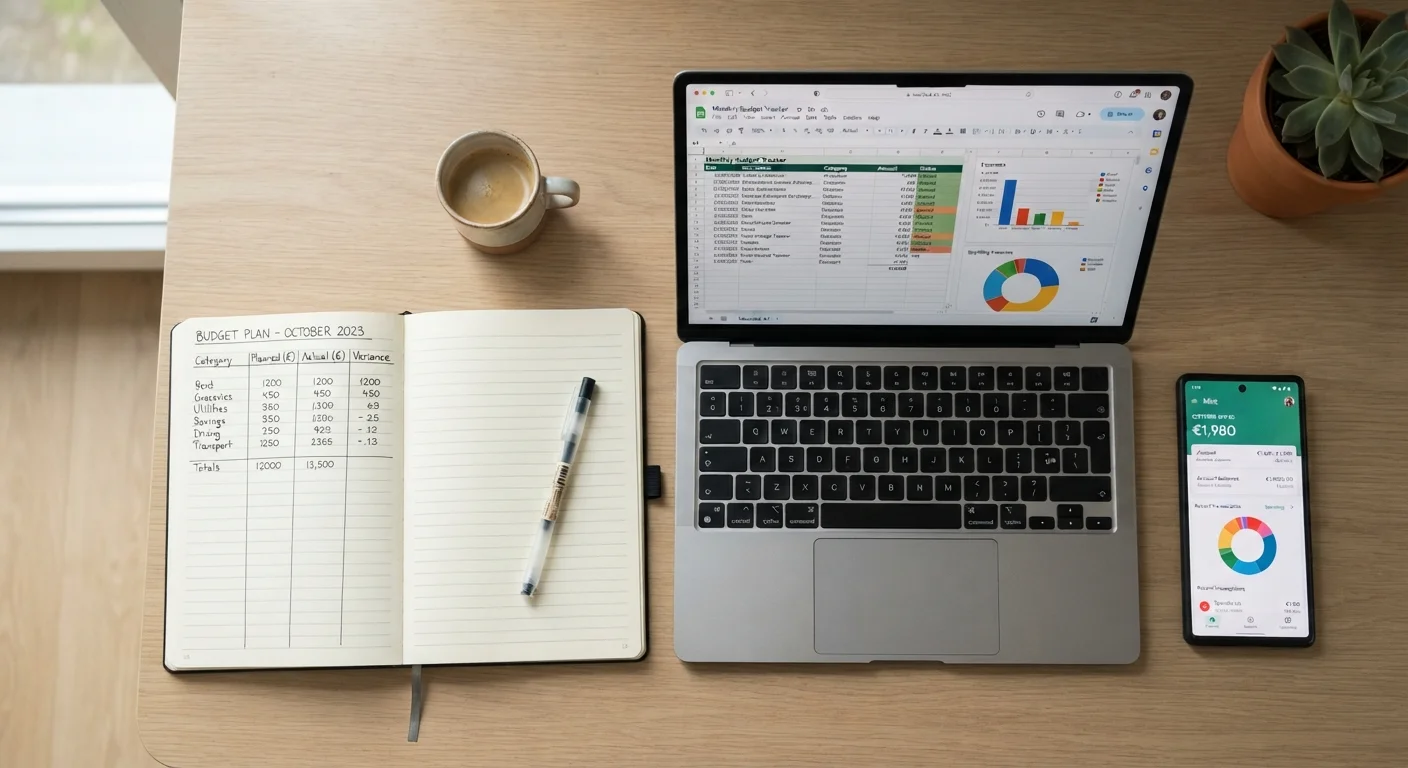
No single budgeting tool is objectively superior - each reflects a different relationship with money, technology, and personal discipline. Paper works well for those who need tactile engagement to stay mindful; spreadsheets suit detail-oriented people who want precision without third-party data sharing; apps reduce friction for those managing complex or fast-moving finances. Consider your habits honestly before choosing.
| Best for | Recommended |
|---|---|
| Those who want mindful, distraction-free budgeting | Paper budgeting |
| Detail-oriented people who want customisable control | Spreadsheet budgeting |
| Busy adults who prefer automation and real-time insight | Digital app budgeting |
| Those with irregular income or complex categories | Spreadsheet or hybrid approach |
Why the Tool You Choose Actually Matters
Budgeting is less about the numbers and more about behavior. The format you use shapes how often you engage with your finances, how clearly you understand your spending, and whether you follow through. That is why comparing paper, spreadsheets, and digital apps is more than a question of convenience - it is a question of which structure reinforces your habits.
For context on underlying budgeting philosophies that interact with your tool choice, see this overview of common budgeting methods. The format you choose can either support or undermine whichever method you adopt.
| Paper | Spreadsheet | Digital App | |
|---|---|---|---|
| Setup effort | Low - pen and paper | Medium - requires template building | Low - guided onboarding |
| Data entry | Fully manual | Mostly manual | Largely automated |
| Customisability | High but unstructured | Very high | Limited to app features |
| Error risk | Higher - manual arithmetic | Low - formulas check math | Low - auto-imported data |
| Privacy | Complete - no data shared | High - local or cloud file | Varies - account linking required |
| Cost | Minimal | Free to low cost | Free to monthly subscription |
| Best for | Mindful, habit-building budgeters | Detail-oriented, flexible users | Busy users wanting automation |
Budgeting on Paper: Intentional but Manual
Writing a budget by hand - whether in a notebook, a printed template, or a dedicated planner - forces deliberate engagement. Research in cognitive psychology consistently suggests that writing by hand improves retention and comprehension compared to typing, which may translate to stronger awareness of spending categories and limits.
The practical advantages are straightforward: no software required, no subscription fees, no connectivity dependency, and no data shared with third parties. For people who find screens distracting or who want a calm, focused budgeting ritual, paper can be genuinely effective.
The trade-offs are equally real. Paper budgets must be updated manually every time money moves. Arithmetic errors are easy to make and harder to catch. Tracking variable spending across a month requires discipline that some people find burdensome. And if the notebook is lost or damaged, so is the record.
Start Simple, Then Add Complexity
If you are new to budgeting, resist the urge to build an elaborate system immediately. A single sheet of paper listing income and five to six spending categories is enough to start. Once the habit is established, you can migrate to a spreadsheet or app without losing momentum. Complexity introduced too early is one of the most common reasons budgeting attempts fail.
Paper budgeting aligns naturally with the envelope method. If you are curious how physical cash allocation compares to app-based spending limits, this comparison of envelope budgeting and digital spending limits covers the trade-offs in depth.
Spreadsheets: Precision With a Learning Curve
A spreadsheet - whether in a free tool like Google Sheets or a desktop application - sits between analog and fully automated. You build the structure yourself, which means it can reflect your financial life exactly: irregular income, split categories, savings targets, or whatever granularity you need.
Formulas handle the arithmetic automatically, reducing error. You can build charts, run scenarios (such as "what if my rent increases by $200?"), and maintain months of history in a single file. For freelancers or others with variable income, a well-designed spreadsheet often outperforms both paper and generic apps. The strategies for budgeting on an irregular income article outlines why flexibility matters here.
The drawbacks: setup takes time and some technical comfort. Data entry is still manual - you are not connected to your bank accounts. And without discipline, the spreadsheet becomes an outdated artifact rather than a living tool. A spreadsheet is only as accurate as the entries you make.
~32%
US adults with a detailed written budget
Gallup polling has consistently found that fewer than one-third of American adults maintain a detailed household budget, suggesting that friction in any budgeting method is a meaningful barrier.
29%
People who stopped using a budgeting app within 3 months
Industry surveys on personal finance app retention suggest a notable share of users disengage within the first quarter, often citing a lack of sustained motivation rather than dissatisfaction with features.
Digital Apps: Automation With Trade-Offs of Its Own
Budgeting apps - those that connect to bank and credit card accounts - offer the lowest data-entry burden. Transactions import automatically, categories populate, and dashboards update in real time. For someone managing multiple accounts or tracking spending across many categories, this automation is a genuine advantage.
Apps can also send alerts when you approach a category limit, generate monthly summaries, and surface patterns you might not notice manually. These features lower the bar for staying engaged with your budget day-to-day.
The concerns are worth taking seriously, however. Linking financial accounts to a third-party app involves sharing sensitive credentials or read-access to transaction data. Security practices and data-sharing policies vary across providers - reading the privacy policy before connecting accounts is advisable. There is also a behavioral risk: when tracking feels automatic, some users disengage and treat the app as a passive report rather than an active tool. The analogue vs. digital planning tools comparison explores this engagement dynamic in a broader planning context.
This article provides general financial information for educational purposes only and does not constitute personalised financial advice. Consult a qualified financial professional for guidance specific to your circumstances.
Choosing Based on Your Actual Habits
The right tool is the one that fits how you actually behave - not how you intend to behave. Consider a few honest questions: Do you check your phone constantly or rarely? Do you prefer structure you build yourself or structure that is given to you? Are you comfortable sharing account access digitally, or does that concern you?
Many people find that a hybrid approach works well. For example, using a paper notebook for weekly check-ins and a spreadsheet for monthly summaries combines the mindfulness of analog methods with the accuracy of computed totals. Others track in an app but review categories manually each week to stay engaged.
If you are evaluating a specific budgeting framework to pair with your chosen tool, the 50/30/20 rule and its alternatives and zero-based vs. percentage-based budgeting are useful starting points. The format and the method work together - a mismatch between the two can undermine even well-intentioned plans.