
Analogue vs. Digital Planning Tools: What Works Better for Focus and Follow-Through

Key Takeaways
- Handwriting notes by hand is linked to stronger information encoding and recall than typing.
- Digital tools excel at coordination, reminders, and syncing across devices and calendars.
- Analogue tools reduce digital distraction during the planning process itself.
- Neither format guarantees follow-through - consistency depends on implementation, not medium.
- A hybrid approach works well for many adults: analogue for reflection, digital for logistics.
Option A
Analogue Planning Tools
The tactile, distraction-free approach to organizing your time.
Best for: People who want deeper engagement with their plans, stronger recall, and a screen-free planning ritual.
Option B
Digital Planning Tools
The flexible, connected system for managing complex schedules.
Best for: People juggling multiple calendars, teams, or locations who need instant access and automated reminders.
If you struggle with distraction during planning sessions
Analogue Planning Tools
Paper removes the temptation of notifications and app-switching, helping you stay focused on thinking through your priorities.
If you manage a shared calendar or coordinate with others
Digital Planning Tools
Digital platforms make collaboration, scheduling across time zones, and automated reminders far more practical than any paper system.
If improving memory and retention of your goals matters to you
Analogue Planning Tools
Research consistently shows that handwriting promotes deeper cognitive processing, which strengthens recall of what you write.
If you travel frequently or work across multiple locations
Digital Planning Tools
Cloud-synced apps ensure your schedule is accessible and up to date on any device, wherever you are.
If you want to build a reflective daily planning habit
Analogue Planning Tools
The slower, deliberate pace of writing by hand encourages thoughtfulness and intention-setting in a way quick digital entry rarely does.
How Each Approach Affects Attention and Focus
The most immediate difference between analogue and digital planning isn't aesthetics - it's the environment each creates when you sit down to plan.
Paper is a closed system. When you open a planner, nothing pings you, no tab beckons, and no algorithm competes for your attention. That low-stimulus environment makes it easier to think clearly about priorities rather than react to incoming noise. For adults who find that planning sessions quickly become browsing sessions, paper removes that friction point entirely.
Digital tools operate in an open system. The same device that holds your calendar also holds your email, social feeds, and every unread message. Even with notification silencing, the cognitive awareness that those distractions are available has been shown in behavioral research to consume mental bandwidth. That said, dedicated focus apps and full-screen calendar modes can partially counteract this - the key is intentional setup.
Managing where your attention goes during planning matters just as much as the plan itself. The medium you choose shapes that environment before you write a single task.
| Criterion | Analogue Tools | Digital Tools |
|---|---|---|
| Distraction level during planning | Very low - closed system | Higher - open ecosystem |
| Memory retention of plans | Stronger via handwriting | Lower with fast typing |
| Reminders and alerts | Manual only | Automated and customizable |
| Sharing and collaboration | Not practical | Seamless and real-time |
| Access across devices/locations | Single physical copy | Synced everywhere |
| Searchability of past entries | Manual, slow | Instant keyword search |
| Encourages reflective thinking | High - slower process | Lower without intentional effort |
| Setup and maintenance | Simple, no tech required | Requires configuration and upkeep |
Memory, Retention, and the Writing Advantage
One of the most well-replicated findings in cognitive psychology is that writing by hand engages the brain differently than typing. Because handwriting is slower and more deliberate, it requires you to summarize and paraphrase - which deepens encoding. Studies comparing note-taking methods have found that people who write by hand tend to retain and comprehend information better than those who type verbatim.
Applied to planning, this suggests that handwriting a weekly review or setting intentions on paper may help those plans stick more firmly in memory. You're more likely to recall what you wrote because the act of writing it required more active processing.
~29%
Better recall with handwritten notes
A study published in Psychological Science found that students who took longhand notes performed notably better on conceptual questions than laptop note-takers.
77%
Adults distracted by devices during planning
Research from the American Psychological Association has found that a large majority of US adults report their devices interrupt focused work and planning time.
Digital entry, by contrast, is faster - which is useful for capturing information quickly but can work against memory consolidation. This doesn't mean digital tools are inferior; it means the use case matters. For logging appointments and meeting links, speed is a feature. For clarifying your top three priorities for the week, slower may actually serve you better.
Where Digital Tools Have a Clear Edge
Digital planning tools do things paper simply cannot. Automated reminders reduce the cognitive load of remembering when to act. Shared calendars make coordination with colleagues, partners, or families far less error-prone. Cloud sync means your schedule is available on your phone, laptop, and tablet simultaneously - a genuine practical advantage for mobile adults.
Search and filtering are also underappreciated features. Finding a meeting note from six months ago in a paper planner is a manual task; in a digital system, it's a keyword search. For anyone managing long-running projects, recurring commitments, or complex logistics, digital tools scale in ways paper cannot.
Integration with other tools - video calls, task managers, email - further reduces friction between planning and doing. If your calendar can generate a meeting link automatically or push a task to your to-do app, that's real time saved. How you structure your schedule matters too - even the best digital system won't help if the underlying plan is too rigid to follow.
Digital Tools Require Intentional Setup
A digital planning system is only as effective as how it's configured. Default notification settings, open browser tabs, and cluttered app layouts can undermine focus as much as help it. If you use digital tools, consider auditing which notifications are truly necessary and whether your planning environment is set up to support focus rather than distraction. Small setup changes - like a dedicated planning app with a minimal interface - can meaningfully shift how well a digital system serves you.
Making a Hybrid System Work
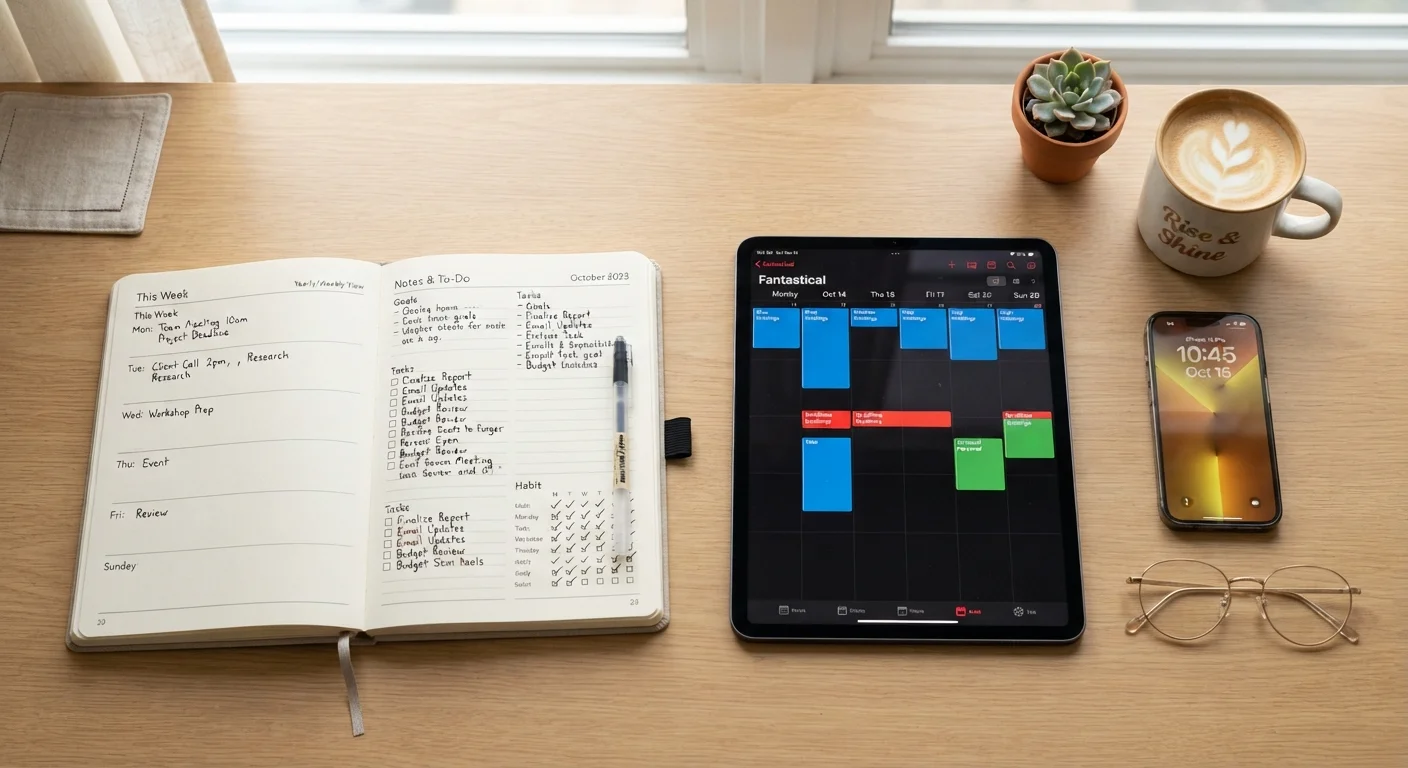
For most adults, the practical answer isn't choosing a side - it's deciding which jobs each tool does best. A workable hybrid: use a digital calendar for all time-bound events, shared commitments, and reminders, while reserving a paper notebook or planner for daily intention-setting, weekly reviews, and reflective goal work.
This separation respects what each format does well. Digital handles logistics and coordination reliably. Analogue handles depth, clarity, and the slower thinking that follow-through actually requires. The planning research broadly supports this: the mode of capture affects how we think about what we capture.
If you're also evaluating how planning intersects with budgeting and financial organization, the same analogue-versus-digital trade-offs apply to personal finance tracking. The decision framework is similar: match the tool to the cognitive demand of the task, not to habit or convention.
Ultimately, the planning tool that supports your focus and follow-through is the one you'll actually use consistently - and that's always a personal fit question worth testing before committing.