
Damp in Older Homes: Rising Damp, Penetrating Damp, and Condensation Are Not the Same Problem

Key Takeaways
- Rising damp travels upward through masonry from ground moisture and rarely climbs higher than about three feet.
- Penetrating damp enters horizontally through defects in the building envelope such as cracked render, failing mortar, or damaged flashing.
- Condensation is an internal moisture problem caused by warm, humid air meeting cold surfaces - not a structural defect.
- Misidentifying the damp type is extremely common and often leads to ineffective or damaging treatments.
- A thorough visual diagnosis - checking patterns, height, and location - should always precede any remediation work.
- Some older homes show more than one damp type simultaneously, requiring each to be addressed separately.
Damp in Older Homes
Damp is moisture that enters or accumulates inside a building's walls, floors, or ceilings in ways that cause visible damage or structural deterioration. In older homes, damp typically falls into one of three distinct categories: rising damp, penetrating damp, or condensation. Each has a different origin, a different pattern of damage, and a different solution. Treating the wrong type wastes money and leaves the real problem untouched.
Older masonry construction - especially pre-1920s brick or stone with lime mortar - behaves differently from modern cavity-wall construction, which affects both how moisture moves through the fabric and which remediation approaches are appropriate.
Why Getting the Diagnosis Right Matters First
Walk into almost any older home and you may find stained plaster, peeling paint, or a musty smell and reasonably assume there's a damp problem. What the evidence rarely tells you immediately is which kind of damp you're dealing with. That distinction matters enormously, because rising damp, penetrating damp, and condensation each require a fundamentally different response. Applying the wrong treatment - a chemical damp-proof injection when the real problem is a blocked gutter, for example - costs money and leaves the underlying issue intact.
Older homes, generally those built before cavity-wall construction became standard in the mid-20th century, are especially prone to misdiagnosis because their solid masonry walls behave differently from modern construction. Lime-based plasters and mortars are intentionally breathable, meaning they absorb and release moisture as conditions change. What looks like active damp is sometimes just normal moisture movement in the fabric of the building.
A Note on Moisture Meter Readings
Handheld moisture meters are widely used by tradespeople to identify damp, but they can give misleading readings in older homes. Salt-contaminated plaster - common after any past damp episode - registers as 'wet' even when dry because salts are hygroscopic (they attract moisture from the air). Readings should always be interpreted alongside visual evidence and the history of the property, not relied upon in isolation.
Rising Damp: What It Is and What It Looks Like
Rising damp occurs when ground moisture is drawn upward through capillary action into the masonry of a wall. It happens when the damp-proof course (DPC) - the horizontal barrier built into a wall to block this upward movement - is absent, damaged, or effectively bypassed. Common ways a DPC gets bridged include raised external soil or pathway levels, render applied below the DPC line, or debris accumulating against the base of the wall.
The telltale signs of rising damp are fairly consistent:
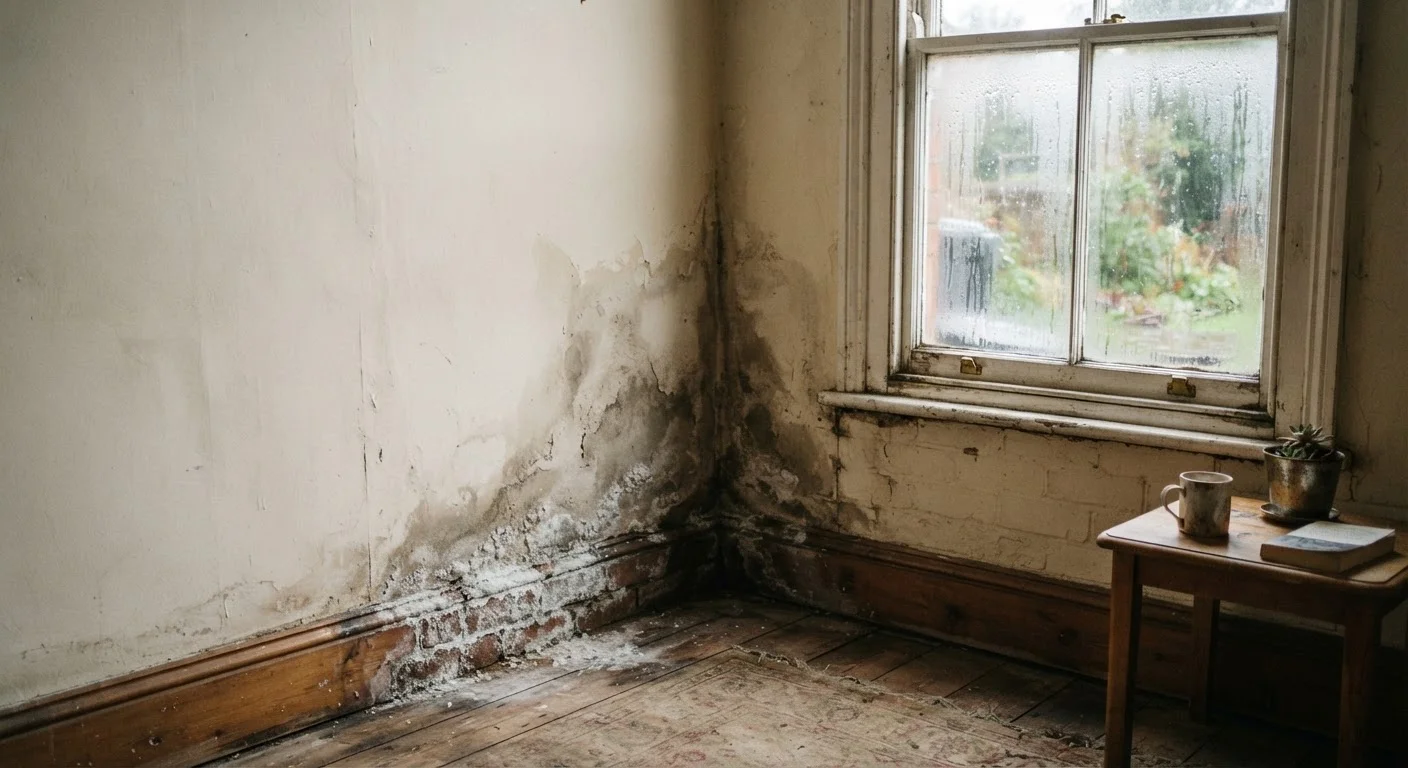
- A horizontal tide mark or staining on lower walls, usually below 3 feet (roughly 1 meter)
- White, powdery deposits on the wall surface - efflorescence - caused by salts drawn up with the moisture
- Damage concentrated at the base of walls, often with plaster that crumbles or feels hollow
- Damp that persists even in warm, dry weather and does not significantly vary with rain
True rising damp is actually less common than it is claimed to be. Salt contamination in old plaster can mimic damp readings on a moisture meter long after the original source has been resolved, which is one reason professional assessment is valuable.
~30%
UK homes with some form of dampness
According to the English Housing Survey, around 3 in 10 homes experience damp at some point, with older properties disproportionately represented.
3 ft
Maximum typical height of rising damp
Building science consensus holds that capillary rise in masonry rarely exceeds approximately one meter - damp above this height has another cause.
~50%
Proportion of household moisture from daily activities
Cooking, bathing, and breathing are significant moisture sources; a family of four can generate several pints of water vapor indoors each day.
Penetrating Damp: Moisture Coming Through the Walls
Penetrating damp enters a building laterally - it comes through the external envelope rather than up from the ground. In older solid-wall construction, water can pass all the way through a wall if there is any defect in the outer surface or if mortar joints have eroded. In cavity-wall homes, water can cross the cavity via mortar bridging or displaced wall ties.
Common sources of penetrating damp include:
- Cracked or spalled render on external walls
- Eroded pointing in brick or stone joints
- Failed or missing flashing around chimneys, dormers, or bay windows
- Damaged or blocked gutters causing water to run down the face of the wall
- Faulty window or door seals and deteriorated caulking
Penetrating damp is strongly associated with rainfall events - damp patches often appear or worsen during or after heavy rain, and they tend to be positioned on the windward face of the building. The location of internal damage typically corresponds to an identifiable external defect at roughly the same height.
Check the Outside Before Treating the Inside
Before arranging any internal damp treatment, inspect the full external envelope of the home: gutters, downpipes, pointing, render, window seals, and flashings. Many cases of apparent internal damp trace directly to a maintenance defect outside that can be repaired at modest cost. Fixing the external defect first prevents the same problem recurring regardless of what is done internally.
Condensation: An Internal Moisture Problem
Condensation forms when warm, moisture-laden air contacts a surface that is cooler than the air's dew point - the temperature at which airborne moisture turns to liquid water. In homes, this most commonly occurs on cold external walls, single-pane windows, and in poorly ventilated rooms like bathrooms and kitchens.
Unlike the other two damp types, condensation is not a defect in the building envelope. It is a consequence of how the home is used and ventilated. Cooking, bathing, drying laundry indoors, and even breathing all add moisture to indoor air. Without adequate airflow to carry that moisture outside, it settles on cold surfaces.
Signs that point toward condensation rather than structural damp:
- Black mold growth - particularly in corners, on window reveals, and behind furniture placed against external walls
- Moisture visible on windows first thing in the morning
- Damp patches that appear in cold weather or after high-activity periods and reduce in summer
- Damage concentrated at upper wall areas and ceilings rather than the base of walls
Improving ventilation - through extractor fans, trickle vents, or simply opening windows - and reducing cold spots through insulation are the primary tools for addressing condensation. These interventions cost far less than structural damp treatments and are more effective when condensation is the actual problem.