

| Primary use of grout | Filling joints between set tiles (Tile Council of North America (TCNA) Handbook) |
| Primary use of caulk | Sealing change planes and movement joints (TCNA Handbook for Ceramic, Glass, and Stone Tile Installation) |
| Primary use of mortar | Bonding tile or masonry to a substrate |
| Flexibility | Caulk: high | Grout: none | Mortar: none |
| Where grout should never be used | Corners, change planes, or joints over expansion gaps (TCNA EJ171 expansion joint guidelines) |
| Caulk color matching | Sanded caulk is available in many grout-matching colors |
Why These Three Materials Get Confused
Grout, caulk, and mortar all fill gaps. That surface similarity leads many homeowners to treat them as interchangeable - and that decision almost always causes problems down the line. Cracked grout in a shower corner, tiles that pop loose from a wall, or a mortar line that lets water seep behind a backsplash are common consequences of using the wrong material in the wrong place.
Each of these materials was engineered for a specific mechanical role. Understanding what that role is - and why it matters - makes the difference between a repair that holds for decades and one that fails within a season.
| Primary use of grout | Filling joints between set tiles (Tile Council of North America (TCNA) Handbook) |
| Primary use of caulk | Sealing change planes and movement joints (TCNA Handbook for Ceramic, Glass, and Stone Tile Installation) |
| Primary use of mortar | Bonding tile or masonry to a substrate |
| Flexibility | Caulk: high | Grout: none | Mortar: none |
| Where grout should never be used | Corners, change planes, or joints over expansion gaps (TCNA EJ171 expansion joint guidelines) |
| Caulk color matching | Sanded caulk is available in many grout-matching colors |
Grout: For Joints Between Tiles, Not Corners
Grout fills the gaps between tiles after they have been set in mortar. It comes in two primary categories: sanded grout, used for joints wider than about 1/8 inch, and unsanded grout, used for narrower joints where sand particles would scratch delicate tile surfaces. Epoxy grout is a third option, offering superior stain and chemical resistance for high-demand areas like commercial kitchens.
What grout does not do is flex. Once cured, grout is rigid. Buildings shift, floors flex under load, and thermal expansion causes materials to expand and contract. Any joint that sits at a change plane - an inside corner, the junction of a floor and wall, or a spot above a structural joint - will experience movement. Rigid grout in those locations will eventually crack, no matter how well it is applied.
Grout
A cement-based (or sometimes epoxy-based) filler used to fill the joints between tiles after they are set. Grout is rigid when cured and is not designed to flex with building movement.
Caulk
A flexible, waterproof sealant - typically silicone, acrylic latex, or a hybrid - used to fill joints where two surfaces meet at an angle or where movement is expected. It remains somewhat pliable after curing.
Mortar
A bonding material made from cement, sand, and water (sometimes with polymer additives) used to adhere tiles or stones to a substrate. It is structural, not cosmetic.
Substrate
The underlying surface to which tile or stone is attached, such as cement board, concrete, or drywall.
Change Plane
Any location where two surfaces meet at an angle - for example, where a floor meets a wall - and where differential movement is most likely to occur.
Thinset
A specific type of mortar with a relatively thin consistency, commonly used to bond ceramic, porcelain, and stone tile to substrates in wet or load-bearing areas.
The Tile Council of North America (TCNA) is explicit on this point: inside corners and change planes in tiled installations should be filled with caulk, not grout. This applies even when grout is used everywhere else on the same surface.
Caulk: For Movement, Transitions, and Watertight Seals
Caulk is a flexible sealant. Its flexibility is its defining and most important property. Because it remains somewhat pliable after curing, it can absorb the minor movement that occurs at transitions between different surfaces, at building expansion joints, and wherever two planes meet.
Common applications in home tiling and finishing work include:
- Inside corners of tiled showers and tub surrounds
- The joint where a tile floor meets a baseboard or wall
- The perimeter of a sink or countertop where it meets a tiled wall
- Around window and door frames on exterior siding
- Along the base of a toilet or around a tub's deck edge
Silicone caulk offers excellent waterproofing and longevity but cannot be painted. Acrylic latex caulk is paintable and easier to tool, but less durable in constantly wet areas. Hybrid formulas attempt to balance both. For wet areas like showers, look for products explicitly labeled for kitchen and bath use - these include mold-inhibiting additives.
Matching Caulk Color to Grout
When caulk is required at a change plane or corner in a tiled area, it should visually match the surrounding grout. Many manufacturers produce sanded or unsanded caulk in colors calibrated to their grout lines. Using a mismatched color will make the joint visible and often looks unfinished. Always purchase caulk from the same manufacturer and product line as your grout when possible.
Mortar: A Bonding Material, Not a Filler
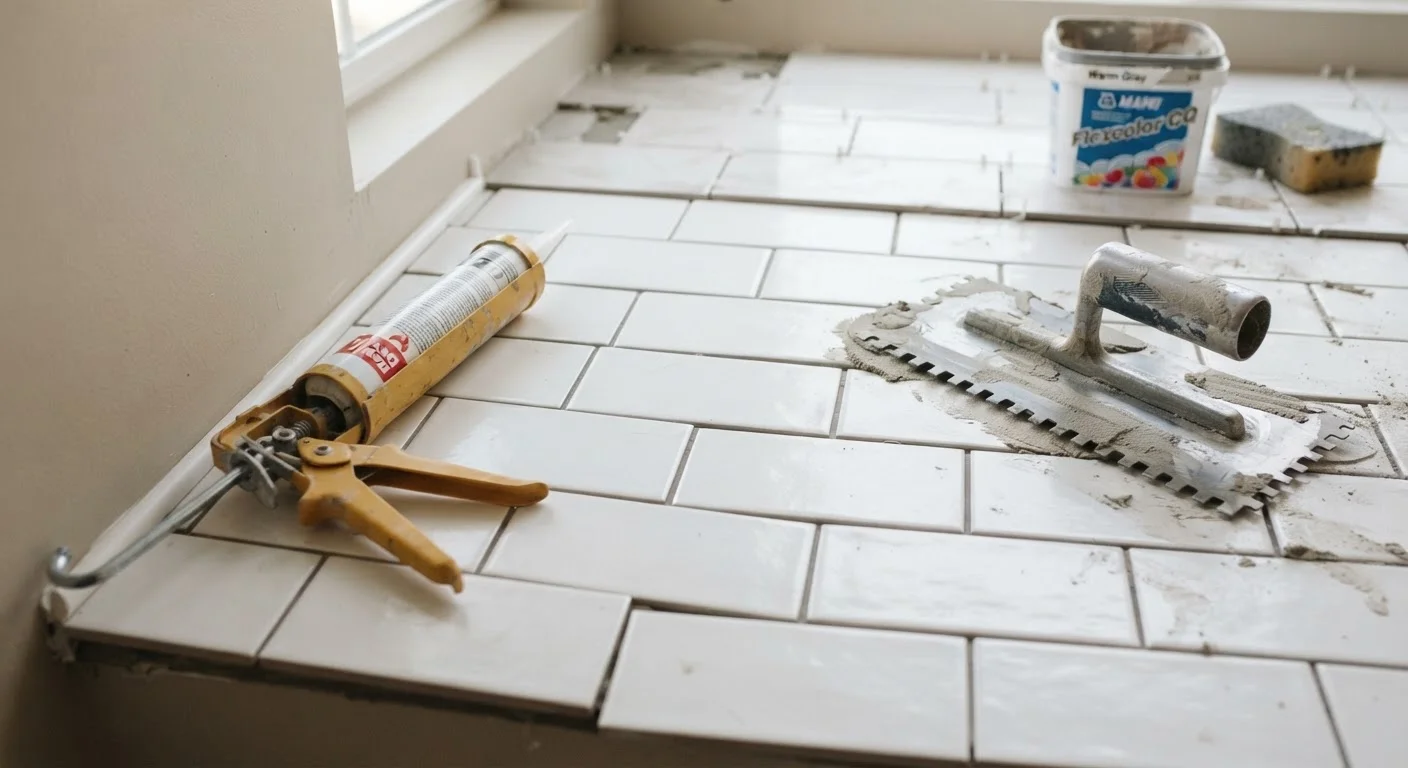
Mortar is fundamentally different from grout or caulk because its job is structural: it bonds tile to a substrate. Attempting to fill a visible joint with mortar - or worse, using it to patch a gap between finished tiles - will produce a rough, unsightly result that often shrinks and cracks as it dries.
Thinset mortar, the most common type for tile installation, is mixed to a smooth, consistent texture and spread with a notched trowel to ensure even coverage and proper adhesion. The notched pattern creates suction points that bond the tile firmly. Full coverage of the tile back - typically at least 95% in wet areas per TCNA guidelines - is the goal.
Where homeowners run into trouble is using leftover mortar to fill grout lines or voids after installation. Mortar lacks the fine-grained, consistent finish of grout, won't accept grout colorants the same way, and cures with a different texture. Always use the material that matches the function of the joint you are filling.
Quick Decision Guide: Which Filler to Use
Use this as a simple reference when you are at the job site and unsure which product belongs in a particular gap:
| Situation | Correct Material |
|---|---|
| Gaps between tiles on a flat surface | Grout |
| Inside corners of a tiled shower | Caulk |
| Where tile floor meets a wall | Caulk |
| Setting tile to cement board or concrete | Thinset mortar |
| Around a tub deck or sink rim | Caulk (mold-resistant) |
| Exterior window or door perimeter | Caulk (paintable or weatherproof) |
| Pointing gaps in a brick or stone wall | Mortar (pointing/repointing) |
When in doubt, consult the TCNA Handbook or the installation instructions provided by your tile or setting-material manufacturer. For large-scale or structurally complex projects - particularly those involving waterproofing in wet areas or exterior masonry - consulting a licensed tile contractor is a worthwhile step before you begin.
#1
Cause of cracked grout in showers
Using grout instead of caulk at inside corners is among the most cited installation mistakes by tile industry professionals.
3 types
Core filler materials every homeowner should know
Grout, caulk, and mortar each serve a distinct function and are not interchangeable in any installation scenario.