

| Most common US residential insulation | Fiberglass batts and rolls (U.S. Department of Energy) |
| Highest R-value per inch (common materials) | Closed-cell spray foam: ~R-6.0 to R-7.0/inch |
| Climate zones in DOE R-value map | 8 zones (1 = hottest, 8 = coldest) (U.S. Department of Energy Building Technologies Office) |
| Attic recommended R-value (cold climates) | R-49 to R-60 (U.S. DOE recommended levels for existing homes) |
| Spray foam cure time (occupant re-entry) | Typically 24 hours minimum after application (EPA guidance on spray polyurethane foam) |
| Cellulose recycled content | Approximately 75-85% post-consumer recycled paper |
Why Insulation Type Matters
Not all insulation performs the same way in every situation. The material you choose affects thermal resistance, moisture behavior, fire safety, and installation complexity - all of which vary by location in the home. Picking the wrong type for an application can reduce effectiveness or even create moisture and air-quality problems.
This reference article covers the most common insulation materials used in US residential construction. Use it to compare options, understand trade-offs, and have better-informed conversations with contractors or building inspectors.
| Most common US residential insulation | Fiberglass batts and rolls (U.S. Department of Energy) |
| Highest R-value per inch (common materials) | Closed-cell spray foam: ~R-6.0 to R-7.0/inch |
| Climate zones in DOE R-value map | 8 zones (1 = hottest, 8 = coldest) (U.S. Department of Energy Building Technologies Office) |
| Attic recommended R-value (cold climates) | R-49 to R-60 (U.S. DOE recommended levels for existing homes) |
| Spray foam cure time (occupant re-entry) | Typically 24 hours minimum after application (EPA guidance on spray polyurethane foam) |
| Cellulose recycled content | Approximately 75-85% post-consumer recycled paper |
Common Insulation Materials: Types and Applications
Each material below is described by its form, typical R-value range per inch, primary applications, and notable limitations. R-value measures thermal resistance - higher values mean better insulating performance.
R-value
A measure of a material's resistance to heat flow. Higher R-values indicate better thermal performance. Required minimums vary by climate zone and building assembly location.
Thermal bridging
Heat loss that occurs through structural elements - such as wood studs or metal framing - that conduct more heat than the surrounding insulation. Continuous insulation layers reduce thermal bridging.
Vapor retarder
A material that limits the movement of water vapor through a building assembly. Controlling vapor diffusion helps prevent condensation and moisture damage inside walls and ceilings.
Air barrier
A system of materials designed to control unintended air movement between conditioned and unconditioned spaces. Air sealing is separate from insulation but works in conjunction with it.
Closed-cell foam
A type of spray polyurethane foam with a dense cell structure that resists moisture and vapor. It has a higher R-value per inch than open-cell foam and can act as a vapor retarder.
Continuous insulation
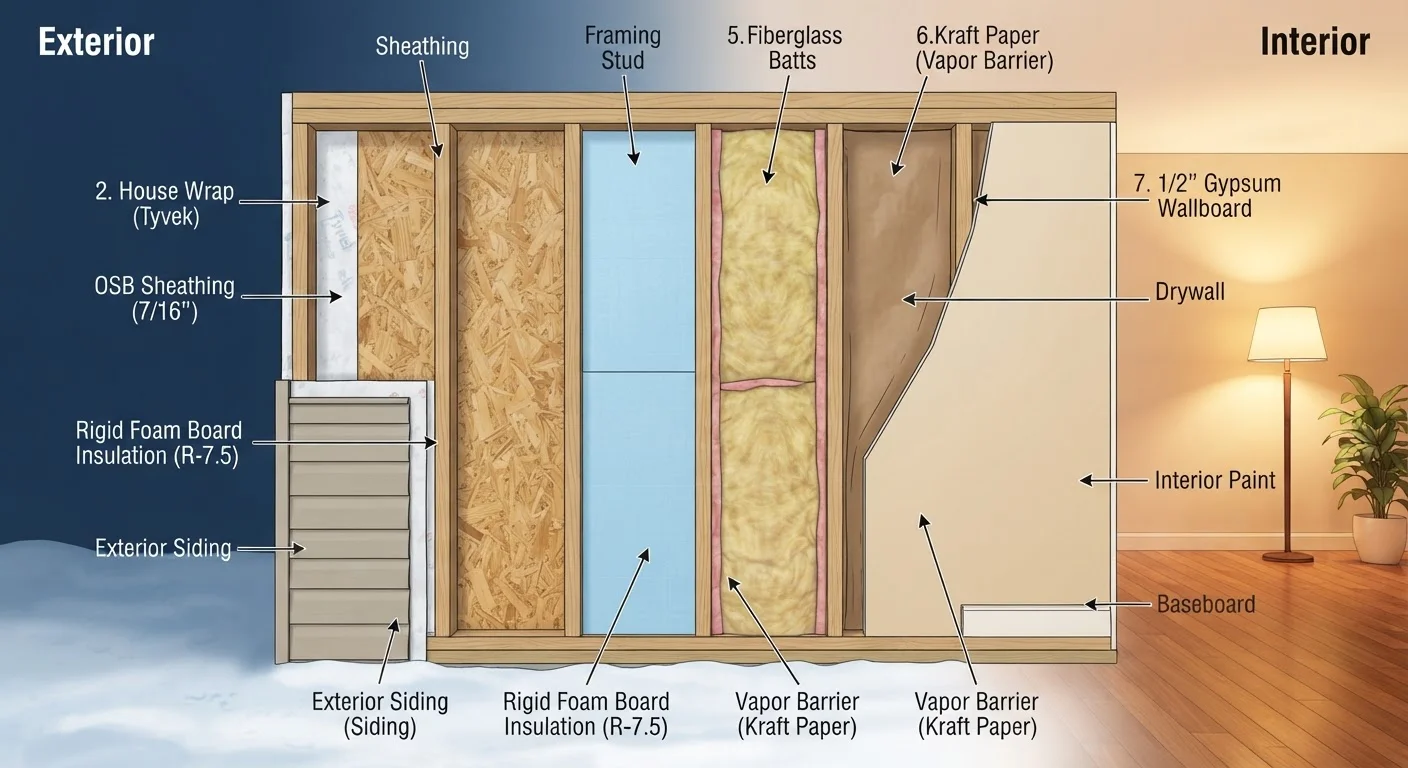
An insulation layer installed without interruption across all structural members, reducing thermal bridging. Rigid foam board applied over exterior wall sheathing is a common example.
Fiberglass Batts and Rolls
Made from fine glass fibers, fiberglass batts are the most widely installed insulation in the US. They fit standard stud and joist cavities in walls, floors, and attics. R-value typically runs R-2.9 to R-3.8 per inch. Proper installation requires filling the cavity completely without compression - gaps and voids significantly reduce performance.
Mineral Wool (Rock Wool / Slag Wool)
Spun from molten rock or industrial slag, mineral wool batts are denser than fiberglass and offer better sound attenuation, fire resistance, and moisture repellency. R-value is similar - roughly R-3.0 to R-3.3 per inch. It's well-suited for exterior walls, fire-blocking applications, and areas prone to humidity.
Loose-Fill (Blown-In) Insulation
Cellulose (made from recycled paper) and blown fiberglass are both installed using blowing equipment, making them effective for attic floors, enclosed wall cavities, and irregular spaces. Cellulose typically provides R-3.2 to R-3.8 per inch; blown fiberglass runs slightly lower. Cellulose is treated with fire retardants and borate-based pest deterrents.
Rigid Foam Board
Available in three formulations - EPS (expanded polystyrene), XPS (extruded polystyrene), and polyisocyanurate (polyiso) - rigid foam boards provide a continuous insulation layer with minimal thermal bridging. R-values range from about R-3.8 (EPS) to R-6.5 (polyiso) per inch. Common uses include foundation walls, exterior wall sheathing, and under-slab applications. Polyiso performs best in warm environments; its effective R-value drops in very cold conditions.
Spray Polyurethane Foam (SPF)
Spray foam comes in two types: open-cell (lower density, R-3.5-3.6/inch, vapor-permeable) and closed-cell (higher density, R-6.0-7.0/inch, vapor barrier). Closed-cell SPF is one of the highest-performing options available and can add structural rigidity. Both types require professional installation with proper respiratory protection and ventilation; occupants typically need to vacate during and after application until fully cured.
Spray Foam and Older Homes
Spray polyurethane foam can significantly tighten a home's air envelope. In older homes with combustion appliances - furnaces, water heaters, fireplaces - this can create backdrafting risks if ventilation is not adjusted. Before using closed-cell spray foam in a significant whole-house application, consult a building performance professional to assess combustion safety and ventilation needs.
Reflective / Radiant Barrier
Radiant barriers - typically foil-faced materials - work by reflecting radiant heat rather than absorbing it. They are most effective in hot climates when installed in attics facing an air space. They do not have a meaningful R-value on their own and should be used alongside conventional insulation rather than as a replacement.
Choosing the Right Insulation for Your Project
Matching material to location and climate is the core decision. Key factors include:
- Location in the home: Attics, crawlspaces, basement walls, and exterior walls each have different moisture exposure, air movement, and space constraints.
- Climate zone: The US Department of Energy's climate zone map defines minimum R-value recommendations by region. Colder zones require higher overall R-values.
- Moisture management: In mixed and humid climates, vapor control matters. Closed-cell spray foam and XPS act as vapor retarders; fiberglass and open-cell foam are vapor-permeable.
- Air sealing: Insulation alone does not stop air infiltration. Spray foam is the exception - it insulates and air-seals simultaneously. Other materials typically require a separate air barrier.
- Building codes and permits: Insulation upgrades in conditioned spaces often require permits, and some spray foam applications require fire-code-compliant thermal barriers. Always verify requirements with your local building department before starting work.
~11%
US homes considered adequately insulated
According to the North American Insulation Manufacturers Association, a large proportion of US homes are under-insulated relative to current DOE recommendations.
R-49
Recommended attic insulation in cold/very cold US zones
The U.S. Department of Energy recommends R-49 to R-60 attic insulation for existing homes in climate zones 5 through 8.
For hazardous or complex work - such as insulating around electrical panels, knob-and-tube wiring, or combustion appliances - consult a licensed insulation contractor or building performance professional rather than proceeding as a DIY project.