

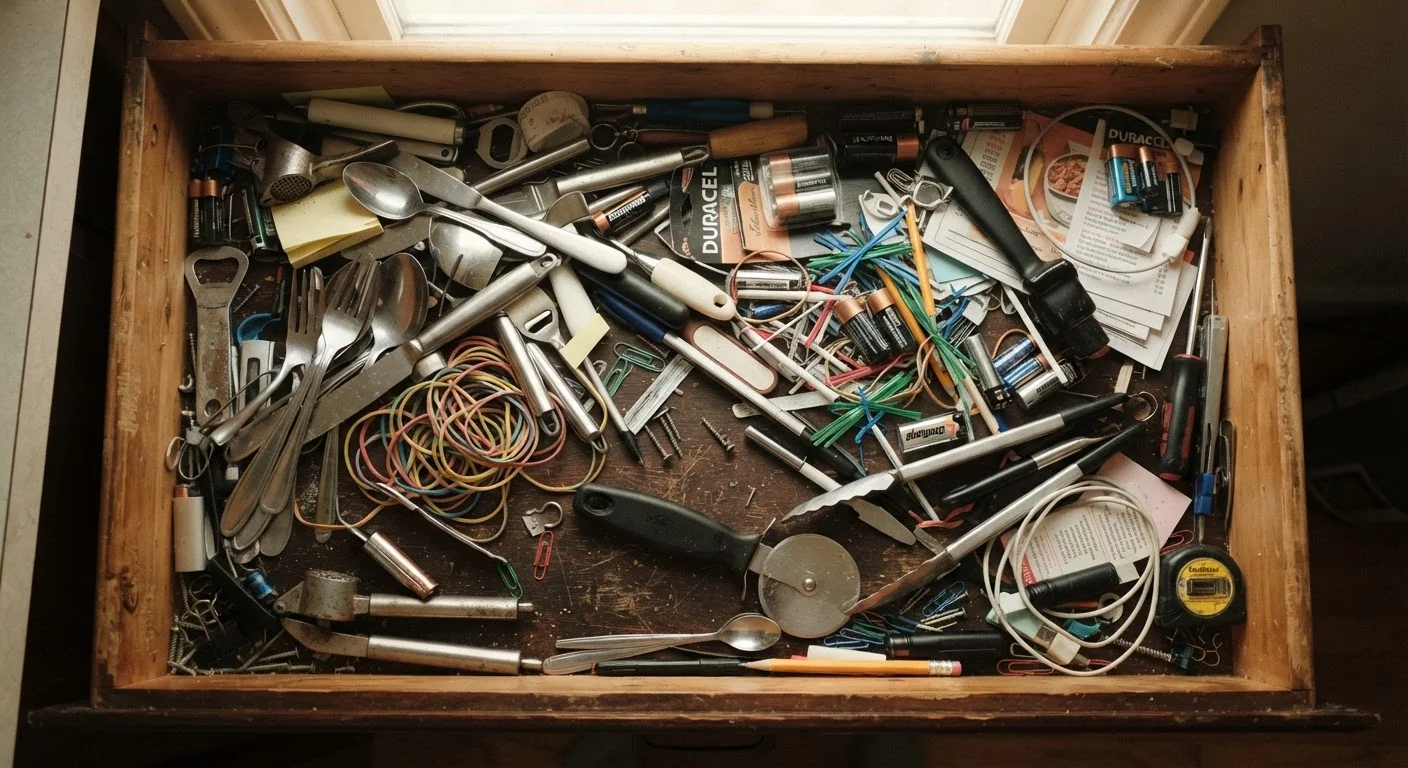
Key Takeaways
- Most kitchen drawer systems fail because of poor item grouping, not lack of storage space.
- Buying organizers before editing your drawer contents almost always leads to wasted money.
- Drawers work best when each one has a single, clearly defined purpose.
- Maintenance is built into the system design - not added as a separate task afterward.
Why Kitchen Drawers Are the First Thing to Fall Apart
Kitchen drawers tend to become disorganized faster than almost any other storage area in the home. They're used dozens of times a day, they're easy to shove things into, and - unlike open shelving - they hide the evidence. The result is that small messes compound unnoticed until opening a drawer becomes a minor frustration every single time.
The good news is that most kitchen drawer chaos isn't a space problem. It's a systems problem. And systems problems are fixable once you understand where the failure points actually are. The mistakes below are the most common ones, and correcting even two or three of them can make a meaningful difference.
For a broader starting point, see our room-by-room home organization guide - it covers the kitchen alongside every other area of the home.
The Mistakes That Derail Kitchen Drawer Organization
These are the patterns that consistently cause even well-intentioned organization attempts to unravel within weeks.
Skipping the edit before organizing - trying to organize everything that's currently in the drawer without removing items first.
Why it happens: It feels faster to sort in place, and people often assume they need everything they've accumulated. Letting go feels like an extra step.
Buying organizers before knowing what needs to be stored.
Why it happens: Attractive storage products feel like a solution, and shopping is more satisfying than editing. Many people purchase bins and dividers in anticipation of getting organized.
Grouping items by shape rather than by how and when they're used.
Why it happens: It's intuitive to put similarly shaped items together - all long tools in one drawer, small items in another - but this ignores how people actually reach for things while cooking.
Treating one drawer as a general catch-all for things with no other home.
Why it happens: The so-called "junk drawer" is a deeply ingrained habit. It's genuinely useful in concept, but without boundaries it expands to absorb everything.
Designing a system that works for one person but not the whole household.
Why it happens: The person who organizes a space tends to optimize it for their own mental model, which others then unconsciously override by using the space differently.
It's also worth noting that kitchen drawer problems rarely exist in isolation. If you're finding that clutter keeps coming back despite your efforts, common organization myths may be working against you - including the belief that you simply need more containers.
Building a System That Actually Holds
~20 min
Average time lost weekly to disorganized kitchen storage
Household efficiency researchers have noted that disorganized kitchen spaces contribute to repeated, small time losses that accumulate across a week.
1/3
Typical reduction in drawer contents after a full edit
Professional organizers commonly report that a thorough declutter of kitchen drawers removes roughly one-third of items through discard or relocation.
A drawer system that holds over time has two qualities: it's easy to use correctly, and it's inconvenient to use incorrectly. That means friction should be low for putting things back where they belong, and high for dumping miscellaneous items in without thought.
Start by assigning each drawer a single category - utensils, baking tools, food storage supplies, and so on. Then use dividers or inserts sized to your actual contents, not generic organizers bought in advance. Label drawers if multiple household members use the kitchen, since shared spaces require explicit cues.
Don't Reorganize Without Editing First
Rearranging items without removing what doesn't belong is one of the most common reasons a newly organized drawer reverts to chaos within weeks. The available space fills right back up because the root cause - too many items without a clear home - was never addressed. Edit before you organize, every time.
Once your drawers are in order, the next challenge is keeping them that way. Small daily habits matter more than occasional overhauls. Our piece on clutter-prevention habits worth adopting covers practical routines that prevent things from sliding back into chaos.