

Key Takeaways
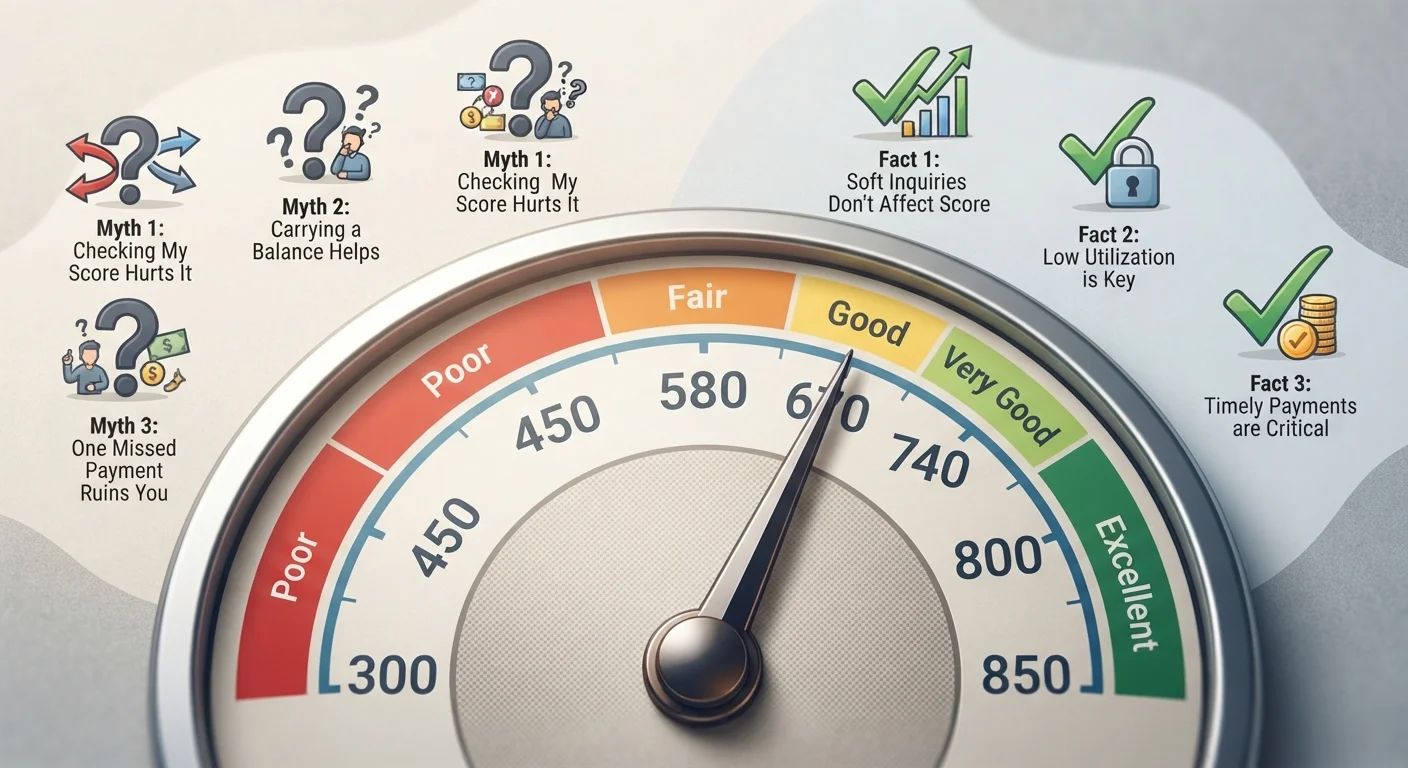
- Checking your own credit score does not lower it - only hard inquiries from lenders do.
- Closing old credit card accounts can actually hurt your score by reducing available credit history.
- Carrying a small balance on your card does not help your credit score improve.
- A single late payment can remain on your credit report for up to seven years.
- You can build credit without taking on debt, using tools like secured cards or credit-builder loans.
Why Credit Myths Persist - and Why They Matter
Credit scores influence whether you qualify for a mortgage, what interest rate you pay on a car loan, and even whether a landlord approves your rental application. Given the stakes, it's worth knowing what actually drives your score - and what doesn't. Unfortunately, misinformation travels fast, and many adults are making financial decisions based on beliefs that simply don't hold up.
If you're new to how scores and reports work, our introductory credit and debt guide lays out the fundamentals. For now, let's focus on the myths that most commonly lead people astray.
Myth
Checking your own credit score will lower it.
Fact
Checking your own score is a 'soft inquiry' and has no effect on your credit score whatsoever.
Credit inquiries come in two types: soft and hard. Soft inquiries - including checking your own score through a credit bureau, bank, or monitoring service - are invisible to lenders and never affect your score. Hard inquiries occur when a lender pulls your credit as part of a formal application. Multiple hard inquiries within a short window (typically 14-45 days, depending on the scoring model) for the same type of loan, such as a mortgage or auto loan, are usually counted as one. Avoiding your own score out of fear is counterproductive - monitoring it regularly is a sound financial habit.
Myth
Closing old credit card accounts you no longer use will improve your score.
Fact
Closing old accounts typically lowers your score by reducing your total available credit and shortening your average credit history.
Two scoring factors are directly affected when you close an account: credit utilization and length of credit history. Closing a card reduces your total available credit, which can push your utilization ratio higher if you carry balances on other cards. It can also lower the average age of your accounts, which is a separate factor scoring models track. Unless an account carries an annual fee that outweighs its benefit, keeping older, no-fee accounts open and lightly used is generally the smarter move. For a deeper look at behaviors that quietly erode scores, see habits that quietly damage your credit.
Myth
You need to carry a small balance to show lenders you're actively using credit.
Fact
Carrying a balance costs you interest and does not improve your score. Paying in full each month is better for both your wallet and your credit.
This myth likely stems from a misunderstanding of how credit activity is reported. Card issuers report your balance and payment status to bureaus whether you pay in full or carry a balance. Scoring models reward on-time payments and low utilization - neither of which requires carrying a balance. In fact, a revolving balance increases your utilization ratio, which can hurt your score. There is no scoring benefit to paying interest unnecessarily.
Myth
Income directly affects your credit score.
Fact
Credit scores do not factor in your income, employment status, or net worth - only how you manage borrowed money.
This is one of the most persistent myths. FICO and VantageScore models are built entirely from data in your credit report, which tracks borrowing and repayment behavior. Your salary, job title, savings account balance, and assets are not included. You can have an excellent score on a modest income and a poor score on a high income. Lenders may consider income separately when evaluating a loan application, but that assessment is independent of the credit score itself. Understanding the difference between your credit report and your score helps clarify what data actually feeds into each.
Myth
You can't build credit without a credit card or loan.
Fact
Several tools exist specifically to help people establish credit without taking on traditional debt.
Secured credit cards require a cash deposit as collateral and report to the major bureaus just like standard cards. Credit-builder loans - offered by some credit unions and community banks - work by holding the borrowed amount in a savings account while you make payments, then releasing the funds to you at the end. Some rental and utility payment reporting services now allow on-time payments to be reported to bureaus as well. These options make it possible to build a positive credit history even if you have no prior credit or are rebuilding after financial difficulties.
Myth
A bad credit score is permanent.
Fact
Credit scores are dynamic - negative information ages off your report, and consistent positive behavior rebuilds your score over time.
Most negative marks, including late payments and collections, fall off your credit report after seven years. Chapter 7 bankruptcies remain for ten years. But the impact of negative items typically diminishes well before they disappear - a late payment from five years ago carries much less weight than one from six months ago. Establishing a consistent track record of on-time payments, keeping balances low, and avoiding excessive new applications are all strategies that can meaningfully improve a score within 12 to 24 months, depending on the starting point. Building better financial habits more broadly - including clearing up common budget misconceptions - supports long-term credit health too.
What Actually Moves the Needle on Your Score
Once you've cleared away the myths, a clearer picture of credit health emerges. The factors that scoring models like FICO weigh most heavily are: payment history (roughly 35%), amounts owed relative to your credit limit (about 30%), length of credit history (15%), new credit inquiries (10%), and credit mix (10%). Understanding these proportions helps you prioritize the right behaviors.
35%
Weight of payment history in FICO score
According to FICO's published scoring model breakdown, on-time payment history is the single largest factor in your credit score.
~1 in 5
Americans with a credit report error
A Federal Trade Commission study found that roughly one in five consumers had an error on at least one of their three major credit reports.
7 years
How long most negative items stay on your report
Under the Fair Credit Reporting Act (FCRA), most adverse information - including late payments and collections - must be removed after seven years.
Credit utilization - the ratio of what you owe to your total available credit - deserves special attention because it's both highly impactful and quickly changeable. Our article on why credit utilization matters more than you think explains the mechanics in detail. Keeping that ratio below 30% - and ideally below 10% - is one of the most reliable ways to support a strong score.
Payment history is equally critical. One missed payment won't permanently define you, but it can stay on your report for seven years and take time to fade in impact. Building a consistent record of on-time payments is the single most reliable path toward strong credit. You can also review your reports for errors that may be artificially dragging your score down - our guide to disputing credit report errors walks through that process step by step.
Don't Apply for Multiple Cards at Once
Each credit card application triggers a hard inquiry, which can temporarily lower your score by a few points. Applying for several cards in a short period signals financial stress to lenders and can compound that effect. Space out applications strategically, and only pursue new credit when you have a clear need for it.