

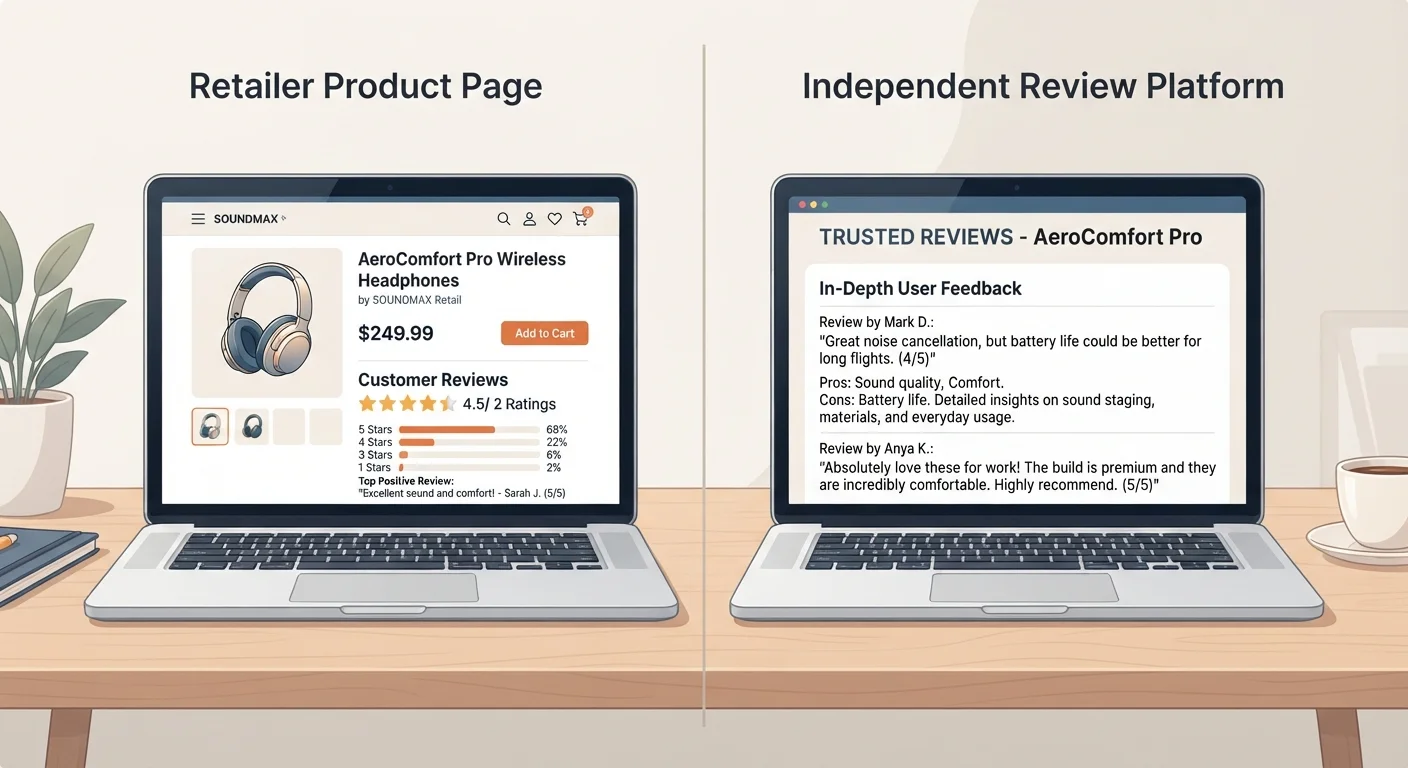
Key Takeaways
- Retailer reviews are convenient but subject to curation, removal, or incentivization by the seller.
- Third-party review platforms operate independently, but vary significantly in their moderation standards.
- The most reliable research strategy combines both sources and looks for consistent patterns across them.
- Red flags like review clustering, vague language, and sudden rating spikes apply on both platforms.
Our Verdict
Neither retailer reviews nor third-party platforms are inherently more trustworthy - each has structural advantages and vulnerabilities. Retailer reviews offer purchase-verified volume; independent platforms offer editorial distance. Used together with a critical eye, they give shoppers the most complete picture.
| Best for | Recommended |
|---|---|
| Quick commodity purchases with straightforward specs | Retailer reviews (verified purchase filters applied) |
| High-stakes or complex purchases requiring in-depth analysis | Third-party review platforms with editorial oversight |
| Detecting fake or manipulated feedback patterns | Cross-referencing both sources simultaneously |
| Service-based or contractor decisions | Third-party platforms with identity-verified reviews |
Why the Source of a Review Matters
When you read a product review, you're making an implicit assumption: that the person who wrote it had no financial stake in what you concluded. That assumption holds up better in some places than others.
Retailer review systems - whether built into a major e-commerce marketplace or a specialty store's product page - operate within an ecosystem where the seller benefits directly from your purchase. Third-party review platforms, by contrast, sit outside the transaction. That structural difference shapes the incentives at play, the moderation policies applied, and ultimately how much weight each review type deserves.
This doesn't mean one source is always reliable and the other isn't. It means each comes with specific strengths and blind spots that every shopper should understand before drawing conclusions. For a broader framework on evaluating review quality, see reading between the lines of online product reviews.
How Retailer Reviews Work - and Where They Fall Short
Retailer review systems typically require a verified purchase to post, which is a genuine advantage. You're hearing from people who actually bought the item, not anonymous commenters with unknown motives. Volume is also a strength: popular products on major platforms can accumulate thousands of reviews, creating meaningful signal about common experiences.
The vulnerabilities, however, are real. Sellers on marketplace platforms sometimes solicit positive reviews through follow-up emails, discount offers, or outright incentivization. Review suppression - where a seller flags or disputes negative reviews - has been documented on multiple platforms. And because the retailer profits from sales, even neutral platforms face structural pressure to avoid alienating sellers.
Watch for Review Clustering Patterns
An unusual concentration of five-star ratings posted within a short time window can indicate coordinated or incentivized review activity - a pattern that appears on both retailer and third-party sites. Filtering by verified purchase and sorting by lowest rating rather than highest or most helpful can surface more representative feedback.
Look for review clustering - an unusual concentration of five-star ratings posted within a short time window - as a possible indicator of coordinated or incentivized review activity. This pattern is visible on both retailer and third-party sites.
Filtering by verified purchase status and sorting by most critical (rather than most helpful) can surface more balanced feedback on retailer platforms.
What Third-Party Platforms Do Differently
Independent review platforms don't sell the products they cover, which removes the most direct commercial conflict of interest. Many employ editorial teams or algorithmic moderation to flag suspicious patterns. Some require identity verification or restrict reviews to documented transactions.
That independence has limits, though. Some platforms generate revenue through advertising, featured listings, or partnerships with businesses they also review - creating subtler conflicts. Moderation quality varies enormously across platforms. And unlike retailer sites, third-party platforms often attract self-selected reviewers: people motivated enough by a strong experience (positive or negative) to seek out a separate site to leave feedback. That self-selection can skew distributions in ways that don't represent the average buyer.
| Retailer Reviews | Third-Party Review Platforms | |
|---|---|---|
| Editorial independence | Low - seller benefits from positive reviews | Higher - no direct sales relationship |
| Purchase verification | Often required (verified purchase badge) | Varies widely by platform |
| Review volume | Typically high for popular products | Varies; often lower per product |
| Manipulation risk | Seller incentivization, review suppression | Paid placements, advertiser conflicts |
| Best for | Commodity goods with many buyers | Services, complex products, category research |
| Reviewer self-selection bias | Moderate - skews toward purchasers | Higher - motivated by strong experiences |
For decisions involving contractors, service providers, or healthcare practitioners - where purchase verification is impractical - well-moderated third-party platforms with identity-linked accounts tend to offer more useful signal than retailer-style systems.
Signals That Suggest a Review Can Be Trusted
Regardless of platform, certain characteristics make individual reviews more credible:
- Specificity: Reviews that mention exact model numbers, describe particular use cases, or note how long they've owned the product tend to reflect genuine experience.
- Balanced tone: Authentic reviews frequently mention at least one limitation even when the overall impression is positive. Uniformly glowing or uniformly hostile reviews warrant skepticism.
- Reviewer history: On platforms that display reviewer profiles, a consistent history of reviews across multiple categories suggests a real person rather than a targeted account.
- Recency context: A product's rating can shift substantially after a manufacturer change or a quality dip. Understanding how review age affects reliability helps you weigh older vs. newer feedback appropriately.
Cross-Reference Before You Conclude
For high-stakes purchases, check at least two independent sources before drawing conclusions. If retailer reviews skew positive but third-party coverage is mixed, treat that discrepancy as meaningful data worth investigating further. A consistent story across sources is the most reliable signal you're getting an accurate picture.
For high-stakes purchases, cross-reference at least two independent sources before drawing conclusions. If retailer reviews skew positive but third-party coverage is mixed, treat the discrepancy itself as meaningful data. See how to evaluate reviews for high-stakes purchases for a more rigorous framework.
Building a Practical Research Habit
The most effective approach treats review research as triangulation rather than a single source check. Start with third-party platforms for category-level understanding: what do knowledgeable reviewers say are the common failure points for this product type? Then move to retailer reviews filtered by verified purchase, sorted by lowest rating, to see what actually goes wrong for real buyers.
If the two sources tell consistent stories, confidence in your conclusion increases. If they diverge sharply, that's a signal to dig further - not to default to whichever source is more favorable. When reviews contradict each other, a structured approach to weighing opposing opinions can help you still reach a confident decision.
Finally, be alert to common rating assumptions that lead shoppers astray - including the idea that a higher review count automatically signals better quality. Volume and reliability are different things, on any platform.