

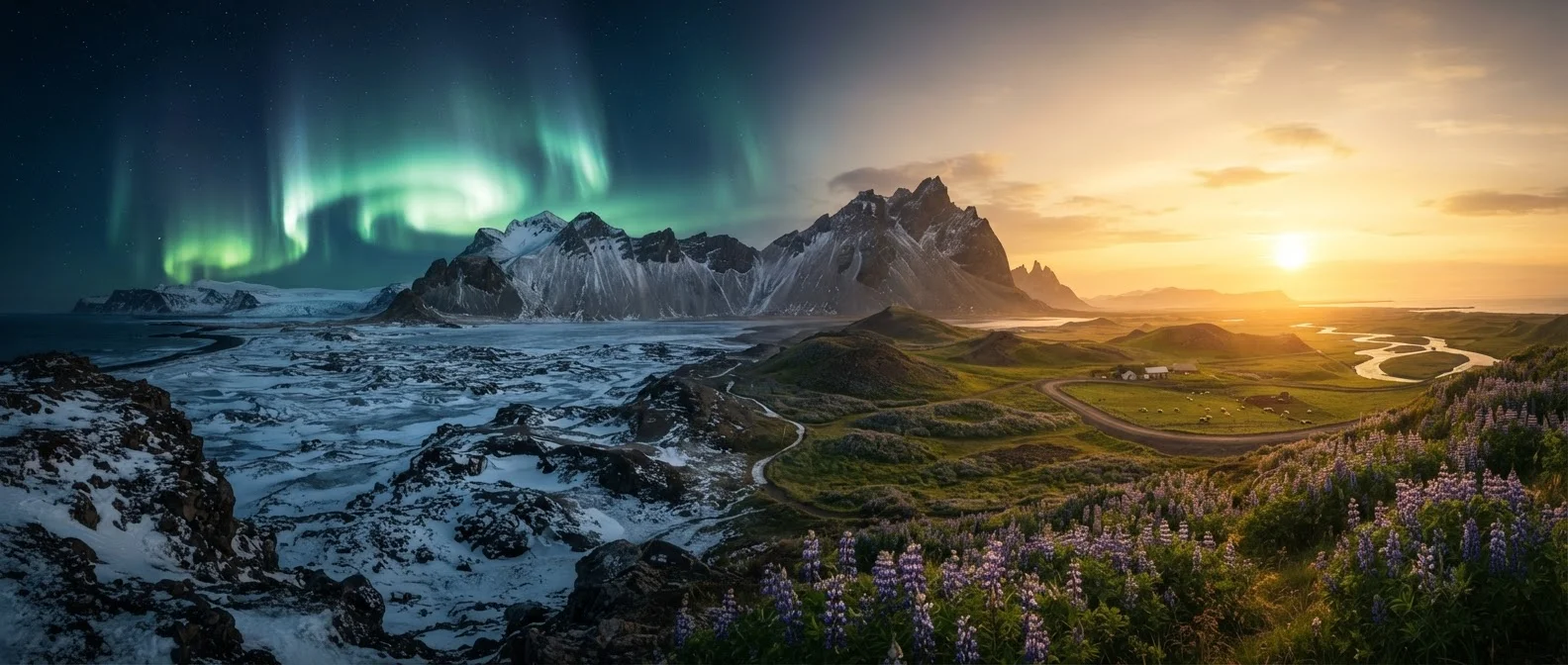
Key Takeaways
- Winter offers the only real chance to see the northern lights, but short daylight hours limit sightseeing time.
- Summer's midnight sun provides nearly 24-hour daylight and opens up the entire Highland interior.
- Ice caves in glacier tongues are a winter-only attraction; puffin colonies and whale watching peak in summer.
- Roads like the F-roads into the Highlands are typically closed from October through May or June.
- Crowd levels and accommodation demand are noticeably higher in summer, particularly June through August.
- Neither season is objectively better - the right choice depends entirely on which experiences matter most to you.
Option A
Iceland in Winter
The dark, dramatic, aurora-chasing season.
Best for: Travelers who want northern lights, ice caves, and a raw, uncrowded landscape experience.
Option B
Iceland in Summer
The bright, action-packed midnight sun season.
Best for: Travelers who want maximum daylight, accessible roads, wildlife, and outdoor adventure.
If seeing the northern lights is your primary goal
Iceland in Winter
The aurora borealis requires darkness, which Iceland only has in meaningful quantities from roughly September through March. Summer's midnight sun makes aurora viewing essentially impossible.
If you want to explore the Highlands and remote interior
Iceland in Summer
The F-roads that access the Highlands are gated and impassable for most vehicles outside summer months. This entire section of Iceland is simply off the table in winter.
If wildlife encounters - puffins, whales, seabirds - are high on your list
Iceland in Summer
Puffins nest in Iceland from May to August, and whale watching tours report the highest sighting frequencies during summer months when marine activity peaks.
If you're drawn to dramatic ice caves inside glaciers
Iceland in Winter
Natural ice caves in glacier tongues like Vatnajökull form and are safely accessible only during the cold months; warmer temperatures make them structurally unstable in summer.
If flexibility and ease of travel matter most
Iceland in Summer
Longer daylight, more open roads, milder temperatures, and more operating tour operators collectively make summer logistics far more forgiving for first-time visitors.
What the Seasons Actually Look Like on the Ground
Iceland's seasonal extremes are more dramatic than almost anywhere else in the Northern Hemisphere. In the depths of winter - think December and January - Reykjavík sees roughly four to five hours of usable daylight. By contrast, at midsummer in late June, the sun barely dips below the horizon, and it never truly gets dark. These aren't just novelty statistics; they fundamentally reshape what a trip feels like and what it can accomplish.
Winter visitors experience moody, low-angled light that makes waterfalls and lava fields look cinematic - but they're also racing the sunset from early afternoon. Summer travelers can hike a volcano at 11 p.m. in full light, but they'll need blackout curtains to sleep. Understanding this trade-off is the starting point for everything else.
It's also worth noting that Iceland's weather is famously unpredictable in any season. Wind, rain, and rapidly shifting conditions are year-round realities. As a general planning principle - one explored in more depth in our article on why 'off-season' travel often misses the point - labeling any season as universally better often leads to poorly matched expectations.
Side-by-Side: How the Two Seasons Compare
Below is a direct comparison of the conditions and experiences each season makes possible. Use this as a quick reference before diving into the details.
| Criterion | Iceland in Winter | Iceland in Summer |
|---|---|---|
| Daylight hours | 4-6 hrs (Dec-Jan) | Nearly 24 hrs (June) |
| Northern lights | Possible (Sep-Mar) | Not possible |
| Ice cave access | Yes (Nov-Mar) | No - structurally unsafe |
| Highland F-roads | Closed | Open (Jul-Sep) |
| Puffin watching | Not available | May-August |
| Crowd levels | Lower | Significantly higher |
| Driving conditions | Ice, snow, high risk | Generally safer |
| Typical temperatures | −5°C to 4°C (23-39°F) | 10°C to 15°C (50-59°F) |
Experiences That Are Season-Specific
Some of Iceland's most iconic experiences are genuinely locked to one season or the other - not just better or worse, but simply unavailable at the wrong time of year.
Winter Exclusives
- Northern lights (aurora borealis): Requires darkness and clear skies. Realistically possible from September to March, with peak darkness in November through January.
- Natural ice caves: Glacier caves in the tongues of Vatnajökull and other outlets are only safe and stable when frozen solid - typically November through March.
- Snow-covered lava fields: The surreal visual of black volcanic rock blanketed in white is a winter-only landscape.
Summer Exclusives
- Highland F-roads: The interior is inaccessible for most of the year. Typically open July through September, weather permitting.
- Puffin watching: Atlantic puffins nest on Icelandic cliffs from May to August before returning to sea.
- Midnight sun: Around the summer solstice, parts of Iceland experience continuous daylight - a disorienting and memorable phenomenon.
- Lupine fields: Nootka lupine carpets roadsides in purple from late May into July.
~21 hrs
Daylight near summer solstice in Reykjavík
Around June 21, Reykjavík receives approximately 21 hours of sunlight, with the remaining hours never reaching full darkness.
~4 hrs
Daylight in Reykjavík at winter solstice
In late December, usable daylight in Reykjavík drops to roughly four hours, fundamentally limiting what can be seen and done in a single day.
3M+
Annual tourist arrivals in Iceland
Iceland has seen international visitor numbers exceed three million in recent peak years, according to the Icelandic Tourist Board, with the bulk concentrated in summer months.
Planning Considerations: Crowds, Access, and Costs
Summer - particularly June through August - is Iceland's peak tourist season. Visitor numbers are meaningfully higher, and this affects everything from accommodation availability to queue lengths at popular sites like Geysir or Jökulsárlón. Booking well in advance is strongly advisable for summer travel.
Winter is comparatively quieter at most attractions, though shoulder periods like late September and early October can offer a compelling middle ground: some aurora potential, autumn foliage on the tundra, and fewer visitors. This is the logic behind shoulder-season planning more broadly - a subject with genuine trade-offs worth understanding, as covered in our guide on planning around shoulder season.
Road conditions also shift dramatically. Winter driving in Iceland carries real risk: black ice, blowing snow, and reduced visibility are common. Renting a 4WD vehicle with winter tires is generally recommended for winter travel outside Reykjavík. Always check road conditions via the Icelandic Road and Coastal Administration (Vegagerðin) before departing. Never assume a road is passable based solely on map data.
Verify Entry and Safety Conditions Before You Go
Travel requirements, road closures, and safety advisories in Iceland can change with little notice. Always check official sources - including the Icelandic Meteorological Office (vedur.is) for weather and the Road and Coastal Administration (road.is) for road conditions - before and during your trip. For entry requirements, consult your government's official travel advisory portal.