

Key Takeaways
- Departure timing matters more with young children - schedule around nap and meal rhythms, not convenience.
- Packing a dedicated in-transit bag for kids prevents digging through luggage mid-journey.
- Movement breaks and low-pressure activity shifts are more effective than passive screen time alone.
- Realistic expectations - including planned buffer time - reduce stress for both adults and children.
- Familiar comfort items from home anchor small children during unfamiliar transit environments.
Why Transit Is the Hardest Part of Family Travel
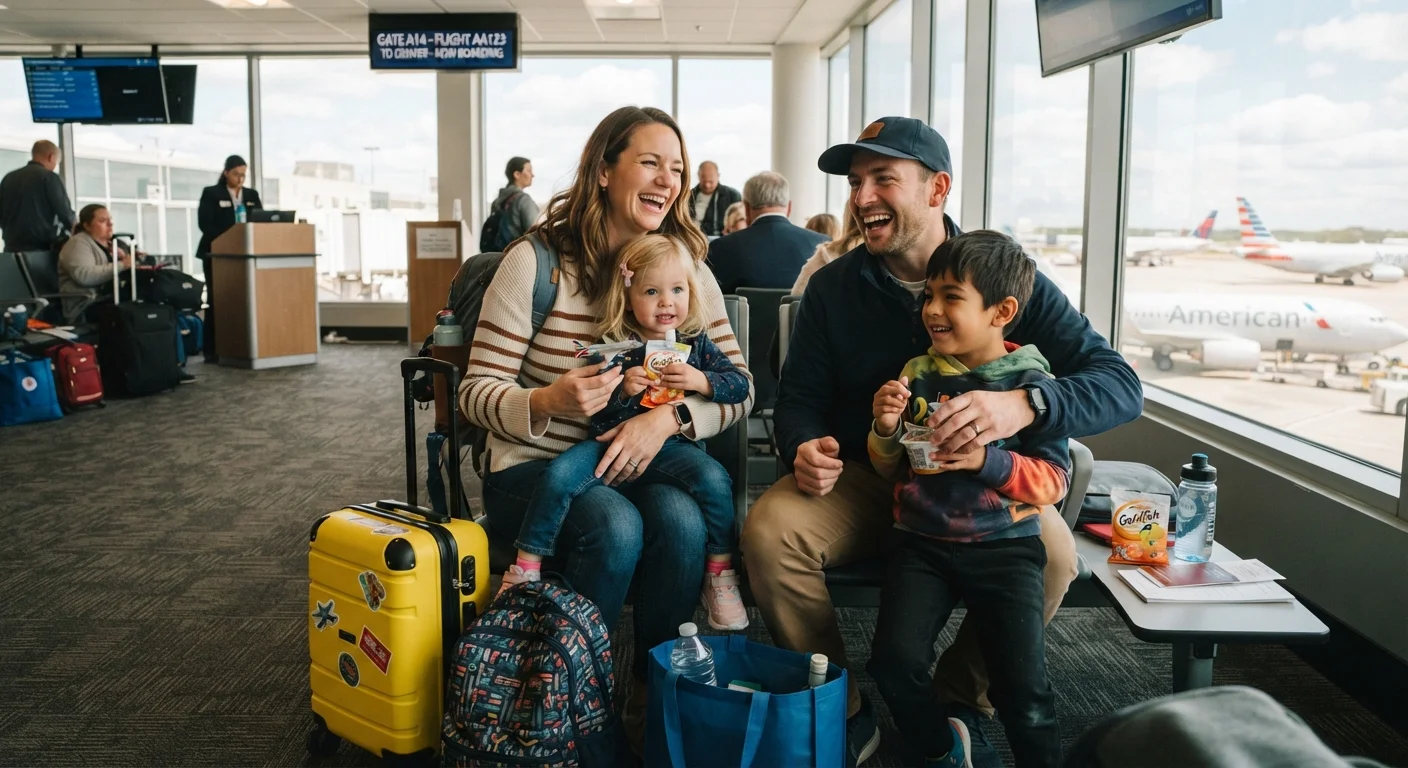
Getting there is genuinely the toughest stretch of any trip with young children. Airports, long drives, train stations - these environments are designed for efficient adult movement, not for a three-year-old who needs to run, eat on a schedule, and make sense of a world suddenly full of strangers and noise.
The good news: most transit meltdowns are predictable, and predictable means preventable. The families who arrive at their destination in decent spirits aren't just lucky - they've usually built a framework around their kids' actual rhythms rather than the idealized version of how travel should go. For a deeper look at how family logistics reshape the entire planning process, see what changes about planning when kids are involved.
~60%
Family travelers citing transit as their top stress point
Research on family travel consistently identifies the journey itself - rather than the destination - as the primary source of parental stress during trips with young children.
20-30 min
Typical focused attention window for toddlers
Child development research broadly places sustained attention capacity for children aged 2-4 at roughly 2-5 minutes per year of age, making frequent activity rotation critical during long transit.
Build Your Schedule Around Biology, Not the Clock
Children under six are largely governed by hunger and sleep - fight those two forces and you'll lose every time. When choosing departure times, look at your child's actual daily rhythm and work backward. A flight that departs at 6 a.m. might seem efficient, but a 3 a.m. wake-up to get there rarely produces a cooperative toddler at the gate.
Mid-morning departures often align with a natural energy window for young children - fed, rested, and curious rather than depleted. On long drives, plan your first stop for roughly when your child would normally eat lunch, not when it's convenient for the highway exit. This single adjustment prevents a significant percentage of backseat crises.
Time Departures Around Your Child's Peak Window
When you have flexibility, aim to depart roughly 60-90 minutes after your child's normal wake-up time. They're fed, alert, and not yet hitting their midday energy trough. This window is often the most cooperative stretch of the day - and the most forgiving for security lines, boarding queues, and the early legs of a drive.
For multi-leg journeys or trips involving grandparents, coordinating these rhythms across generations adds a layer of complexity. Planning a multi-generational trip without the drama covers that coordination in detail.
The In-Transit Bag: Your Most Powerful Tool
Pack a dedicated bag - not a corner of a checked suitcase - that lives within reach throughout the entire journey. This bag is your operational kit. Its contents should be curated before you leave home, not assembled in a panic at the gate.
Pack the in-transit bag the night before departure, not the morning of.
Morning departures are already high-stress. Pre-packing eliminates last-minute scrambling and ensures nothing critical gets left behind when everyone is rushed and tired.
Include at least one genuinely novel item the child hasn't seen before.
Novelty drives sustained attention in young children far more reliably than familiar toys. A new small activity or inexpensive item reserved specifically for transit holds attention during the most demanding stretches.
Pack two full changes of clothes per child in your carry-on or within-reach bag.
Spills, accidents, and unexpected messes are a near-certainty on long journeys with young children. A single change of clothes is often not enough, and digging through checked luggage mid-transit isn't an option.
Separate snacks into individually portioned containers or bags before leaving home.
Handing a child an open bag of crackers mid-flight leads to crushed crackers and conflict. Pre-portioned snacks give children a sense of control, make it easy to pace feeding throughout a journey, and reduce mess significantly.
Managing Energy and Attention on the Move
Young children can't sustain passive attention for long stretches, and screens alone aren't a complete solution. The most effective in-transit strategy rotates between short activity windows: a downloaded show, then a simple coloring activity, then a snack, then a walk to the end of the train car. This rotation - roughly every 20 to 30 minutes for toddlers - works with their attention span rather than against it.
Physical movement breaks are non-negotiable on long journeys. At airports, find a quiet corridor and let kids walk, squat, or move freely before boarding. On road trips, treat every fuel stop as a 10-minute movement window. The investment in those breaks pays off in calmer, more manageable stretches afterward.
It also helps to mentally reframe arrival expectations. A well-structured itinerary always builds in buffer time - and that's doubly important when small children are part of the equation.
What Actually Helps When Things Go Sideways
Even well-prepared families hit rough patches. A flight delay, a missed nap, an overstimulated child - these happen. The single most useful mindset shift is accepting that public discomfort is temporary and manageable, not a crisis. Other travelers in the vicinity of a crying child are almost universally more sympathetic than parents in those moments believe.
Keep one or two comfort items from home - a specific stuffed animal, a familiar blanket - accessible throughout transit. These sensory anchors help small children self-regulate in unfamiliar environments. If you're traveling with a child who's particularly sensitive to transitions, narrating the journey in simple terms ("first we sit on the plane, then we land, then we get to the hotel with the pool") gives them a mental map that reduces anxiety.
Every Child Is Different - Adjust Accordingly
These strategies reflect common patterns in young children's travel behavior, but every child has a distinct temperament and routine. What works brilliantly for one family may need significant adjustment for another. Treat any new approach as an experiment, observe what actually reduces friction for your specific child, and build your travel toolkit from there.
Teen travel introduces a different set of challenges - if your family spans ages, traveling with teenagers gets complicated in its own distinct ways worth understanding separately.