

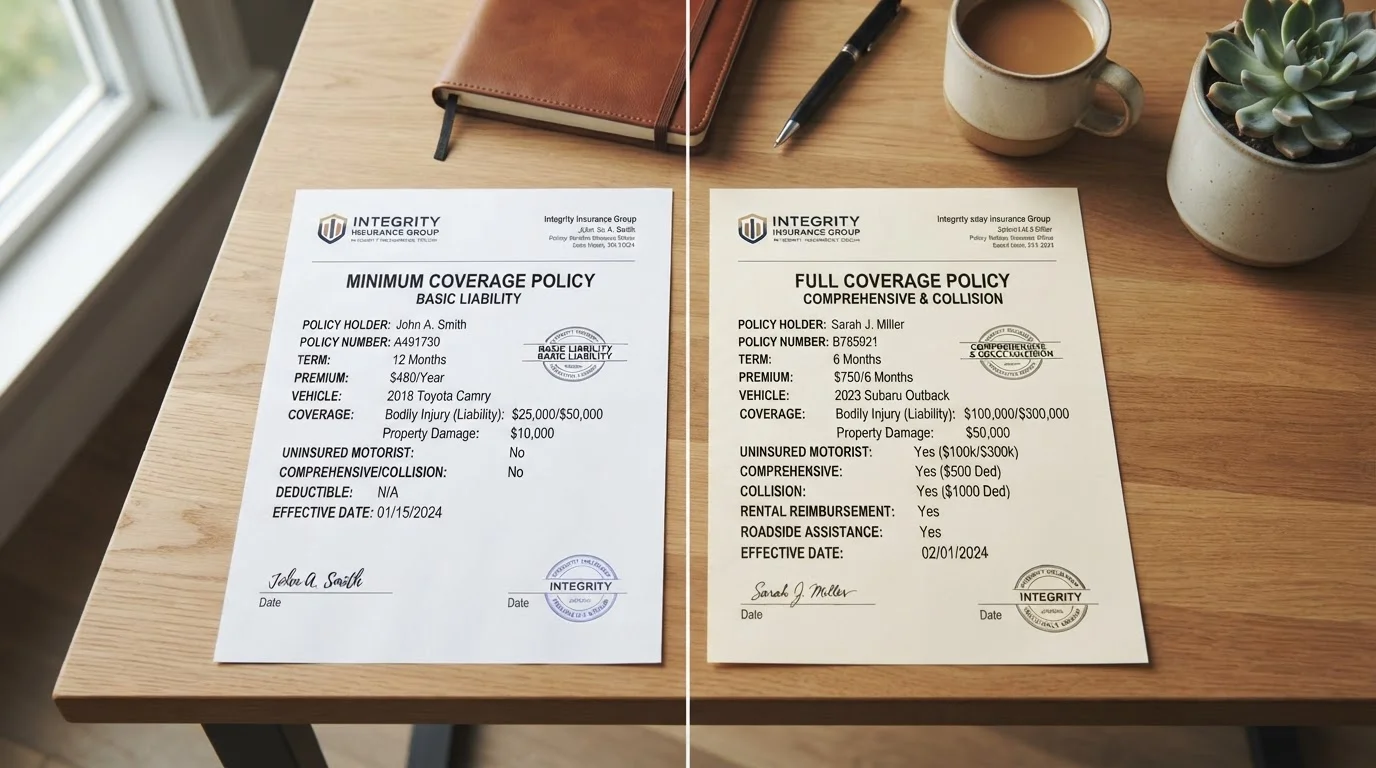
Key Takeaways
- State minimum coverage only pays for damage you cause to others - your own vehicle and injuries may not be covered.
- Full coverage typically bundles liability, collision, and comprehensive into one policy.
- Lenders generally require full coverage on financed or leased vehicles.
- The premium difference between minimum and full coverage varies significantly by driver profile and vehicle.
- Carrying only minimum coverage can expose drivers to serious out-of-pocket liability after a serious accident.
Option A
State Minimum Coverage
The legally required baseline every driver must carry.
Best for: Drivers with older, low-value vehicles who can absorb out-of-pocket vehicle repair costs.
Option B
Full Coverage
A broader protection package that extends well beyond liability.
Best for: Drivers with financed vehicles, newer cars, or limited financial cushion for unexpected repair bills.
If you own an older, low-value vehicle outright
State Minimum Coverage
When a vehicle's market value is low, the cost of collision and comprehensive coverage may exceed what you'd ever recover in a claim. Minimum coverage keeps you legal at lower cost.
If your vehicle is financed or leased
Full Coverage
Lenders typically require collision and comprehensive coverage for the life of the loan or lease. Dropping below those requirements can trigger a lender-placed policy, often at higher cost.
If you lack emergency savings to cover vehicle repairs or medical bills
Full Coverage
Without a financial buffer, an accident involving your own vehicle or injuries could create significant debt. Broader coverage transfers that financial risk to the insurer.
If you drive in a high-traffic or high-theft area
Full Coverage
Comprehensive coverage addresses theft, vandalism, and weather events - risks that increase with urban density and regional factors minimum policies completely ignore.
What Each Coverage Level Actually Includes
State minimum coverage is exactly what it sounds like: the lowest level of insurance your state legally permits you to carry. In most states, that means bodily injury liability - which pays for injuries you cause to other people - and property damage liability, which pays for damage you cause to other vehicles or structures. Neither covers your own vehicle or your own medical bills.
Full coverage is an industry term, not a defined policy type. In practice, it refers to a policy that combines liability coverage with collision coverage (repairs to your vehicle after an accident regardless of fault) and comprehensive coverage (repairs or replacement for events like theft, hail, flooding, or animal strikes). Some full coverage policies also include medical payments coverage or personal injury protection, depending on the state and insurer.
For a complete breakdown of what each coverage type protects against, see our full auto insurance guide.
Minimum Requirements Vary by State
Every U.S. state sets its own minimum liability limits, and some states also require personal injury protection (PIP) or uninsured motorist coverage. What qualifies as "legal" in one state may fall short of another's baseline. Always verify your own state's current requirements through your state's department of motor vehicles or insurance commissioner.
Head-to-Head: Key Differences at a Glance
The table below shows how the two approaches compare across the coverage areas that matter most to most drivers.
| Criterion | State Minimum Coverage | Full Coverage |
|---|---|---|
| Bodily injury liability | Included (state-mandated limits) | Included (often higher limits) |
| Property damage liability | Included (state-mandated limits) | Included (often higher limits) |
| Collision coverage | Not included | Included |
| Comprehensive coverage | Not included | Included |
| Your vehicle's repair costs | Not covered | Covered (subject to deductible) |
| Required for auto loans/leases | No | Typically yes |
| Premium cost | Lower | Higher |
| Financial risk if at fault | High - you pay above limits | Lower - broader protection |
One frequently overlooked gap in minimum-only policies: neither standard liability type provides any protection when the driver who hits you carries no insurance or inadequate coverage. That gap is addressed by a separate add-on - uninsured and underinsured motorist coverage - which is worth understanding regardless of what base policy you carry.
The Real Financial Risk of Minimum Coverage
The core problem with state minimum coverage isn't that it's illegal - it isn't. The problem is that minimum limits are often too low to cover the actual cost of a serious accident. A common minimum bodily injury limit is $25,000 per person, but hospital bills from a significant collision can dwarf that figure. Once a claim exceeds your policy limit, you may be personally responsible for the difference.
1 in 8
Drivers on U.S. roads are uninsured
According to the Insurance Research Council, roughly one in eight drivers carried no insurance - a risk that minimum-only policyholders face without uninsured motorist coverage.
$23,900+
Average cost of an injury claim
The Insurance Information Institute reports that the average bodily injury liability claim regularly exceeds state minimum liability limits, leaving minimum-coverage drivers potentially exposed.
~30%
Typical premium increase for full vs. minimum coverage
Premium differences vary widely by driver, vehicle, and location, but industry analyses commonly show full coverage costing substantially more than minimum-only policies.
If you're weighing cost savings against coverage adequacy, it also helps to understand which specific trade-offs tend to hurt drivers most. Our piece on coverage decisions that often come back to haunt drivers examines common gaps people regret only after a claim.
When Full Coverage Makes Sense - and When It May Not
The case for full coverage is strongest when the financial downside of going without it is real. That includes anyone still making payments on a vehicle - lenders require collision and comprehensive precisely because the vehicle serves as loan collateral. It also includes drivers who couldn't absorb a multi-thousand-dollar repair bill without significant financial strain.
The case for sticking with minimum coverage is narrower but legitimate. If your vehicle's current market value is low - say, under $4,000-$5,000 - the math sometimes tips against paying for collision and comprehensive. An insurer's payout is capped at the vehicle's actual cash value, so annual premiums plus a deductible can approach or exceed a potential claim. To understand exactly how collision and comprehensive pay out in different scenarios, see our collision vs. comprehensive breakdown.
Ultimately, this decision intersects with broader budgeting priorities. Thoughtful spending and budgeting strategies can help you assess whether a higher monthly premium is manageable - or whether building a self-insurance fund makes more sense for your situation.
This article provides general insurance information for educational purposes only and is not personalized insurance, financial, or legal advice. Coverage terms, requirements, and costs vary by state and insurer. Consult a licensed insurance professional and review actual policy documents before making coverage decisions.