

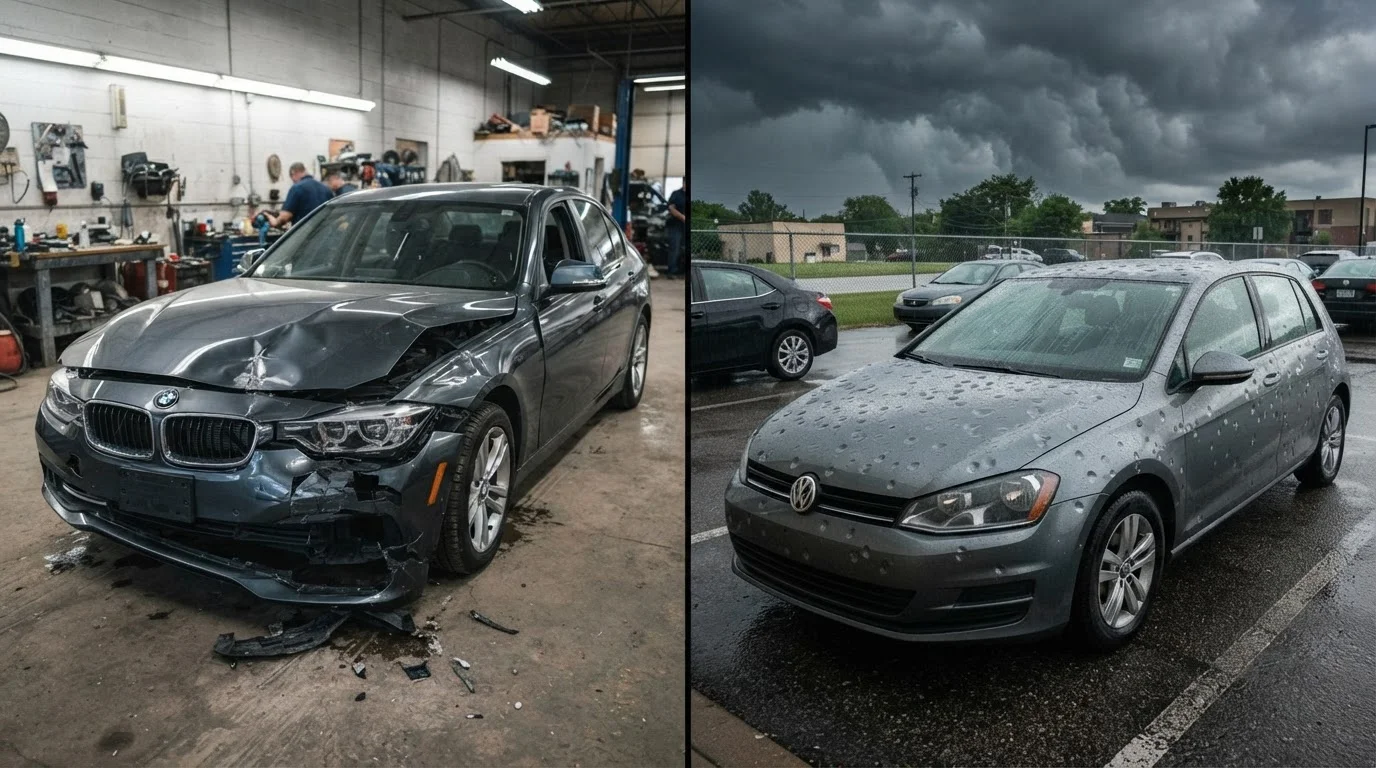
Key Takeaways
- Collision covers damage from crashes with other vehicles or objects, regardless of fault.
- Comprehensive covers non-collision events like theft, weather, fire, and animal strikes.
- Both coverages are typically optional unless required by a lender or lease agreement.
- Each has a separate deductible that you pay before your insurer contributes to a claim.
- Your car's value relative to your premium and deductible should guide your coverage decision.
Option A
Collision Coverage
The coverage that responds when your car hits something - or gets hit.
Best for: Drivers who want protection when they're involved in an at-fault accident or single-vehicle crash.
Option B
Comprehensive Coverage
The coverage that protects against events beyond driver control.
Best for: Drivers who want protection from theft, weather damage, animal strikes, and other non-collision events.
If you're financing or leasing your vehicle
Both Collision and Comprehensive Coverage
Most lenders and leasing companies require both coverages to protect their financial interest in the vehicle.
If your car's market value is low relative to your deductible
Neither - evaluate carefully
When a car's value is only marginally higher than your deductible, the financial case for either coverage weakens significantly.
If you live in an area with high vehicle theft or severe weather
Comprehensive Coverage
Comprehensive responds to theft, flooding, hail, and other environmental risks that collision coverage won't touch.
If you're a new or high-mileage driver in urban traffic
Collision Coverage
More time on the road and in dense traffic increases the statistical likelihood of a crash - collision coverage addresses exactly that risk.
If you want the broadest possible vehicle protection
Both Collision and Comprehensive Coverage
Together, they cover the widest range of physical damage scenarios, from accidents to acts of nature.
What Each Coverage Actually Does
Auto insurance policies can look like a maze of overlapping terms. Collision and comprehensive are two of the most commonly misunderstood - largely because both pay for physical damage to your own vehicle, yet they respond to entirely different situations.
Collision coverage pays for damage to your car when it makes impact with another vehicle or a stationary object - a guardrail, a telephone pole, or another parked car. It applies whether you caused the accident or not, and it also covers single-vehicle incidents like rolling into a ditch.
Comprehensive coverage handles everything outside of a collision. That includes theft, vandalism, fire, flooding, hail, falling trees, and animal strikes - hitting a deer, for instance, falls under comprehensive, not collision. Think of it as protection against events largely outside your control as a driver.
For a broader look at how these fit into your overall policy, see our guide to auto insurance basics.
| Criterion | Collision Coverage | Comprehensive Coverage |
|---|---|---|
| What triggers a claim | Impact with vehicle or object | Theft, weather, fire, animal strike |
| Fault required? | No - applies regardless of fault | No - non-collision events |
| Typical premium cost | Generally higher | Generally lower |
| Deductible applies? | Yes, per claim | Yes, per claim |
| Required by state law? | No | No |
| Required by lenders/lessors? | Usually yes | Usually yes |
| Covers deer strike? | No | Yes |
| Covers flood damage? | No | Yes |
| Covers rollover accident? | Yes | No |
Deductibles, Premiums, and What You'll Actually Pay
Both collision and comprehensive come with a deductible - the amount you pay out of pocket before your insurer covers the rest. Deductibles are set per claim, not per year, and are chosen when you buy or renew your policy. Common ranges run from $250 to $1,500, though options vary by insurer.
A higher deductible lowers your monthly premium but increases your out-of-pocket cost when you file a claim. A lower deductible works the reverse way. There's no universally right choice - it depends on your cash reserves and how much risk you're comfortable carrying.
~$522/yr
Average US collision coverage premium
According to the National Association of Insurance Commissioners (NAIC), average collision premiums have risen steadily alongside vehicle repair costs.
~$182/yr
Average US comprehensive coverage premium
NAIC data consistently shows comprehensive premiums are significantly lower than collision premiums for most drivers.
6 in 10
Insured vehicles with both coverages
Industry estimates suggest a majority of insured vehicles carry both collision and comprehensive, partly driven by lender requirements.
Collision premiums are generally higher than comprehensive premiums. Crashes are statistically more frequent than catastrophic weather events or theft for most drivers, which drives up the actuarial risk - and therefore the cost.
It's worth knowing that if your car is declared a total loss, your insurer pays the actual cash value (ACV) of the vehicle minus your deductible - not the replacement cost. Understanding how your car gets valued after a loss is important; our article on agreed value vs. actual cash value explains this in detail.
When You're Required to Carry Both
Neither collision nor comprehensive is mandated by state law in the US - states require liability coverage, not physical damage coverage for your own vehicle. However, if you're financing or leasing, your lender almost certainly requires both. This protects the lender's financial stake in a vehicle they technically co-own until the loan is paid off.
Once a vehicle is paid off, the requirement disappears and the decision becomes yours. That's when many drivers start asking whether dropping one or both coverages makes financial sense. Our breakdown of state minimum vs. full coverage addresses exactly that trade-off.
Lender Requirements Don't End at Purchase
Even if your loan balance drops significantly, lenders typically require collision and comprehensive until the loan is fully paid off - not just until you reach a certain equity threshold. Always check your loan agreement directly rather than assuming you've met the threshold. Dropping required coverage can trigger a lender-placed insurance policy, which is often more expensive and less favorable than coverage you'd choose yourself.
If you drop collision on an older vehicle to save on premiums, understand that any at-fault accident - or single-vehicle incident - means the repair cost comes entirely out of pocket. The coverage decisions that can backfire are often the ones made without fully accounting for this.
Making the Call: Keep, Drop, or Adjust?
A commonly cited rule of thumb is to reconsider physical damage coverage when your annual premium for that coverage approaches 10% of the vehicle's market value - but this is a general guideline, not a financial formula suited to every situation. Your driving environment, financial cushion, and risk tolerance all matter.
If you live somewhere with high rates of vehicle theft or frequent severe weather, comprehensive may offer meaningful protection even on a paid-off car. If your vehicle has depreciated significantly and you have savings to absorb a loss, dropping collision may make practical sense.
Drivers who financed with little down may also want to look at gap insurance, which covers the difference between what you owe on a loan and what your insurer pays if the car is totaled. It's a separate product from collision and comprehensive but often relevant in the same conversation.
For a fuller picture of how these coverages interact with liability and other policy components, see our comparison of the three core coverage types.
This article is for general informational purposes only and does not constitute personalized insurance, financial, or legal advice. Coverage terms, availability, and costs vary by insurer, policy, and state. Consult a licensed insurance professional to evaluate coverage options suited to your specific situation.