

Key Takeaways
- Liability coverage pays for damage and injuries you cause to others - it does not cover your own vehicle.
- Collision coverage pays to repair or replace your car after an accident, regardless of who was at fault.
- Comprehensive coverage handles non-collision events like theft, weather damage, and animal strikes.
- Most lenders require both collision and comprehensive if you're financing or leasing a vehicle.
- Each coverage type carries its own deductible and limit, which directly affects your premium.
Our Verdict
No single coverage type is sufficient on its own for most drivers. Liability is legally required nearly everywhere, but it leaves your own vehicle unprotected. Collision and comprehensive fill different but complementary gaps. The right combination depends on your vehicle's value, financing status, and financial tolerance for out-of-pocket loss.
| Best for | Recommended |
|---|---|
| Drivers with older vehicles they own outright | Liability only (with optional collision/comprehensive if vehicle value justifies it) |
| Those financing or leasing a vehicle | Liability + Collision + Comprehensive (typically lender-required) |
| Drivers in areas prone to weather events, wildlife, or vehicle theft | Liability + Comprehensive |
| Those seeking the broadest everyday financial protection | All three coverage types combined |
Why These Three Coverage Types Form the Foundation
Auto insurance policies are built from individual coverage components, each designed to handle a specific category of risk. Liability, collision, and comprehensive are the three core building blocks that appear on the vast majority of personal auto policies in the United States. Understanding what each one actually does - and what it explicitly does not cover - is essential before deciding how to structure your policy.
These coverage types are not interchangeable. They respond to different events, involve different parties, and serve fundamentally different financial purposes. Conflating them is one of the most common reasons drivers end up with gaps they only discover after a loss.
For a deeper look at how coverage decisions connect to your overall budget, the Smarter Budgeting hub offers practical frameworks for evaluating costs and trade-offs across major purchases.
Liability Coverage: Protecting Others From Your Mistakes
Liability coverage pays for bodily injury and property damage that you cause to other people in an at-fault accident. If you run a red light and hit another vehicle, your liability coverage pays for the other driver's medical bills, lost wages (up to policy limits), and damage to their car. It does not pay anything toward your own injuries or your own vehicle's repairs.
Every U.S. state except New Hampshire requires drivers to carry a minimum level of liability coverage. Those minimums vary considerably by state and are often expressed as split limits - for example, $25,000 per person / $50,000 per accident for bodily injury, plus $25,000 for property damage. Meeting the state minimum is a legal floor, not a financial safety net. If your liability limits are exhausted, you may be personally responsible for the remainder.
State Minimums Often Leave You Underprotected
The minimum liability limits set by your state may not come close to covering a serious accident. Medical costs and vehicle repair bills can quickly exceed $25,000 per person limits, leaving you personally liable for the difference. Review your limits carefully - carrying only what's legally required is a legal baseline, not a financial strategy.
To understand the broader picture of what state minimums actually protect - and what they leave exposed - see State Minimum vs. Full Coverage.
Collision Coverage: Repairing Your Vehicle After an Accident
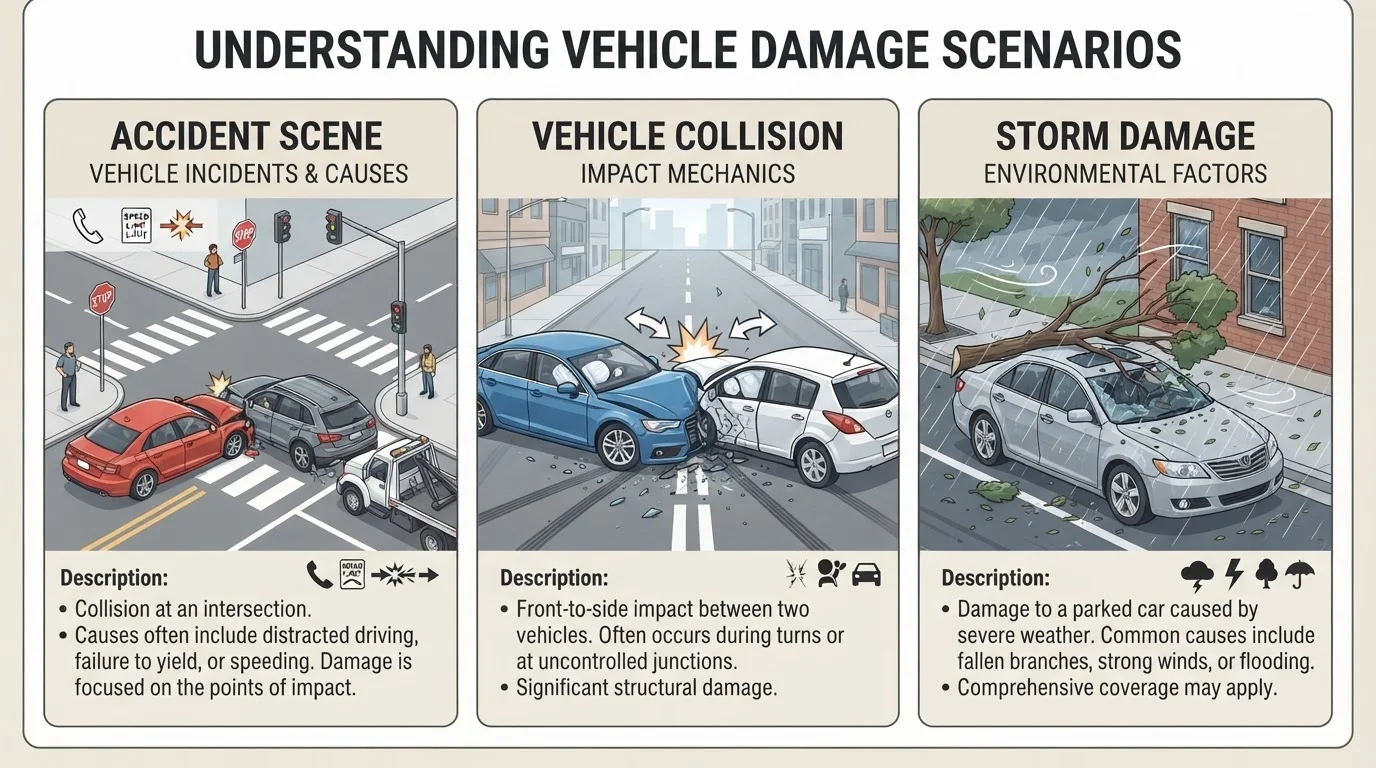
Collision coverage pays to repair or replace your vehicle when it's damaged in an accident - whether you collide with another car, a guardrail, or a stationary object. Fault is largely irrelevant: if your car is damaged in a collision, this coverage responds regardless of who caused the accident (though your insurer may pursue the at-fault party separately through a process called subrogation).
Collision coverage comes with a deductible - commonly ranging from $250 to $1,500 - which you pay out of pocket before the insurer covers the rest. Choosing a higher deductible lowers your premium but increases what you'll owe after a claim. Your insurer pays up to the actual cash value of your vehicle, not the original purchase price.
Weigh Your Vehicle's Value Before Adding Collision
If your car's actual cash value is relatively low, the annual cost of collision coverage - plus your deductible - might approach or exceed what you'd collect after a total loss. A general rule of thumb: if the coverage costs more than 10% of the vehicle's market value annually, it may warrant reconsideration. Always run the numbers for your specific situation.
For a detailed side-by-side breakdown of how collision and comprehensive differ in specific scenarios, see Collision vs. Comprehensive: When Each Pays Out.
Comprehensive Coverage: Handling What Isn't a Collision
Comprehensive coverage - sometimes called "other than collision" - pays for vehicle damage caused by events outside of a traffic accident. Covered perils typically include theft, vandalism, fire, hail, flooding, falling objects, and collisions with animals (such as hitting a deer). If a tree branch falls on your parked car overnight, comprehensive is the coverage that responds.
Like collision, comprehensive carries a deductible and pays up to the vehicle's actual cash value. Because it covers a wide range of lower-probability events, comprehensive premiums tend to be lower than collision premiums for most drivers - though this varies by location, vehicle, and insurer.
If you're financing a vehicle and want to understand how gap coverage layers on top of comprehensive after a total loss, Gap Insurance: What It Covers and Who It's For explains when that additional protection is relevant.
| Liability | Collision | Comprehensive | |
|---|---|---|---|
| What it covers | Damage/injury you cause to others | Your vehicle in a collision | Non-collision damage to your vehicle |
| Covers your own car? | No | Yes | Yes |
| Fault requirement | You must be at fault | Fault not required | Fault not applicable |
| Example events | At-fault accident injuring others | Collision with car or object | Theft, hail, flooding, animal strike |
| Deductible applies? | No | Yes | Yes |
| Legally required? | Yes, in nearly all states | No (lender may require) | No (lender may require) |
Choosing the Right Combination for Your Situation
Most drivers need at least liability coverage to legally operate a vehicle. Whether to add collision, comprehensive, or both depends on several practical factors: the age and market value of your vehicle, whether you have a loan or lease, your local environment (high-theft area, severe weather region), and how much financial risk you're willing to absorb out of pocket.
It's also worth noting that liability coverage alone leaves a significant gap when the other driver is uninsured or underinsured. For context on that specific risk, Uninsured and Underinsured Motorist Coverage explains how that protection works and why many drivers underestimate the need for it.
This article is for general informational purposes only and does not constitute personalized insurance advice. Coverage terms, requirements, and availability vary by state and provider. Consult a licensed insurance agent or adviser to evaluate options appropriate to your specific situation.