

Key Takeaways
- Monthly visual checks - fluids, tires, lights - catch most problems before they become expensive.
- Your owner's manual is the most reliable maintenance schedule for your specific vehicle.
- Dashboard warning lights should never be ignored, even if the car feels fine to drive.
- Skipping routine services has a compounding effect on long-term reliability and repair costs.
- Many basic checks take under ten minutes and require no tools or mechanical knowledge.
Start here
Why the Dealership Doesn't Teach You This
Next
The Checks You Should Do Every Month
Then
Understanding Your Service Schedule
Watch for
Warning Signs That Need Immediate Attention
Build on it
Building Habits That Protect Your Car Long-Term
Why the Dealership Doesn't Teach You This
Buying your first car involves a lot of paperwork, a lot of handshaking, and very little time spent explaining what happens after you drive off the lot. Dealerships are structured around the sale - not around turning you into a confident vehicle owner. That gap is where most new drivers run into trouble.
The reality is that basic maintenance knowledge isn't difficult to acquire, but it's rarely offered proactively. If you're also navigating a financing agreement for the first time, see what first-time buyers often misunderstand about car loans to make sure the full cost of ownership is part of your thinking from the start.
Owner's manual
The booklet that comes with your vehicle outlining how it works, what it needs, and when. It contains maintenance schedules specific to your make and model - always the first place to check.
Dipstick
A long metal rod in the engine bay used to check oil level. You pull it out, wipe it, reinsert it, then pull it again to see where the oil sits on the marked scale.
Service interval
The mileage or time period between scheduled maintenance visits, as specified by the manufacturer. Common examples include oil changes and tire rotations.
Tire pressure (PSI)
PSI stands for pounds per square inch - the unit used to measure how inflated your tires are. The correct PSI for your car is set by the manufacturer, not by the tire maker.
Coolant
A liquid that circulates through the engine to prevent it from overheating. Also called antifreeze. It's stored in a plastic reservoir in the engine bay with MIN and MAX markings.
Check engine light
A dashboard indicator that signals the car's onboard computer has detected a fault somewhere in the engine or emissions system. A mechanic can read the stored fault code to diagnose the cause.
The Checks You Should Do Every Month
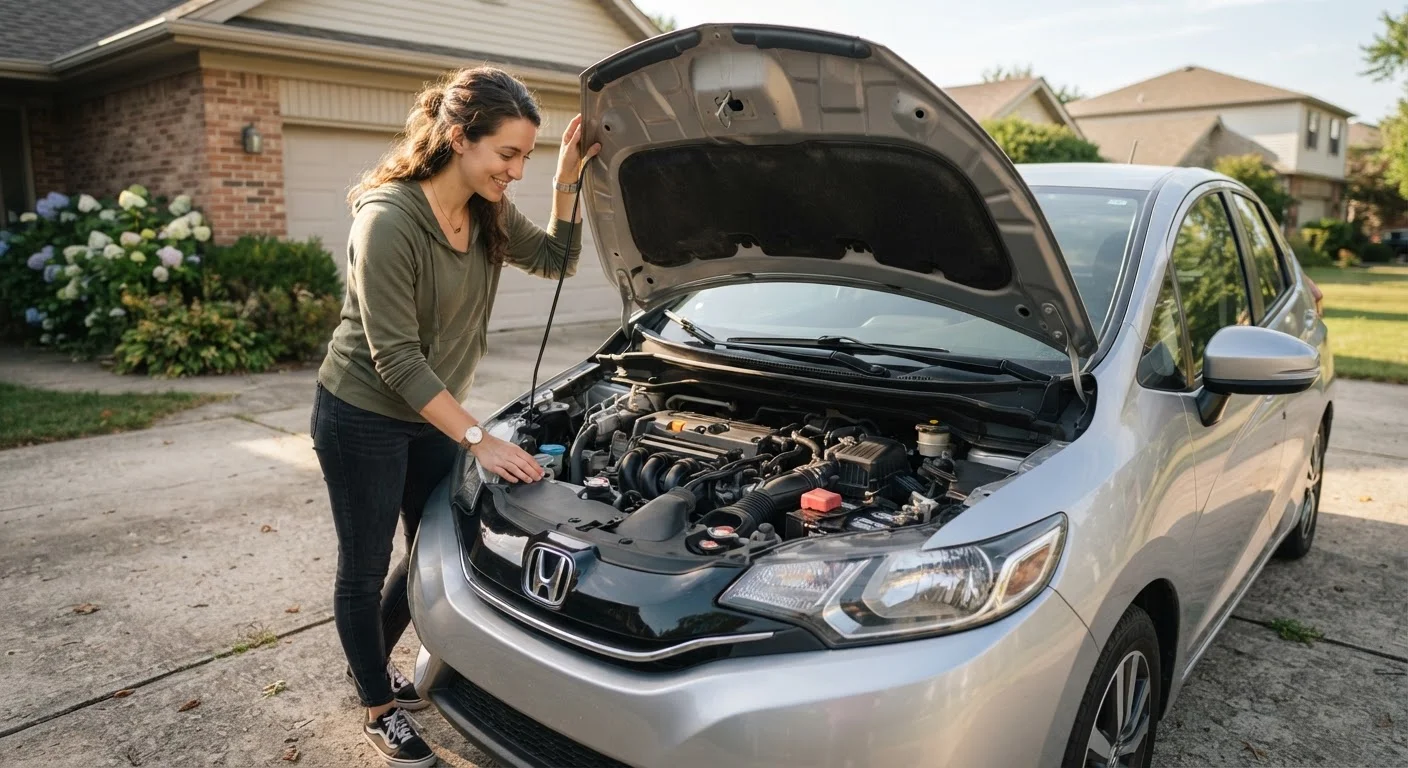
A monthly routine of simple checks is the single highest-value habit a new driver can build. None of these require tools, and together they take about ten minutes.
- Engine oil: Check the level and color using the dipstick with the engine cold. Add oil of the type specified in your owner's manual if the level is low. Dark, gritty oil that smells burnt may mean it's due for a change.
- Coolant: Check the plastic reservoir near the radiator. The level should fall between the MIN and MAX markers. Never open the radiator cap when the engine is hot.
- Tire pressure: Use a gauge to check all four tires - including the spare if your car has one. The correct pressure is on the sticker inside the driver's door jamb, not on the tire sidewall.
- Windshield washer fluid: The one fluid you can safely top up yourself with no risk of mechanical error.
- Lights: Walk around the car and confirm that all headlights, brake lights, and turn signals are working. A burned-out brake light is both a safety issue and a traffic stop waiting to happen.
Make It a Habit, Not a Chore
Link your monthly check to something you already do reliably - like the first day of each month or whenever you fill the gas tank. Keep a tire pressure gauge in the glove box so it's always on hand. Small prompts eliminate the reason to skip.
Understanding Your Service Schedule
Your owner's manual contains a maintenance schedule tailored to your exact vehicle - and it's worth reading at least once. It lists service intervals in miles and months, and specifies which fluids, filters, and components need attention at each stage.
Common scheduled services include oil and filter changes, tire rotations, air filter replacements, brake inspections, and transmission fluid checks. Intervals vary widely by vehicle and driving conditions, so the manual is always more reliable than generic advice.
One persistent source of confusion: the traditional 3,000-mile oil change rule. Modern engines and synthetic oils have largely made that interval obsolete for most vehicles - but many drivers still follow it unnecessarily. Car maintenance myths that may be costing you money covers this and other outdated assumptions in more detail.
Skipping services has consequences that build over time. What happens when you fall behind on your service schedule explains the compounding effect on reliability and repair costs.
Severe vs. Normal Driving Conditions
Owner's manuals often list two maintenance schedules: one for normal conditions and one for severe driving. Severe conditions include frequent short trips, stop-and-go traffic, dusty environments, or towing. If your typical driving matches any of these, the shorter service interval applies to your vehicle.
Warning Signs That Need Immediate Attention
Dashboard warning lights are the car's way of flagging a problem it can't fix on its own. The instinct to ignore them - especially when the car still drives fine - is one of the more expensive mistakes new owners make.
- Check engine light: Can indicate anything from a loose fuel cap to a more serious engine or emissions fault. Have it read by a mechanic or an auto parts store with a code reader.
- Oil pressure warning: Pull over safely and turn the engine off. Driving with low oil pressure can cause severe engine damage within minutes.
- Temperature warning: Indicates the engine is overheating. Stop driving, let the engine cool, and check coolant levels before continuing - or call for assistance.
- Brake warning light: Could mean low brake fluid or a fault in the brake system. Don't delay having this checked.
Beyond the dashboard, pay attention to sounds and sensations: grinding when braking, pulling to one side, vibration at highway speed, or a smell of burning when the car is parked. These are the car communicating through channels that don't involve warning lights.
Never Ignore an Oil Pressure Warning
If the oil pressure warning light comes on while you're driving, pull over safely and shut the engine off as soon as it's safe to do so. Continuing to drive - even for a short distance - can cause catastrophic engine damage that is not covered by most standard warranties. Call for roadside assistance if needed.
Building Habits That Protect Your Car Long-Term
Maintenance isn't only about what you do in the driveway - it's also about how you drive. Aggressive acceleration, late braking, and consistently overloading the vehicle all accelerate wear on components that are expensive to replace. Driving and ownership habits that extend a car's life goes deeper on the behavioral side of vehicle care.
For tasks beyond the basics, it helps to know where the sensible boundary sits between DIY and professional work. Which car maintenance jobs you can do yourself gives a clear framework for that decision.
Finally, make sure your insurance coverage matches your actual situation. As a new driver, your risk profile and coverage needs may differ from more experienced owners. Understanding auto insurance types and coverage options is a straightforward starting point.
The most important thing a new driver can do is stay engaged with their vehicle. A car that's paid attention to rarely surprises you.