

Key Takeaways
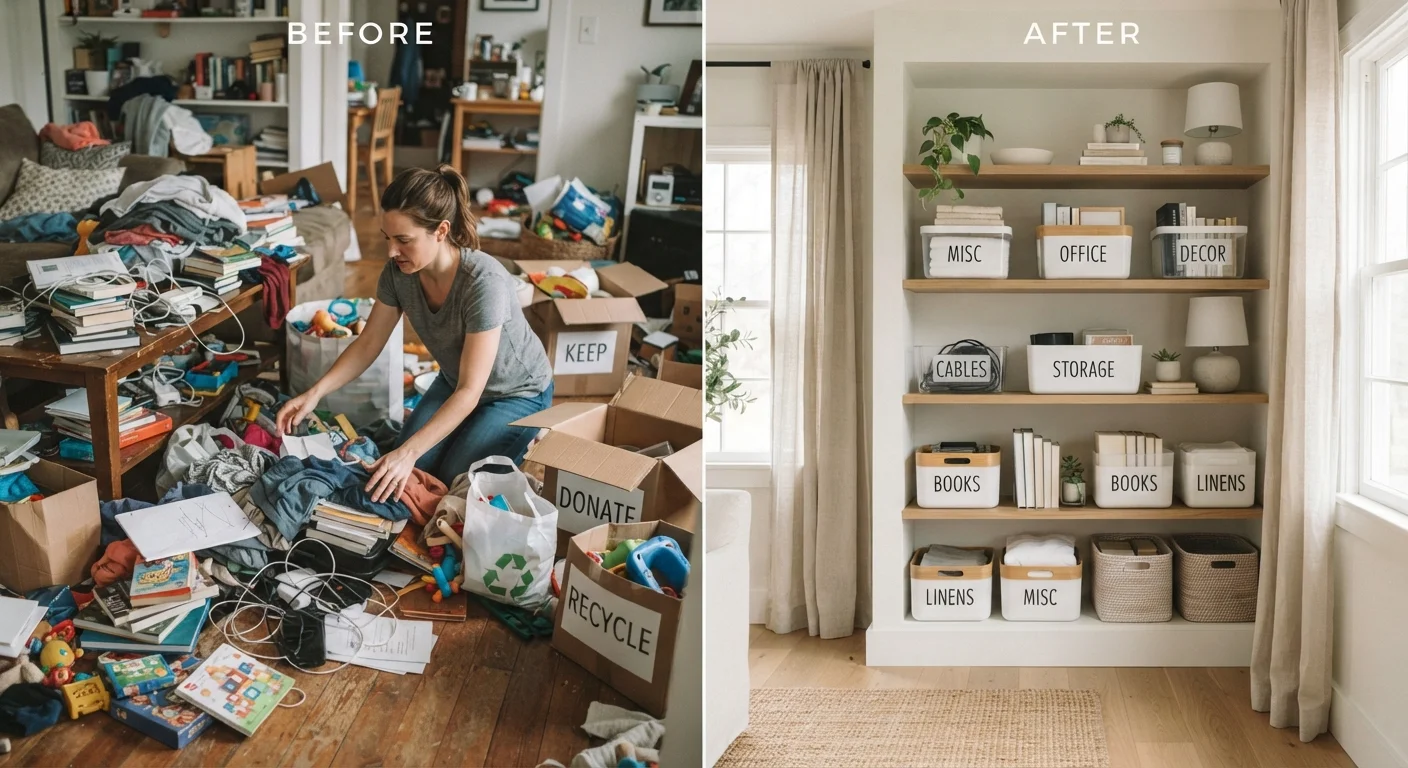
- Decluttering means deciding what to keep, donate, or discard - before any storage system is built.
- Organizing means creating a logical, sustainable home for the items you've already decided to keep.
- Doing these in the wrong order - organizing first - wastes time and money on storing things you may not need.
- Clutter is a volume problem; disorganization is a systems problem. Each requires a different solution.
- Most homes benefit from repeated cycles of both, not a single one-time effort.
Option A
Decluttering
The essential first step - reducing what you own.
Best for: Anyone who has accumulated more possessions than their space or lifestyle can reasonably accommodate.
Option B
Organizing
The purposeful second step - arranging what remains.
Best for: People who have already edited their belongings and need a reliable, maintainable system for what stays.
If your home feels stuffed no matter how many bins or baskets you add
Decluttering
More storage won't solve a volume problem. Reducing what you own is the only lasting fix when space feels perpetually overwhelmed.
If you've already pared down your possessions but still can't find things easily
Organizing
When you own a manageable amount but lack a logical system, organizing addresses the real gap - structure, not quantity.
If you're preparing for a move, renovation, or major life change
Decluttering
Transitional moments are the most efficient time to reduce. Moving only what you genuinely need saves both effort and space.
If a specific area - a pantry, wardrobe, or home office - works but feels chaotic
Organizing
Zone-specific disorganization is a systems issue. Thoughtful categorization and designated homes for items can resolve it without purging.
Two Different Problems, Two Different Solutions
It's easy to conflate decluttering and organizing - both involve handling your belongings, and both promise a tidier home. But they solve fundamentally different problems, and confusing them is one of the most common reasons people feel stuck after spending a weekend working on their space.
Decluttering is a decision-making process. Its goal is to reduce the total volume of what you own by identifying what no longer serves you - items that are broken, duplicated, outdated, or simply taking up space without contributing value. The output of decluttering is a smaller, more intentional collection of possessions.
Organizing is a systems-design process. Its goal is to create logical, accessible homes for the items you've already decided to keep. Good organization means that every object has a designated place, and that place makes practical sense given how you actually use your home.
Understanding this distinction matters because the two steps build on each other in a specific order. Common organizing myths often lead people to skip straight to buying storage solutions - an approach that organizes clutter rather than eliminating it. The result is a tidy-looking space that still feels overwhelming, because too much stuff is simply being hidden more neatly.
Clutter vs. Mess: A Useful Distinction
Mess is temporary disorder - dishes in the sink, laundry on the chair. Clutter is structural excess - more than your space or lifestyle can accommodate. Tidying addresses mess. Decluttering addresses clutter. Organizing addresses neither of those directly; it creates the systems that prevent both from recurring.
How to Tell Which Problem You Actually Have
Before committing time and energy to either process, it helps to diagnose your situation accurately.
Ask yourself: If I had half the items in this space, would it feel manageable? If yes, you likely have a clutter problem - a volume issue that no amount of labeling or bin-buying will fix. Research into how physical environments affect us suggests that excess objects in a space can contribute to a sense of mental overload; the psychology of clutter is worth understanding before you start.
Now ask: Do I own a reasonable number of things, but regularly lose track of them or run out of space in illogical ways? If yes, the problem is structural - you need an organizing system, not a purge.
Many homes have both problems in different rooms or categories. A kitchen might be genuinely overstocked with gadgets (a clutter problem), while a home office might have a sensible amount of supplies arranged in a way that makes retrieval difficult (an organizing problem).
| Criterion | Decluttering | Organizing |
|---|---|---|
| Core question | Should I keep this? | Where should this live? |
| Problem it solves | Too much stuff | No logical system |
| Primary action | Sort, decide, remove | Categorize, assign, arrange |
| Tools needed | Donate bags, trash bags | Storage containers, labels |
| When to do it | First | After decluttering |
| Outcome | Fewer possessions | Better-arranged possessions |
| Can be ongoing? | Yes - revisit seasonally | Yes - refine as life changes |
Why Sequence Matters: Declutter Before You Organize
Professional organizers consistently recommend completing the decluttering phase before introducing any new storage or organizational systems - and there's a practical reason for that order.
When you organize first, you're building a system around an unknown quantity. You might buy twelve storage bins only to find, once you've sorted through everything, that you only needed four. You may assign permanent homes to items you'd have discarded had you looked at them more critically. And you may spend hours labeling and arranging things that belong to a version of your life that no longer fits.
Decluttering first gives you an accurate picture of what you actually own and use. That information makes organizing far more efficient - you're sizing the system to reality, not approximation. If you'd like support with a specific area, the wardrobe decluttering guide walks through a practical, room-specific approach without requiring you to empty everything at once.
Once a space is decluttered and organized, the remaining challenge is maintenance. Clutter-prevention habits like the one-in-one-out rule help keep volume in check so the system you build continues to function over time.
80%
Items rarely or never used
Research cited by professional organizing associations suggests the majority of household items are seldom used, reinforcing the value of decluttering before investing in storage.
1 hour
Average daily time lost to disorganization
Surveys on household productivity have found that searching for misplaced items can account for significant lost time each day, a problem that organized systems directly address.
When to Consider Professional Help
Some situations genuinely benefit from outside support. If a space feels so overwhelming that you don't know where to begin, or if emotional attachment to objects is making decisions difficult, a professional organizer can provide both structure and perspective. What professional organizers actually do - and how to assess whether hiring one suits your situation - is worth reviewing before you decide.
Whether you work alone or with help, the goal remains the same: own only what serves your current life, and give everything you keep a logical, accessible place. That combination - fewer things, better arranged - is what actually produces the calm, functional home most people are aiming for.
For a broader grounding in the language and methods behind home organization, the home organization terms reference explains common concepts in plain language, from zone-based storage to category-first sorting methods.