

Key Takeaways
- Systems that reduce friction work better than systems that require perfect behavior from young children.
- Age-appropriate chores and ownership over specific spaces build lasting tidying habits in kids.
- Reducing the total volume of belongings is the single most effective clutter-control strategy.
- A daily reset routine - brief and consistent - prevents chaos from compounding over the week.
- Storage should be designed around how children actually use and return things, not adult convenience.
Why Standard Organizing Advice Falls Short for Families
Most home organization frameworks assume adults as the only users of a space. When children are involved, those systems tend to collapse within days - not because parents aren't trying, but because the systems weren't built for the reality of how kids move through a home. Toys migrate. Snacks appear in unexpected rooms. Backpacks land where they land.
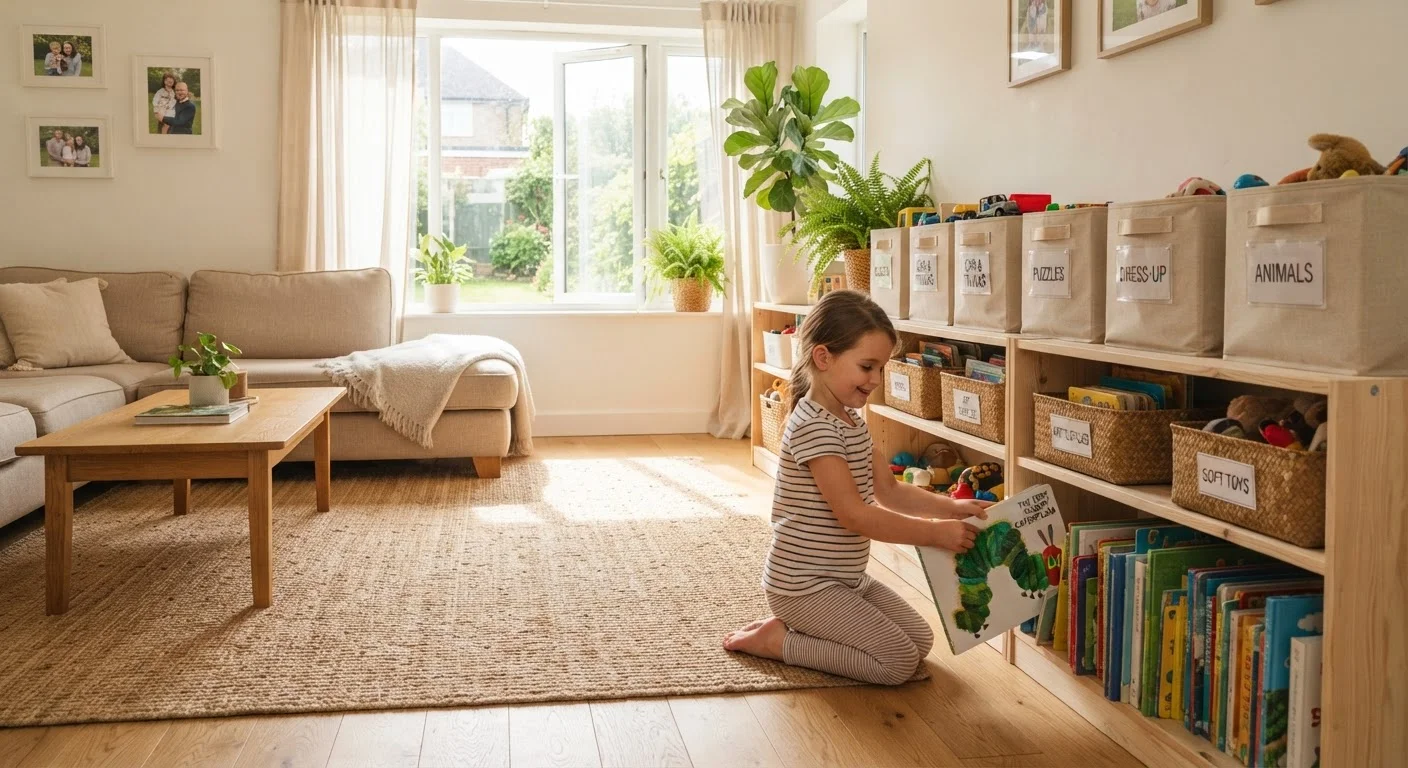
The shift that makes the biggest difference isn't finding more storage - it's designing systems with low barriers to entry. A bin without a lid gets used. A labeled shelf at a child's eye level gets respected. These aren't compromises; they're intentional design choices. For a broader foundation, see our room-by-room home organization guide, which covers strategies suited to any living situation.
Design storage around how children actually return things, not how adults prefer to store them.
If a storage solution requires multiple steps - opening a lid, sorting by subcategory, stacking neatly - children will bypass it consistently. The easier it is to return something, the more often it happens without reminders.
Establish a brief, predictable daily reset at the same time each day.
Consistency converts tidying from a chore into a routine. When the reset happens at a fixed time tied to an existing anchor (meals, bath, bedtime), it requires less negotiation and feels less disruptive to play.
Assign each child ownership over a specific zone or category of items.
Vague responsibility produces vague results. When a child knows that the book shelf is "their job," they're more likely to notice when it's disordered and more motivated to address it.
Rotate toys rather than displaying everything at once.
A smaller selection reduces visual clutter and tends to increase engagement - children play more deeply with fewer items. Rotating also makes the reappearance of stored toys feel novel.
Create a consistent landing zone for items that enter the home daily.
Backpacks, shoes, jackets, and lunchboxes dropped at the door create cascading disorder if there's no designated home for them. A defined drop zone near the entry prevents these items from migrating through the house.
Building Routines Kids Can Actually Follow
Children thrive on predictability, and tidying is no exception. A short daily reset - 10 to 15 minutes before dinner or bedtime - prevents disorder from compounding. When the routine happens at the same time every day, it becomes automatic rather than adversarial. Framing it as "putting things to sleep" or "returning things home" resonates better with younger children than instructions to clean up.
Make the Reset Feel Manageable
Instead of calling it "clean up time," frame the reset around returning things to where they sleep or live. For young children especially, language that personalizes objects reduces resistance. Using a consistent song or timer also signals the start and end of the task clearly, which helps children who struggle with open-ended requests.
Assigning ownership over specific zones or categories gives children a concrete sense of responsibility. A five-year-old can be responsible for returning books to the shelf; an eight-year-old can manage their own bedroom floor. The goal isn't a perfect result - it's building the habit of participation. Over time, that participation pays off in ways that no organizational product ever could.
The Role of Volume Control and Smarter Storage
No storage system can outpace an unchecked volume of belongings. Periodically rotating toys - keeping some accessible and storing others out of sight - reduces visible clutter and often increases how much children actually engage with what's available. A smaller selection gets more attention than an overwhelming one.
3-4 years
Age children can begin consistent tidying routines
Child development research generally supports that children as young as three can participate in simple sorting and returning tasks when expectations are clearly defined and modeled.
~40%
Reduction in visible clutter from toy rotation
Home organization practitioners commonly report that rotating accessible toys by roughly two-thirds meaningfully reduces floor clutter without requiring additional storage space.
When choosing storage, match it to the child's physical ability. Open bins, shallow drawers, and clearly labeled containers remove the friction that causes things to end up on the floor. Our storage solutions for small spaces explores this further, with approaches that work even in compact homes.
Preventing clutter from re-accumulating is its own discipline. The one-in-one-out rule and other clutter-prevention habits offers practical daily habits that keep organized spaces from reverting over time.