

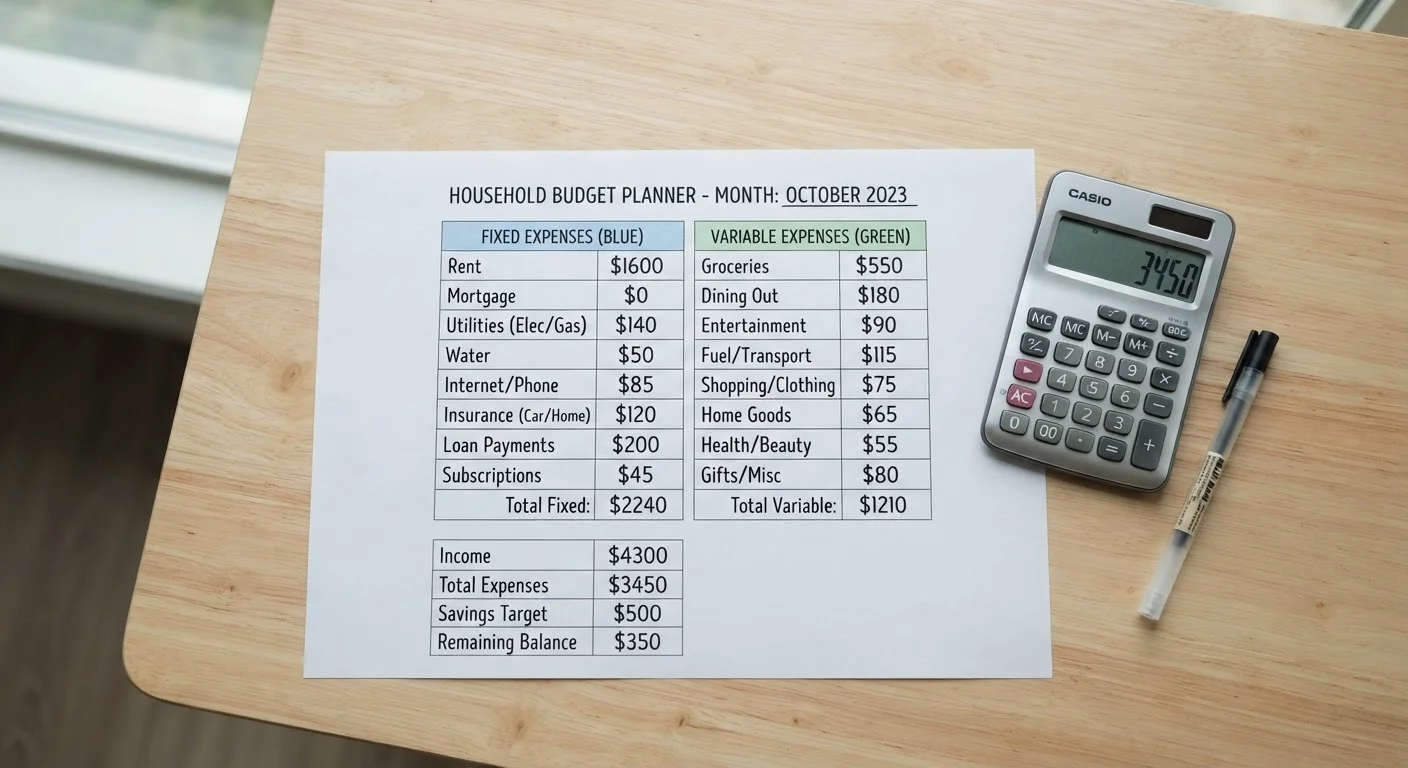
Key Takeaways
- Fixed expenses stay the same amount each billing cycle, making them easy to plan around.
- Variable expenses fluctuate month to month and represent your primary opportunity to adjust spending.
- Both expense types are necessary - the goal is to understand, not eliminate, each category.
- Knowing which costs are fixed helps you set a true spending floor before allocating discretionary money.
- Variable expenses are not the same as unnecessary spending - groceries vary but are essential.
Option A
Fixed Expenses
The predictable, non-negotiable costs in your budget.
Best for: Understanding which costs are stable and must be covered before anything else each month.
Option B
Variable Expenses
The flexible costs that shift with your habits and choices.
Best for: Identifying where your spending has room to adjust when income changes or savings goals shift.
If you want to know exactly how much income you must earn to break even each month
Fixed Expenses
Adding up your fixed expenses gives you an accurate baseline - the minimum monthly income required to keep the lights on and stay current on obligations.
If you're looking for places to reduce spending quickly
Variable Expenses
Variable costs fluctuate by definition, which means they can be adjusted without breaking a contract or missing a fixed obligation. This is where most short-term budget flexibility lives.
If you're building a budget for the first time
Fixed Expenses
Start by listing all fixed costs to establish a reliable spending floor, then layer in variable expenses around what remains of your take-home pay.
If your income changes month to month
Variable Expenses
Variable expense categories can be scaled up or down in response to a lower-income month, making them the natural adjustment lever in an irregular-income budget.
What Makes an Expense Fixed?
A fixed expense is any recurring cost that stays the same amount from one billing cycle to the next, regardless of how much you use a service or how your life changes month to month. Common examples include rent or mortgage payments, car loan installments, health insurance premiums, and subscription services billed at a flat rate.
The defining characteristic is predictability. Because the dollar amount doesn't change, you can plan around fixed expenses with precision. They represent commitments - often contractual - that you cannot easily reduce on short notice without a meaningful consequence, such as breaking a lease or missing a loan payment.
Fixed expenses form your budget's spending floor. Before you allocate a single dollar to groceries, entertainment, or savings, these costs must be covered. Knowing the total amount gives you a concrete answer to the question: what is the minimum I must earn after taxes to meet my obligations? For a refresher on why after-tax income matters here, see our guide to net vs. gross income.
What Makes an Expense Variable?
A variable expense is any cost that changes in amount from month to month. The total depends on your consumption, your choices, or circumstances outside your control. Groceries, utility bills, gasoline, dining out, clothing, and medical co-pays are all variable expenses.
It's important to separate two subcategories that often get conflated:
- Essential variable expenses - costs you cannot eliminate but whose amounts shift (groceries, electricity, gas for commuting). You can reduce these, but you cannot eliminate them.
- Discretionary variable expenses - costs tied to lifestyle choices that can be reduced or paused without serious consequence (restaurant meals, streaming upgrades, hobby supplies).
This distinction matters because variable does not mean optional. Cutting your grocery budget is very different from cutting a streaming service. For a deeper look at how to identify the truly discretionary layer of your spending, see our guide to discretionary spending.
| Criterion | Fixed Expenses | Variable Expenses |
|---|---|---|
| Amount each month | Same every cycle | Changes month to month |
| Predictability | High - easy to plan around | Low to moderate - requires tracking |
| Common examples | Rent, loan payments, insurance premiums | Groceries, utilities, gas, dining out |
| Short-term flexibility | Low - often contractually set | High - can adjust spending quickly |
| Where savings come from | Large decisions (refinance, renegotiate) | Day-to-day spending choices |
| Budget role | Sets your spending floor | Fills remaining discretionary space |
How the Distinction Shapes Your Budget Strategy
Understanding this difference is not just a labeling exercise - it changes how you budget. When income drops or a savings goal demands more resources, you cannot renegotiate your rent or mortgage payment on the spot. What you can do is examine your variable expenses and make deliberate reductions there.
~67%
of US adults live paycheck to paycheck at some point
Research from various consumer finance surveys consistently shows a majority of US households report difficulty covering unexpected expenses, underscoring why knowing your fixed vs. variable costs matters.
3-6 months
of fixed expenses often recommended for an emergency fund
Many personal finance practitioners suggest sizing an emergency fund around your fixed monthly obligations - the costs that continue regardless of income disruption.
Conversely, if you want to lower your fixed costs over time, that requires larger decisions - renegotiating a subscription, refinancing a loan, or moving to less expensive housing. These changes take planning and lead time, but they have a compounding effect: reducing a fixed cost saves you that same amount every single month going forward.
A practical approach used in many budgeting frameworks - including the zero-based and percentage-based methods - is to list fixed expenses first, subtract them from take-home pay, and only then distribute what remains across variable spending categories and savings.
Some Expenses Blur the Line
A few costs don't fit neatly into either category. For example, a cell phone plan may have a fixed base rate plus variable data overage charges. Similarly, a minimum loan payment is fixed, but paying extra toward principal is variable. When categorizing your own expenses, place the predictable minimum in the fixed column and treat any additional amount as variable. This keeps your spending floor accurate without overstating your obligations.
For a broader reference on how essential versus flexible costs map onto your overall budget structure, the discretionary vs. non-discretionary spending reference offers a useful companion framework.
This article is for general informational and educational purposes only and does not constitute personalized financial advice. Consult a qualified financial professional for guidance specific to your situation.