

Key Takeaways
- The 50/30/20 rule splits after-tax income into needs (50%), wants (30%), and savings or debt repayment (20%).
- "Needs" are expenses you cannot avoid; "wants" are discretionary spending choices you make by preference.
- The 20% savings category can cover an emergency fund, retirement contributions, and paying down debt.
- The rule is a starting point, not a rigid prescription - high-cost cities or low incomes may require adjustment.
- Simpler than line-item budgets, it works best for people who want structure without micromanaging every dollar.
The 50/30/20 Rule
The 50/30/20 rule is a budgeting framework that divides your after-tax income into three categories: 50% for needs, 30% for wants, and 20% for savings and debt repayment. It gives you a ready-made structure without requiring detailed expense tracking. The goal is to balance living comfortably today while also building financial stability for the future.
The framework is commonly attributed to U.S. Senator Elizabeth Warren and her daughter Amelia Warren Tyagi, who outlined it in their 2005 book 'All Your Worth.' It uses after-tax (net) income as its baseline, not gross income.
How the Three Categories Work
At its core, the 50/30/20 rule creates three spending buckets from your monthly after-tax income. Understanding what belongs in each bucket is where most people need the most clarity.
50% - Needs
This half covers essential expenses: housing (rent or mortgage), utilities, groceries, transportation, minimum loan payments, and health insurance premiums. The key test is necessity - if skipping the expense would threaten your housing, health, or employment, it's a need. Subscriptions, gym memberships, and dining out don't qualify, even if they feel essential.
30% - Wants
Wants are the choices that make life enjoyable but aren't required for survival. Streaming services, restaurant meals, vacations, clothing beyond basics, and hobbies fall here. This category isn't meant to be eliminated - it's meant to be conscious. Knowing 30% is your ceiling helps you make deliberate trade-offs rather than spending by default. For more on reframing spending choices, see The Trade-Off Mindset.
20% - Savings and Debt Repayment
The final 20% is allocated to building financial resilience. This includes emergency fund contributions, retirement account deposits, and paying down debt beyond the minimum. For most people, this bucket does multiple jobs simultaneously. Even if you're just starting, directing any fixed percentage here consistently builds the habit that matters most over time. Resources on saving and investing fundamentals can help you decide how to allocate within this category.
Start by Calculating Your After-Tax Income
Before applying the percentages, confirm your actual take-home pay - not your salary. Check a recent pay stub for your net pay after federal and state taxes, Social Security, and Medicare deductions. If you're self-employed, subtract estimated quarterly taxes from your gross receipts. Using the right starting number makes every percentage calculation accurate.
Applying the Rule to a Real Budget
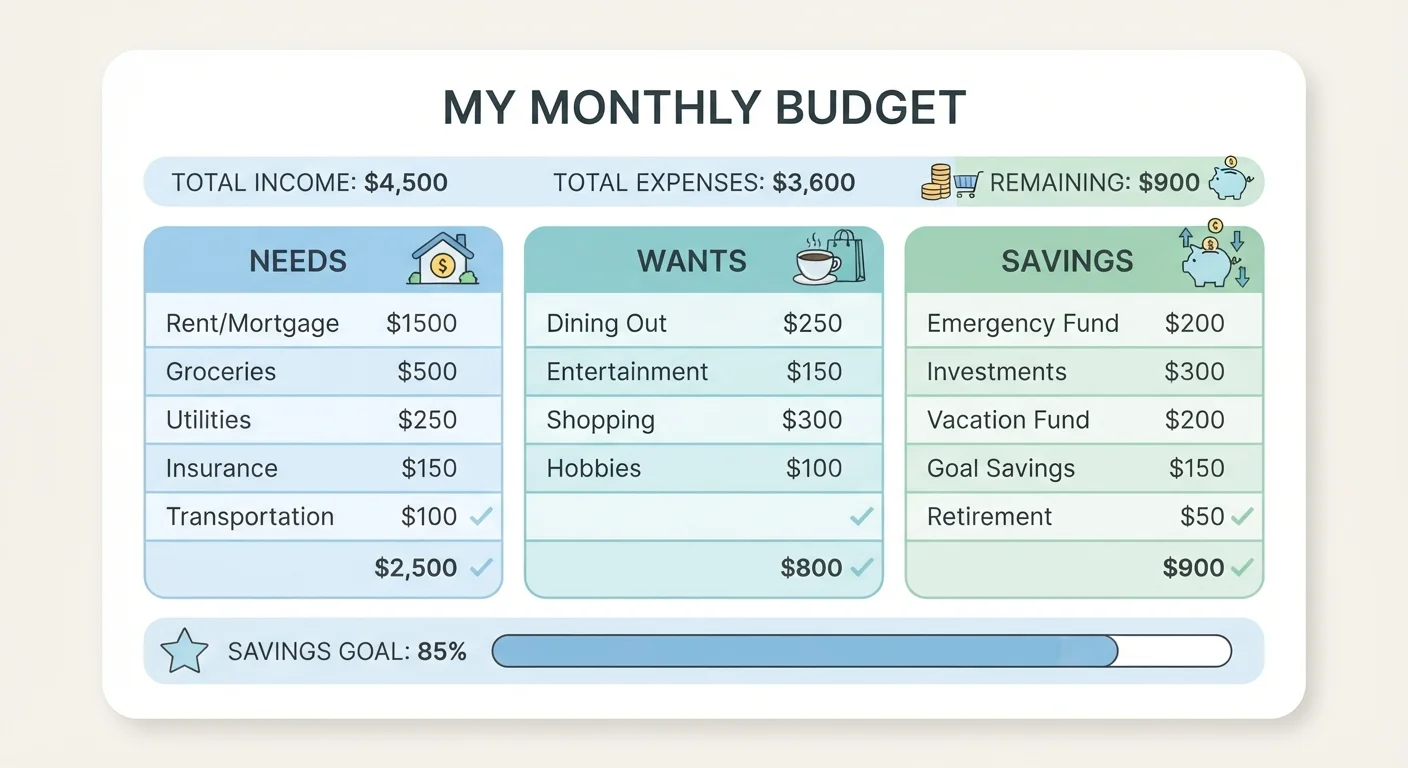
The math is straightforward. If your monthly after-tax income is $4,000, the targets are: $2,000 for needs, $1,200 for wants, and $800 for savings and debt repayment.
The practical challenge is categorization. Some expenses blur the line. A car payment is a need if you require the car to work, but it becomes a want if you chose a more expensive model than basic transportation required. Internet service is a need for remote workers; a premium package with extra channels may not be. The framework asks you to be honest about these distinctions rather than reclassifying wants as needs to justify spending.
Once you know your take-home pay and fixed expenses, you can quickly see whether your current spending aligns with the targets or where you're out of proportion. Many people find their needs exceed 50% - often due to housing costs - which surfaces a concrete, addressable problem rather than just a vague sense of financial stress.
Where the 50/30/20 Rule Works - and Where It Doesn't
The rule's appeal is its simplicity. Unlike zero-based budgeting, which requires tracking every dollar, the 50/30/20 framework demands minimal record-keeping. That makes it more likely to stick for people who have avoided budgeting because it felt too complicated. It's also flexible enough to accommodate variable incomes - freelancers and gig workers can apply the percentages to each month's actual earnings.
~37%
Average share of income spent on housing
The U.S. Bureau of Labor Statistics Consumer Expenditure Survey consistently shows housing consuming the largest share of household budgets, often challenging the 50% needs ceiling.
1 in 4
Americans with no emergency savings
Surveys from the Federal Reserve's Report on the Economic Well-Being of U.S. Households indicate a significant share of adults cannot cover an unexpected $400 expense with savings - underscoring the importance of the 20% savings allocation.
20%
Savings and debt repayment target
The 50/30/20 framework allocates this share specifically to building financial resilience, covering emergency funds, retirement contributions, and accelerated debt payoff.
However, the framework has real limitations. In high-cost metro areas, housing alone can consume 40-50% of take-home pay, leaving little room for other needs before the 50% cap is reached. People carrying significant student loan debt or with dependents face similar pressure. For low-income households, the math simply may not work without addressing income or fixed costs first.
The 20% savings target may also feel unreachable early in a financial journey. Financial educators often suggest starting smaller - even 5% - and increasing gradually, rather than abandoning the framework because the target seems out of reach.
For a broader comparison of how the 50/30/20 rule stacks up against other approaches, see how it compares to other practical budgeting frameworks. And if you're managing a savings goal for travel, the same percentage-based thinking applies - travel budgeting from scratch shows how to adapt it for trip planning.
This article provides general financial education and is not personalized financial advice. For guidance tailored to your individual situation, consider consulting a licensed financial adviser.