

Key Takeaways
- Budgeting works better when framed as trade-offs rather than restrictions.
- Every spending decision implicitly deprioritises something else - making that visible helps.
- Aligning purchases with personal values reduces buyer's remorse and decision fatigue.
- Trade-off thinking doesn't require a strict budget system to be effective.
- Small, consistent realignments often have more impact than dramatic spending cuts.
Trade-Off Mindset
A trade-off mindset treats every spending decision as a conscious choice to prioritise one thing over another - not a sacrifice, but a deliberate exchange. Instead of framing a budget as a list of restrictions, it frames spending as a series of decisions that reflect what you actually value. When you choose to spend more in one area, you're implicitly choosing to spend less somewhere else.
In behavioural economics, this reframing is linked to 'opportunity cost awareness' - recognising that every purchase has an implicit cost in the form of what you didn't buy or save instead.
Why 'Spending Less' Is the Wrong Frame
Most budgeting advice leads with subtraction: spend less on coffee, cancel subscriptions, cut back. It's framed as discipline - denying yourself things you want. That framing isn't just unpleasant; it tends not to work. Willpower is finite, and a budget built on self-denial is hard to sustain.
A more durable approach starts from a different premise: you're not giving things up, you're choosing what to keep. When resources are limited, every 'yes' is automatically a 'no' to something else. The question isn't whether trade-offs exist - they always do - but whether you're making them deliberately or by default.
Default spending - where money leaves your account without clear intention - is where most people feel the gap between what they earn and what they have to show for it. The trade-off mindset closes that gap not by restricting spending, but by making its logic visible. For a broader look at how needs and wants complicate those choices, see how to weigh needs versus wants in a budget.
This Is General Financial Information
The trade-off mindset is a general framework for thinking about spending decisions - it is not personalised financial advice. Individual circumstances vary widely, and for complex financial situations, consulting a licensed financial professional is worthwhile.
How Trade-Off Thinking Works in Practice
The mechanics are straightforward. Before or after a spending decision, ask: what am I exchanging for this? Not in a guilt-inducing way, but as a factual question. Spending $80 on a dinner out means $80 less for groceries, savings, or next month's utilities. That's not a judgment - it's just the arithmetic.
What changes is that the exchange becomes conscious. You might decide the dinner is worth it. You might not. But either way, you're the one making the call rather than discovering after the fact that money has disappeared.
This approach pairs naturally with any structured budgeting framework. The 50/30/20 rule gives categories; trade-off thinking gives the reasoning inside those categories. Similarly, zero-based budgeting asks you to justify every dollar - trade-off thinking is the mindset that makes that justification feel real rather than mechanical.
Identifying Your Actual Priorities
The trade-off mindset only works if you know what you're trading toward. That means getting honest about values - not aspirational values, but revealed values: what your spending history actually shows you care about.
Pull up three months of bank or card statements and look for patterns. Where do you consistently spend without regret? Where do charges appear that you barely remember? The first category reveals genuine priorities worth protecting. The second reveals candidates for reallocation.
~33%
Of adults who report feeling financially stressed despite earning enough
Research from the American Psychological Association's annual Stress in America surveys consistently finds that money is a top stressor even for households above median income, suggesting income alone doesn't resolve spending-satisfaction gaps.
3 months
Typical review period to spot meaningful spending patterns
Financial counsellors commonly recommend reviewing at least three months of transactions to smooth out one-off expenses and reveal true recurring spending habits.
This exercise doesn't require a complete overhaul. Often, small realignments - moving $30 or $50 a month from low-satisfaction spending to high-satisfaction spending - make a noticeable difference in how 'enough' your budget feels. For readers still navigating myths that make getting started harder, common budgeting myths worth unlearning is a useful companion piece.
Putting It Together Without Overcomplicating It
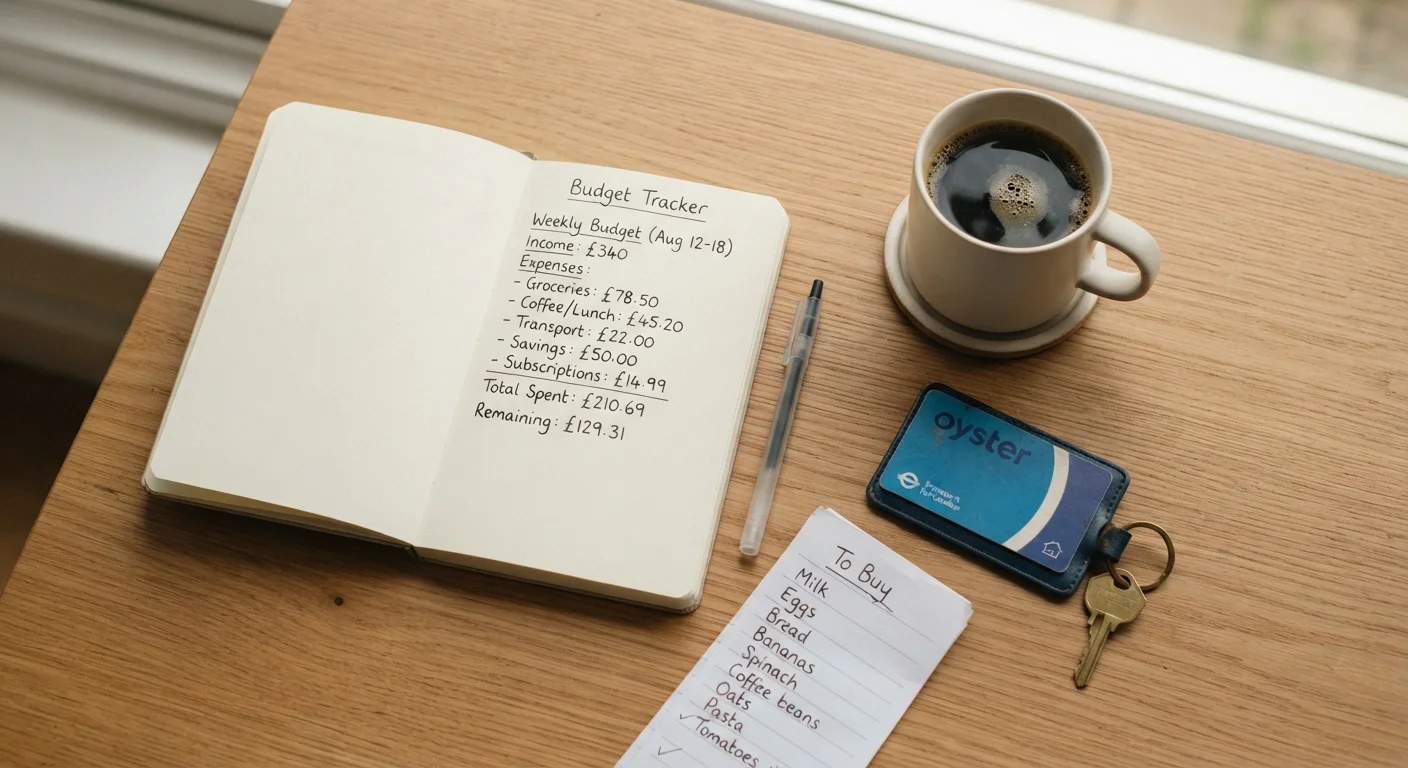
The trade-off mindset doesn't require a specific tool or system. It works alongside a notebook, a spreadsheet, or a budgeting app - the trade-offs between those tools are worth understanding separately. What matters is the habit of pausing, even briefly, to name the exchange you're making.
Start with one spending category where you feel most uncertain - often discretionary spending like food, entertainment, or subscriptions. For one month, before any purchase in that category, ask: what does this cost me elsewhere, and is that trade worth it? You don't have to say no more often. You just need to say yes more deliberately.
Start With One Category, Not Your Whole Budget
Trying to apply trade-off thinking across every spending category at once is overwhelming and unsustainable. Pick the one area where you feel most uncertain or dissatisfied, apply the 'what am I trading for this?' question there for 30 days, and let the habit build before expanding it.
Over time, this habit reshapes spending patterns without requiring ongoing willpower. Choices start to self-organise around what genuinely matters, and the feeling of 'never having enough' often eases - not because income increased, but because the money being spent is doing more of what you actually want it to do. That's the core promise of trade-off thinking: not deprivation, but alignment.