

Key Takeaways
- The right debt management approach depends heavily on your current life stage and income trajectory.
- Student loans, mortgages, and credit card debt each carry different urgency levels and repayment logic.
- Entering retirement with significant debt can strain fixed incomes in ways that are hard to reverse.
- Paying down high-interest debt almost always delivers a better guaranteed return than most investments.
- A consistent budget review habit helps you realign debt priorities as your circumstances evolve.
Why Debt Looks Different at Every Life Stage
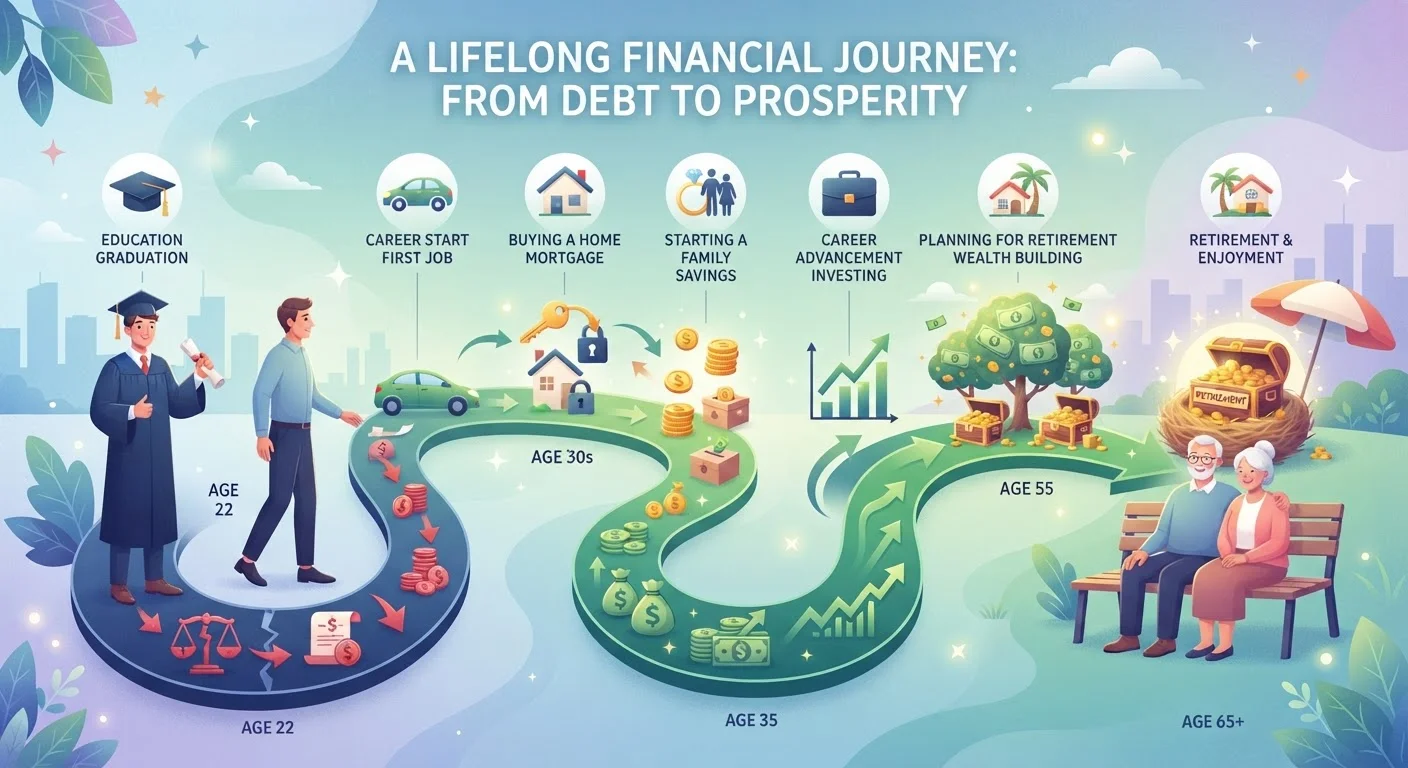
Debt is not a single problem with a single solution. The student loan that feels manageable at 23 carries entirely different weight at 45. The mortgage you take on in your 30s can be a wealth-building tool or a long-term burden depending on how you manage it. Understanding how your relationship with debt should evolve - rather than applying one-size-fits-all advice - is the foundation of sound long-term financial health.
If you are new to the basics of credit, the Credit & Debt from the Ground Up guide covers scores, reports, and borrowing fundamentals worth understanding first. This article builds on those principles and maps them across the full arc of adult financial life.
~$37,000
Average student loan debt per U.S. borrower
According to Federal Reserve data, average student loan balances vary widely by degree type and institution.
20%+
Typical credit card APR range
Federal Reserve consumer credit data consistently shows average credit card interest rates exceeding 20% in recent years.
43%
U.S. households carrying credit card balances
Federal Reserve Survey of Consumer Finances data indicates roughly 4 in 10 households carry revolving credit card debt month to month.
Your 20s: Building Credit While Managing Student Loans
For most people, the 20s mean entering the credit system for the first time - often with a student loan already in hand. The dual challenge is repaying that debt while establishing a positive credit history that will matter enormously for future borrowing.
Prioritize on-time payments above all else
Payment history is the single largest factor in most credit scoring models. Missing a student loan payment - even once - can set back your credit score significantly. Set up autopay if your servicer allows it; many federal student loan programs offer a small interest rate reduction for doing so.
Avoid high-interest consumer debt early on
Credit cards, buy-now-pay-later arrangements, and personal loans can snowball quickly when income is entry-level. Carrying a balance on a card with a 20%+ APR while making minimum payments is among the most costly financial habits to develop. The Healthy Borrowing Habits Worth Building Early article outlines practical ways to use credit without letting it use you.
In your 20s, make at least the minimum payment on every account before directing extra cash anywhere - protecting your payment history is non-negotiable at this stage.
A single missed payment can remain on a credit report for up to seven years, affecting mortgage eligibility and interest rates far into the future.
Before refinancing federal student loans privately, list out every federal protection you would give up - income-driven repayment, deferment options, and certain forgiveness programs - and confirm you genuinely don't need them.
Many borrowers refinance for a marginally lower rate and later regret losing access to federal safety nets during income disruptions.
Understand your repayment options
Federal student loans offer income-driven repayment plans that cap monthly payments based on earnings. These can provide breathing room - but extending your repayment term means paying more interest over time. Refinancing may lower your rate, but private refinancing typically eliminates federal protections. Weigh the trade-offs carefully before acting.
Your 30s and 40s: Mortgages, Family Costs, and Competing Priorities
Midlife typically brings the largest debts of a person's life: mortgages, auto loans, and sometimes medical or childcare costs layered on top of remaining student loans. This is also when income tends to grow - but so do expenses.
The 'Debt Stack' Review
In your 30s and 40s, list every debt - balance, interest rate, and remaining term - in a single document. Update it annually. This 'debt stack' review makes it immediately clear which obligations are most expensive and where extra payments will have the most impact. Many people carry debts they have not actively evaluated in years.
Treat your mortgage as a long-term instrument
A mortgage is generally considered "productive" debt - it finances an asset that may appreciate over time. That said, it is still a significant obligation. Making occasional extra principal payments, if your loan allows, can meaningfully shorten your repayment term and reduce total interest paid. Even one extra payment per year can have a notable long-run effect.
Rank your debts by interest cost
In midlife, people often carry several types of debt simultaneously. The debt avalanche vs. debt snowball comparison explains how to prioritize payoff systematically. High-interest revolving debt (credit cards) almost always deserves attention before lower-rate installment debt.
Balance debt payoff with retirement saving
One of the most common midlife dilemmas is whether to aggressively pay down debt or contribute more to a 401(k) or IRA. If your employer matches retirement contributions, capturing that match first is generally advisable - it is an immediate guaranteed return. After that, directing extra funds toward high-interest debt often makes mathematical sense. A licensed financial adviser can help you model the trade-offs for your specific situation.
Your 50s: The Debt-Free Push Before Retirement
The decade before retirement is arguably the most consequential for debt management. Entering retirement carrying significant balances - especially high-interest consumer debt - can permanently compress a fixed income that may need to last 20 to 30 years.
Entering Retirement in Debt Changes the Math Entirely
When you rely on a fixed income, every dollar committed to debt repayment is a dollar unavailable for housing, healthcare, or emergencies. Unlike your working years, you cannot easily increase income to compensate. The pre-retirement decade is your most important window to reduce or eliminate high-cost obligations - missing it is difficult to recover from.
Target elimination, not just reduction
In your 50s, the goal shifts from managing debt to eliminating it. Refinancing or consolidating outstanding balances may help simplify and reduce interest costs - but only if it accelerates payoff rather than extending the repayment window. Run the numbers on total interest paid, not just monthly payment size.
Avoid taking on new long-term obligations
A new 30-year mortgage or a large home equity loan at 55 will follow you well into retirement. If you need to borrow in this decade, favor shorter terms even if the monthly payment is higher - you want debts retired before earned income stops.
This is also a good time to revisit your overall financial picture. The Wealth-Building Over a Lifetime guide covers how to align debt elimination with longer-term wealth strategies.
Retirement and Beyond: Protecting Fixed Income from Debt
Once earned income stops or significantly decreases, debt becomes a fixed monthly drain on resources that are now finite. Social Security benefits, pension payments, and retirement account withdrawals must stretch further when debt payments claim a share.
Debt in retirement is manageable - but requires planning
Some retirees carry a small remaining mortgage balance or a modest car payment - this is not automatically a crisis. What matters is whether fixed income comfortably covers necessary expenses including those debt obligations. A useful benchmark: many financial professionals suggest keeping total housing costs (including any mortgage) below 30% of gross income, though your own circumstances will vary.
High-Interest Debt Can Outlast Retirement Plans
Carrying credit card balances or personal loans into retirement is one of the most common and difficult-to-reverse financial strains retirees face. At 20%+ APR, a $10,000 balance accrues significant interest each month - eating directly into Social Security or pension income. Make eliminating high-rate debt a firm goal before your last working year.
Avoid decisions that could jeopardize retirement assets
Withdrawing from a traditional IRA or 401(k) early to pay off debt triggers income taxes and, before age 59½, an additional penalty. Tapping retirement savings to eliminate lower-interest debt may cost more than it saves. Model any such decision carefully, ideally with the help of a certified financial planner or tax professional.
Staying on top of a realistic personal budget remains essential in retirement - fixed income demands disciplined spending tracking.
Strategies That Apply at Any Age
While debt priorities shift across life stages, several principles hold regardless of where you are in the journey.
- Know the cost of every debt. APR, fees, and repayment terms determine true cost. Familiarize yourself with key borrowing terms before signing anything.
- Review your debt picture annually. Life changes - income, family size, interest rates - mean your repayment strategy should be revisited regularly, not set once and forgotten.
- Emergency savings reduce reliance on debt. A cash reserve prevents a single unexpected expense from becoming a high-interest loan. Even a modest buffer matters.
- Track spending to find payoff capacity. The Budgeting Basics hub offers practical tools to identify where cash flow can be redirected toward debt.
- Seek qualified advice for complex situations. Debt intersects with taxes, estate planning, and investment strategy. A licensed financial adviser or credit counselor can provide guidance tailored to your circumstances.
This article is for general informational and educational purposes only and does not constitute personalized financial, legal, or tax advice. Consult a qualified financial professional before making decisions about your own debt or financial situation.