

Key Takeaways
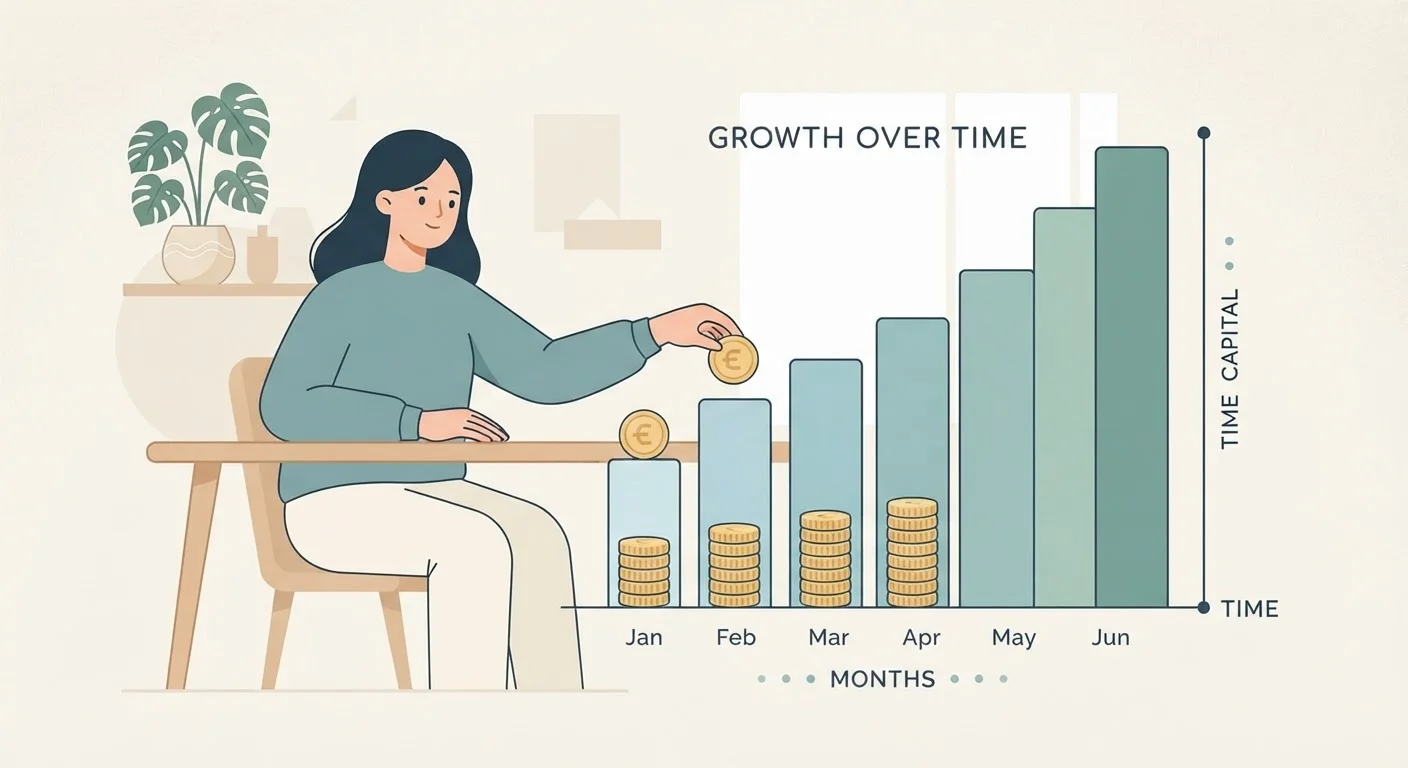
- Dollar-cost averaging invests a fixed amount on a regular schedule, removing the need to time the market.
- Consistent contributions automatically buy more shares when prices fall and fewer when prices rise.
- Research generally shows lump-sum investing outperforms DCA over long periods in rising markets, but DCA reduces the risk of a poorly timed single purchase.
- DCA is especially practical for investors who receive income regularly, such as through a paycheck.
- The strategy works best when paired with a diversified, long-term investment plan.
- This article is general financial education, not personalized investment advice - consult a licensed financial adviser for guidance specific to your situation.
Dollar-Cost Averaging
Dollar-cost averaging (DCA) is an investment approach where you invest a fixed dollar amount at regular intervals - weekly, monthly, or quarterly - regardless of whether the market is up or down. Because the amount stays constant, you automatically buy more shares when prices are low and fewer when prices are high. Over time, this can lower the average price you pay per share compared to making one large purchase at the wrong moment.
DCA does not guarantee a profit or protect against loss in declining markets. It primarily reduces the risk of poor timing relative to a single lump-sum purchase made at a market peak.
How Dollar-Cost Averaging Works in Practice
The mechanics of dollar-cost averaging are straightforward. Suppose you invest $300 every month into a broad market index fund. In one month, the share price is $50 - you buy 6 shares. The next month, the price drops to $30 - your $300 now buys 10 shares. The month after that, the price rises to $60 - you buy 5 shares. After three months you hold 21 shares at a total cost of $900, giving you an average price of roughly $42.86 per share, even though the price averaged $46.67 across those same months.
This math - buying more units when prices are low - is what proponents mean when they describe DCA as a disciplined, market-agnostic approach. The investor doesn't need to predict market direction; the schedule does the work.
Automate to Stay Consistent
Setting up automatic transfers on a fixed date each month removes the temptation to skip a contribution when markets feel uncertain. Automation is one of the most reliable ways to maintain the discipline that dollar-cost averaging requires. Check whether your brokerage or retirement account supports automatic investment scheduling.
Many employer-sponsored retirement plans, such as 401(k)s, already use dollar-cost averaging automatically by deducting a fixed percentage from each paycheck. If you contribute to such a plan, you may already be practicing DCA without labeling it that way.
What the Research Says: DCA vs. Lump-Sum Investing
Dollar-cost averaging is often presented as universally superior, but the evidence is more nuanced. Analysis comparing DCA with immediate lump-sum investing - putting all available funds to work at once - generally finds that lump-sum investing produces higher returns over extended periods, particularly in markets with a long-term upward bias. The reason is straightforward: money invested earlier has more time to grow, a principle closely tied to how compound interest works over time.
Where DCA earns its place is in managing timing risk. An investor who happens to deploy a large lump sum just before a sharp market correction faces a meaningful short-term setback. DCA spreads that exposure across multiple purchase points, softening the impact of any single bad entry. For investors who are psychologically prone to panic-selling after a large loss, the reduced volatility of a DCA approach may support better long-run behavior - staying invested matters enormously.
~2/3
Cases where lump-sum outperformed DCA
Vanguard research examining rolling 12-month investment windows across US, UK, and Australian markets found lump-sum investing outperformed a 12-month DCA approach approximately two-thirds of the time.
~2.3%
Average performance gap, lump-sum vs. DCA
In the same Vanguard analysis, lump-sum investing outperformed DCA by an average of roughly 2.3 percentage points over 12-month periods, driven by earlier market participation.
When Dollar-Cost Averaging Makes the Most Sense
DCA is most practical in a few specific situations:
- You receive income in regular intervals. Most workers earn a paycheck bi-weekly or monthly. Investing a fixed amount each pay period aligns naturally with cash flow without requiring any lump sum to be available upfront.
- You are new to investing and anxious about timing. Committing to a schedule sidesteps the paralysis of waiting for the "right" moment - which research suggests is rarely identified correctly in advance.
- Market conditions are unusually volatile. In periods of high uncertainty, spreading purchases reduces the chance of buying heavily at a temporary peak.
- You are building toward a long-term goal. DCA pairs well with a diversified portfolio - see how portfolio diversification works in practice - by steadily adding to a range of assets over years.
DCA is generally less advantageous when you already have a large sum available and a long investment horizon ahead, since keeping cash on the sidelines waiting to be deployed forgoes potential market participation. It also loses some benefit if transaction fees apply to each purchase, making less frequent intervals more cost-effective in those cases.
Common Misconceptions and Limitations
A few points often get glossed over in popular explanations of dollar-cost averaging:
It doesn't remove market risk. If the market declines steadily over a long period, DCA will still result in losses - it simply means you accumulated shares at gradually lower prices. The underlying investment still needs to recover for the strategy to pay off.
It isn't a strategy by itself. DCA is a contribution method, not an investment selection framework. What you invest in matters as much as how you invest. Applying DCA to a poorly diversified or high-cost portfolio does not offset those problems. Consider how your contribution schedule fits into a broader plan, including how it aligns with choosing between index and actively managed funds.
Consistency is essential. The benefits of DCA depend on maintaining the schedule through both up and down markets. Pausing contributions during downturns - precisely when more shares can be purchased cheaply - undermines the strategy's core advantage.
Transaction Costs Can Affect the Math
If your brokerage charges a per-trade fee, frequent small purchases can erode the value of each contribution. Many platforms now offer commission-free trades for common funds and ETFs, but it's worth confirming the fee structure before setting a contribution frequency. Fewer, larger contributions may be more cost-effective if fees apply.
This article is for general informational and educational purposes only and does not constitute personalized financial or investment advice. Investment involves risk, including the possible loss of principal. Consult a licensed financial adviser before making decisions based on your individual circumstances.