

Key Takeaways
- Diversification reduces company-specific risk but cannot protect against broad market downturns.
- Owning many investments doesn't guarantee diversification if they all move together.
- True diversification spans asset classes, sectors, and geographies - not just individual stocks.
- Correlation between assets is the key concept: low or negative correlation provides better protection.
- Even a well-diversified portfolio requires periodic review as market conditions shift.
Portfolio Diversification
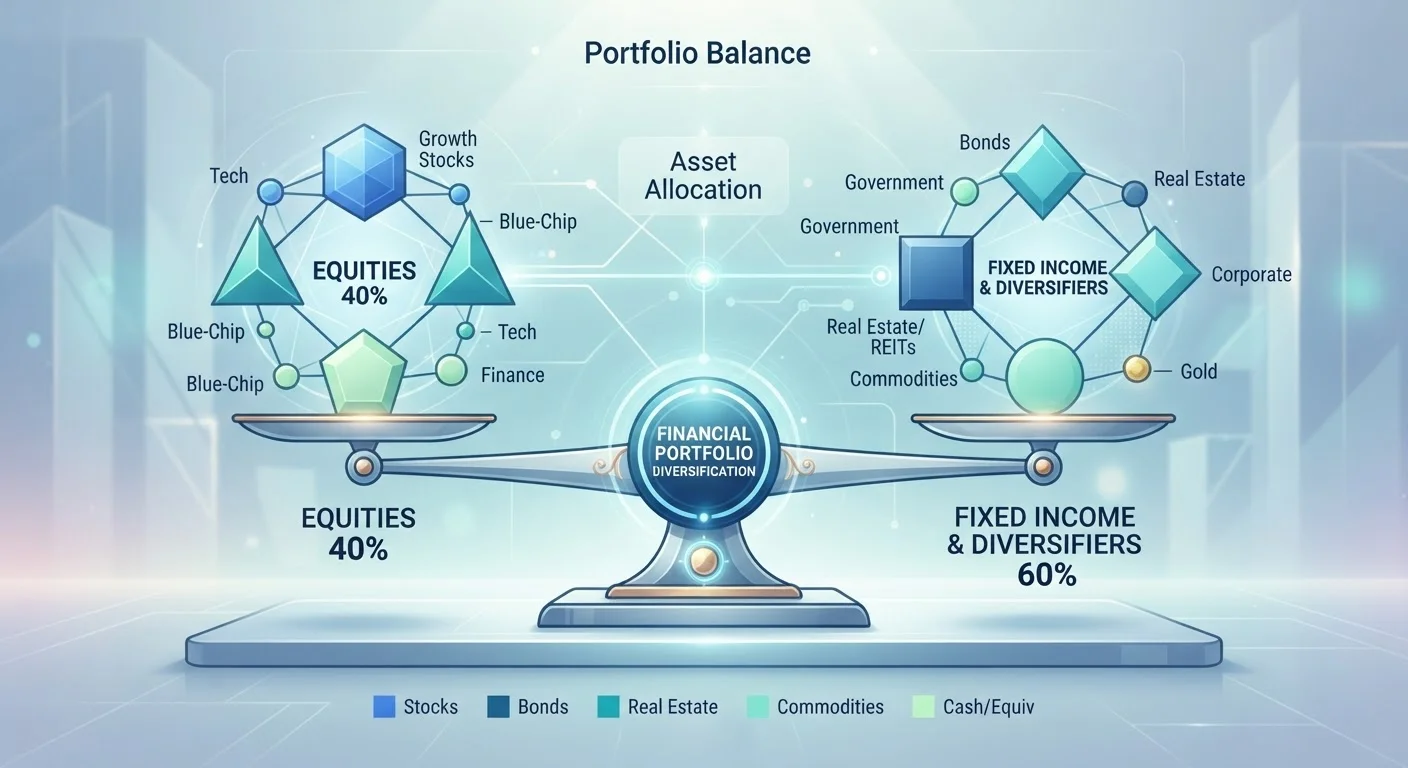
Portfolio diversification is the practice of spreading investments across different asset types, sectors, or geographies so that a loss in one area doesn't devastate your entire portfolio. The core idea is that different investments don't always move in the same direction at the same time. When one investment falls, another may hold steady or rise, smoothing out your overall returns.
In finance, diversification works by reducing unsystematic risk - the risk specific to an individual company or sector - but it cannot eliminate systematic risk, which affects the entire market.
The Simple Version - and Why It Falls Short
Most people first encounter diversification as a variation of "don't put all your eggs in one basket." It's a useful starting point. If you invest everything in a single company's stock and that company fails, you lose everything. Spread across dozens of companies, and one failure is survivable.
But the conventional shorthand can be misleading. Owning 50 stocks doesn't automatically mean you're diversified - if all 50 are U.S. technology companies, they're likely to fall together when the tech sector struggles. The number of holdings matters far less than how those holdings relate to each other.
This relationship is measured by correlation - a statistical concept that describes how two investments tend to move relative to each other. Two perfectly correlated assets move identically; two negatively correlated assets move in opposite directions. Genuine diversification means holding assets with low or negative correlation, so that losses in one are cushioned by stability or gains in another.
~20-30
Stocks needed to reduce most company-specific risk
Academic research in portfolio theory, including foundational work by economists studying equity portfolios, generally finds that much of unsystematic risk is eliminated within this range of holdings - though only when those holdings are genuinely uncorrelated.
1.0
Correlation of perfectly identical assets
A correlation of 1.0 means two assets move identically - holding both provides zero diversification benefit. Effective diversification targets assets with correlations meaningfully below 1.0, ideally closer to zero or negative.
60/40
Traditional stock-to-bond portfolio split
The 60% stocks / 40% bonds allocation has been a commonly cited starting framework for balanced portfolios, though its appropriateness varies significantly by individual risk tolerance, time horizon, and financial goals.
Two Types of Risk - and What Diversification Can Actually Do
To understand diversification's real limits, it helps to distinguish between two categories of investment risk:
- Unsystematic risk (also called specific or idiosyncratic risk): the risk tied to a particular company, industry, or sector. A pharmaceutical company faces a clinical trial failure; a retailer faces supply-chain disruption. This risk is largely diversifiable - spreading across many unrelated companies reduces your exposure to any single one of these events.
- Systematic risk (also called market risk): the risk affecting the entire economy or financial system - recessions, interest rate changes, geopolitical crises. This risk cannot be diversified away by holding more assets within the same market. When global financial conditions deteriorate, nearly all asset classes tend to fall.
Diversification is most effective at reducing unsystematic risk. It does not protect against the type of broad downturns that affect all markets simultaneously. Anyone who held a textbook-diversified portfolio in 2008 still experienced significant losses - they just lost less than someone concentrated in a single sector.
This is worth being clear-eyed about. Diversification improves your odds and limits worst-case outcomes; it doesn't prevent them. For context on investing misconceptions more broadly, see common investing misconceptions examined.
What Genuine Diversification Actually Looks Like
Meaningful diversification typically works across several dimensions simultaneously:
Asset Classes
Stocks, bonds, real estate investment trusts (REITs), and cash equivalents historically behave differently in various economic conditions. Stocks may offer higher long-term growth potential but with more volatility; bonds generally provide more stability but lower returns. The trade-offs are real - bonds are often described as safer than stocks, but that framing has limits.
Sectors and Industries
Within stocks, spreading across sectors - technology, healthcare, energy, consumer staples, financials - reduces exposure to any one industry's cycles. A downturn in energy prices, for example, affects an energy-heavy portfolio far more than a broadly spread one.
Geography
International diversification adds another layer. Different countries experience different economic cycles, currency dynamics, and regulatory environments. A portfolio concentrated entirely in U.S. equities is exposed to the specific performance of one national economy.
Time (Via Consistent Investing)
Diversifying across time - by investing consistently rather than in one lump sum - is another dimension many overlook. Dollar-cost averaging spreads your purchase prices over time, reducing the risk of investing a large sum right before a downturn.
Review Your Portfolio's Actual Correlations
Many investors assume their holdings are diversified simply because they hold assets across different fund names. Check whether your funds overlap heavily in their underlying holdings - two funds labeled differently may hold many of the same stocks. Fund data providers often publish correlation figures and holdings breakdowns that can help you assess true diversification.
Common Misconceptions That Undermine Good Diversification
Several widespread assumptions about diversification can give investors false confidence:
- "I own an index fund, so I'm diversified."
- A broad index fund provides excellent within-market diversification, but owning only one fund still concentrates you in a single asset class and geography. It's a strong foundation, not a complete strategy. For a detailed comparison, see index funds vs actively managed funds.
- "More holdings always means more diversification."
- Thirty highly correlated assets offer less true diversification than ten uncorrelated ones. Quantity without variety creates the appearance of safety, not the substance of it.
- "Diversification means I won't lose money."
- This is the most dangerous misconception. Diversification is about managing the shape of risk, not eliminating it. Poorly timed expectations can lead to panic selling when a diversified portfolio still declines in a broad downturn.
This article provides general financial information for educational purposes only and does not constitute personalised investment advice. Individual circumstances vary significantly. Consult a licensed financial adviser before making investment decisions.