

Key Takeaways
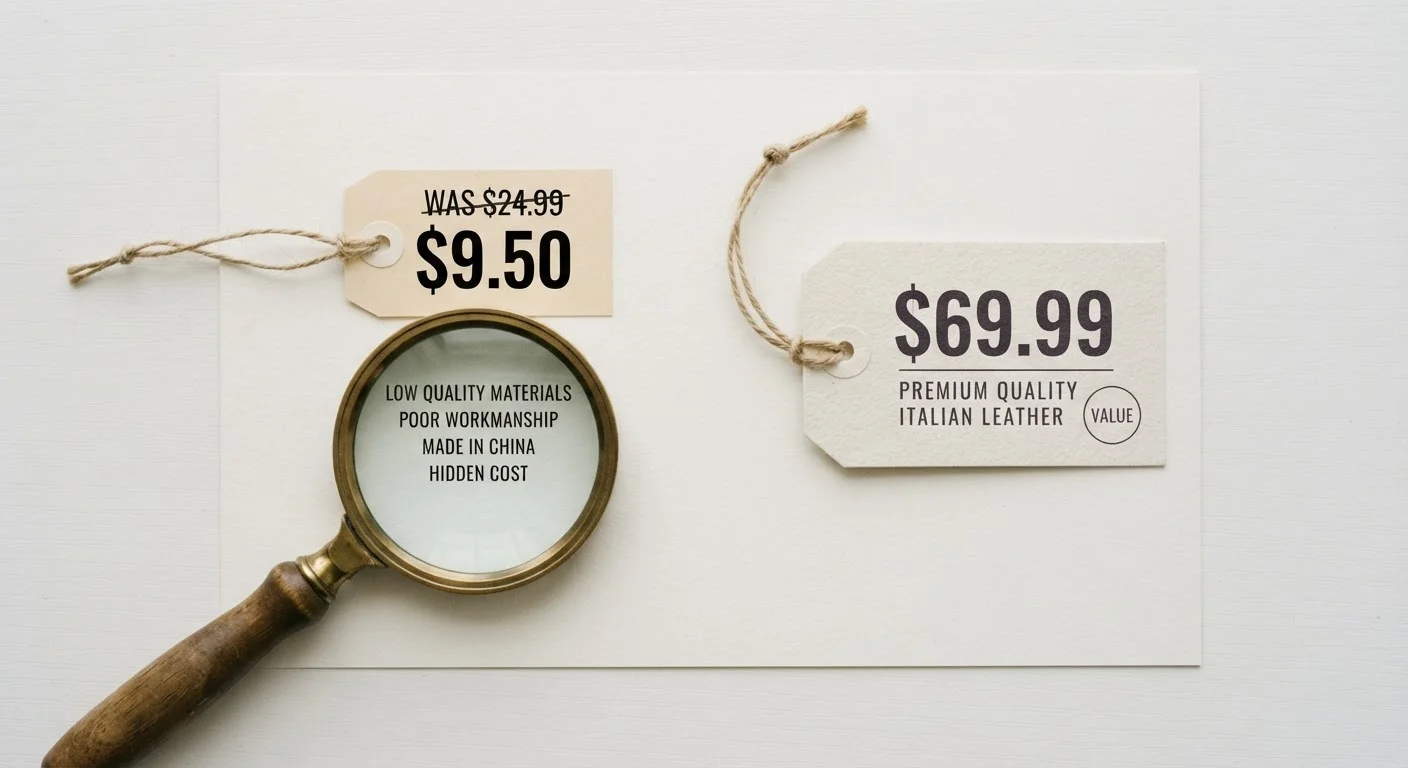
- Price is what you pay upfront; value is what you receive across the life of a purchase.
- A lower price can mask higher long-term costs through replacement, repairs, or missing features.
- Value is personal - it depends on your specific needs, usage frequency, and priorities.
- Comparing price alone across different quality tiers produces misleading conclusions.
- Factors like warranty coverage, durability, and ongoing costs significantly shape real-world value.
Option A
Price
The number on the tag - immediate, visible, and easy to compare.
Best for: Quick initial filtering when your budget has a hard ceiling and upfront cost is the primary constraint.
Option B
Value
The full return on your spend - durability, utility, and total cost over time.
Best for: Shoppers making considered purchases where long-term satisfaction and total cost of ownership matter most.
If your budget is genuinely fixed and non-negotiable
Price
When financial constraints are real and immediate, price is the practical gating factor. Focus on finding the highest value within your hard limit rather than stretching beyond it.
If you're making a high-frequency or long-duration purchase
Value
Items you use daily or expect to last years reward value-led thinking. A higher upfront cost often yields lower total expenditure and fewer replacements over time.
If you're evaluating two options at the same price point
Value
When price is equal, value becomes the decisive differentiator - look at durability, support, and feature relevance to your actual use case.
If the purchase is low-stakes and short-term
Price
For single-use or trial purchases where longevity is irrelevant, optimising for price is entirely rational and avoids over-investing in something temporary.
Why Price and Value Are Not Interchangeable
Walk into any purchasing decision and you'll encounter both concepts immediately - but most shoppers treat them as synonyms. They aren't. Price is a single data point: the number attached to a product at the moment of transaction. Value is a ratio: what you receive relative to what you spend, measured across the full lifespan of ownership.
Conflating the two is one of the most common and costly comparison errors shoppers make. It's explored in detail in common product comparison pitfalls, but the price-vs-value confusion deserves its own treatment because it shapes so many downstream decisions.
Consider two items performing the same function. One costs significantly less upfront but requires replacement in 18 months. The other costs more initially but lasts five years with minimal maintenance. Over that five-year window, the cheaper option may cost substantially more in aggregate - plus the friction of researching and replacing it twice. Price said one thing; value said another entirely.
| Criterion | Price | Value |
|---|---|---|
| Definition | Upfront monetary cost | Total benefit relative to total cost |
| Time horizon | Point of purchase only | Full ownership lifespan |
| Visibility | Immediately visible | Requires research and calculation |
| Personalization | Objective - same for all buyers | Subjective - varies by use case |
| Includes ongoing costs | No | Yes |
| Includes warranty/support | No | Yes |
| Risk of misleading you | High - ignores long-term factors | Lower - when assessed carefully |
What Actually Determines Value
Value isn't a fixed property of any product - it's contextual. The same item can represent excellent value for one shopper and poor value for another, depending on usage patterns, priorities, and alternatives available. That said, several factors reliably shape it:
- Durability and lifespan: How long will the product perform at an acceptable level? Longer lifespan spreads cost over more time, lowering effective cost-per-use.
- Ongoing costs: Consumables, accessories, energy draw, and maintenance all add to what you actually pay. Hidden costs that make a cheap product expensive covers this in depth.
- Feature relevance: Features you won't use don't add value - they add price. When more features is actually a disadvantage explains how to filter for what genuinely matters to your situation.
- Post-purchase support: Warranty terms and return policies directly affect your financial risk. A product with a strong warranty transfers risk back to the manufacturer. See warranty and return policy as comparison criteria for a structured approach.
~60%
Shoppers who regret impulse purchases
Consumer research consistently finds that a majority of shoppers report post-purchase regret tied to decisions made primarily on price without assessing quality or fit.
2-3x
Typical lifespan gap between budget and mid-tier goods
Product testing in categories such as appliances and tools frequently shows mid-tier items lasting two to three times longer than entry-level equivalents, affecting total cost of ownership.
How to Apply Both Concepts Without Overthinking It
The goal isn't to ignore price - it's to use it correctly. Price is a useful first filter: it eliminates options outside a realistic range quickly. But once you've narrowed to a realistic set of candidates, value should take over as the primary decision framework.
A practical starting point: calculate cost-per-use or cost-per-year for comparable options. This converts price into a more meaningful metric and often reverses apparent bargains. If one item costs 40% more but lasts three times as long, it's the more efficient spend by a considerable margin.
Equally important is comparing like with like. A budget-tier option benchmarked against a premium alternative is rarely a fair contest - the price difference often reflects genuine capability gaps. Comparing products at the same tier gives a framework for identifying true equivalents before drawing conclusions.
Finally, reading reviews critically can surface real-world durability and ownership data that spec sheets omit - particularly useful for gauging how value holds up past the point of purchase. For ongoing guidance on balancing these trade-offs, smarter budgeting strategies provides a practical foundation.
This article is for general informational and educational purposes only. Individual circumstances vary; readers should evaluate purchasing decisions based on their own needs and financial situation.