

| Most common fake review trait | Vague superlatives with no specific product detail |
| Red flag timing pattern | Sudden spike of 5-star reviews within days of each other |
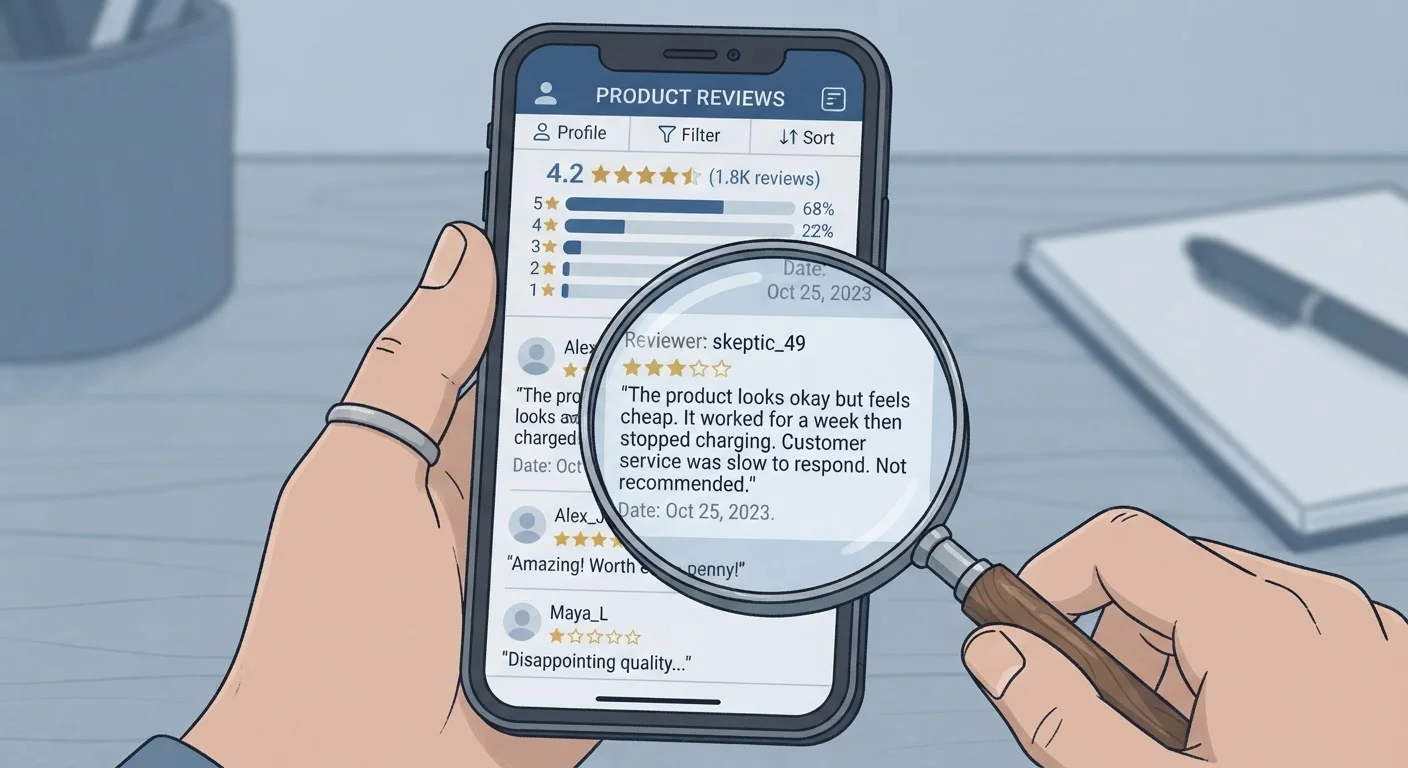
| Distribution warning sign | Bimodal rating curve - mostly 1s and 5s, few in between |
| Profile red flag | Reviewer with 30+ reviews posted in under two weeks |
| Language check technique | Search a suspicious phrase verbatim to find copy-paste patterns |
Why Fake Reviews Are Hard to Spot at a Glance
Fabricated reviews are designed to look real - that's the entire point. They mimic the format of genuine feedback: a star rating, a short paragraph, maybe a product-specific detail or two. What they can't easily replicate is the texture of actual experience. Once you know the specific signals that distinguish authentic feedback from manufactured praise, review sections become far more readable.
This reference covers the clearest, most reliable indicators - drawn from patterns researchers, platforms, and consumer advocates have documented. For a broader framework on reading reviews critically, see the complete guide to reading reviews critically.
| Most common fake review trait | Vague superlatives with no specific product detail |
| Red flag timing pattern | Sudden spike of 5-star reviews within days of each other |
| Distribution warning sign | Bimodal rating curve - mostly 1s and 5s, few in between |
| Profile red flag | Reviewer with 30+ reviews posted in under two weeks |
| Language check technique | Search a suspicious phrase verbatim to find copy-paste patterns |
Language and Content Signals
The words in a review carry the most diagnostic weight. Genuine reviewers write from specific experience; fabricated ones tend to write from a promotional template.
- Vague, superlative-heavy language: Phrases like "amazing product," "exceeded expectations," or "couldn't be happier" without any supporting detail are a consistent marker of inauthentic reviews. Real buyers tend to describe the specific context - what they used the item for, what surprised them, what fell short.
- Repetitive phrasing across multiple reviews: When several reviews for the same product use nearly identical sentence structures or repeat the same uncommon adjective, it suggests a coordinated campaign. Copy a suspicious phrase into a search engine to check if it appears verbatim elsewhere.
- Reviewer profile mismatch: A reviewer who has left 40 five-star reviews in two weeks across unrelated product categories is unlikely to be a typical shopper. Thin or brand-new profiles attached to glowing reviews deserve extra scrutiny.
- No mention of negatives: Genuine users almost always note at least one limitation, caveat, or personal preference. A review that reads as entirely positive with zero qualification is statistically unusual for authentic feedback.
Review gating
A practice where sellers selectively solicit reviews only from customers who report satisfaction, filtering out negative experiences before they reach public platforms. This artificially inflates average ratings.
Brushing scam
A scheme in which sellers ship unsolicited packages to real addresses, then post verified purchase reviews using those recipients' accounts to boost a product's review count and credibility.
Rating distribution
The spread of star ratings across all reviews for a product, from one to five stars. Healthy distributions typically show a gradual curve; sharp bimodal patterns (mostly 1s and 5s) can indicate manipulation.
Incentivized review
A review written by someone who received the product for free or at a significant discount in exchange for feedback. Platform rules require disclosure; undisclosed incentivized reviews violate most platform terms of service.
Verified purchase badge
A label applied by a platform indicating the reviewer made a confirmed transaction. It reduces some types of fraud but does not guarantee an unbiased or accurate review.
For more on how language patterns reveal review quality, see reading between the lines of online product reviews.
Timing, Volume, and Distribution Signals
Authentic reviews accumulate organically over time. Manufactured ones often arrive in identifiable clusters.
Platform Tools Can Help - Up to a Point
Several third-party browser extensions and websites analyze review patterns for a given product URL, flagging anomalies in timing, language, and reviewer behavior. These tools are useful as a starting filter, but they are not definitive - treat their output as one data point alongside your own reading of the reviews.
- Review timing clusters: A sudden spike of reviews - particularly five-star ones - within a short window after a product launch or a period of low activity can indicate an orchestrated campaign. Many platform review tools display review dates; checking them takes under a minute.
- Rating distribution anomalies: A product with 800 five-star reviews and 200 one-star reviews, but almost nothing in between, is a red flag. Authentic rating distributions for most products form a more continuous spread. A heavily bimodal distribution often reflects either suppressed middle reviews or imported fake positives.
- Unverified review concentration: While verified purchase labels aren't foolproof - as explained in verified purchase vs. unverified review - a product where the majority of five-star reviews are unverified while one-star reviews are mostly verified warrants caution.
- Incentivized review disclosures absent: Platforms require reviewers to disclose when they received a product free or at a discount. If a review reads like a promotion but carries no such disclosure, it may not have followed proper guidelines. See review manipulation tactics retailers use for how these schemes operate.
Negative reviews often surface the most useful signal. Reading negative reviews strategically explains how to separate legitimate complaints from noise.
~30-40%
Estimated share of online reviews that may be fake
Various consumer research organizations and academic studies have estimated that a substantial minority of online reviews across major platforms show signs of inauthenticity, though exact figures vary by category and platform.
1 in 3
Shoppers who have suspected a review was fake
Consumer sentiment surveys consistently find that a large share of online shoppers express doubt about review authenticity, particularly for lower-priced marketplace goods.