

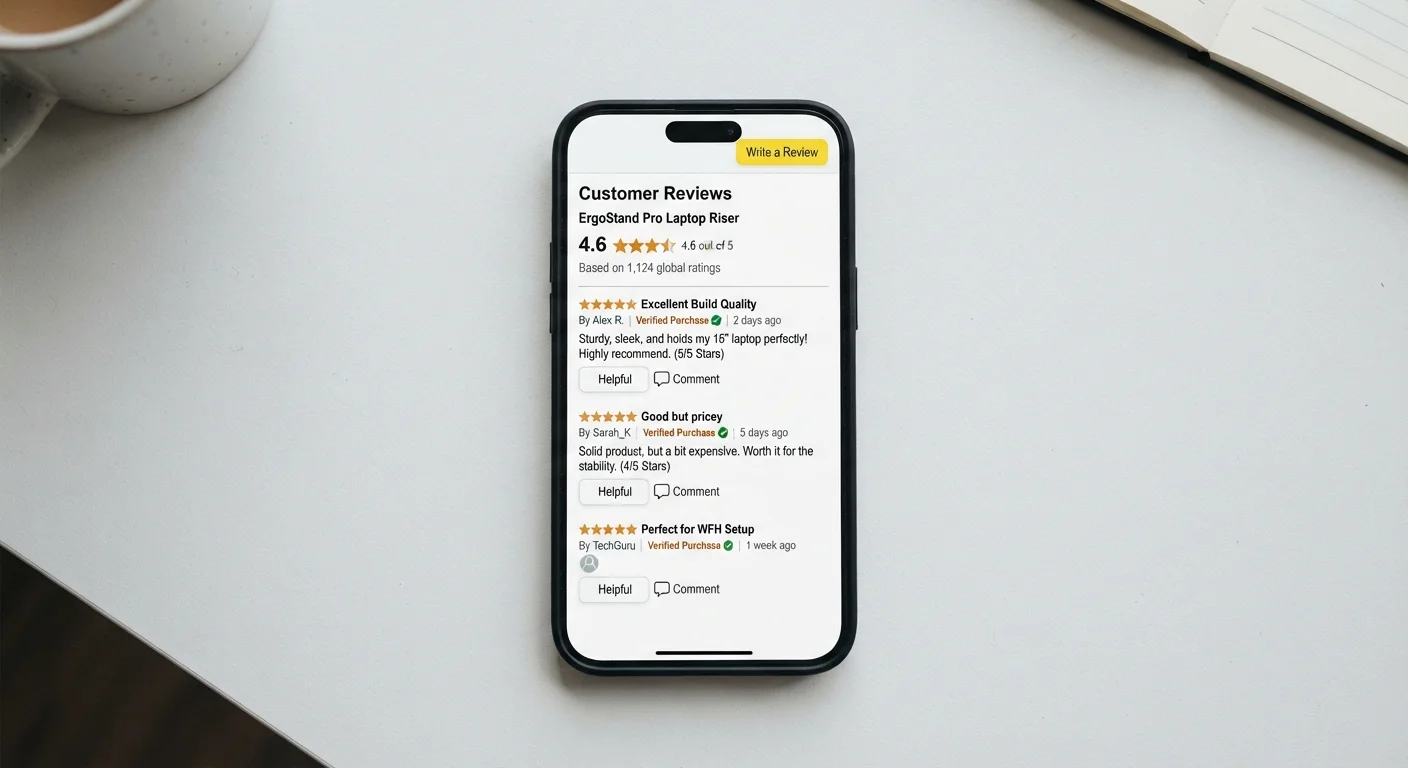
Key Takeaways
- Star ratings are averages that can be skewed by incentivized or fake submissions.
- Verified purchase badges confirm a transaction occurred, not that the review is unbiased.
- Written review text contains the most actionable, specific information for shoppers.
- Reviewer profile history is one of the strongest signals of authenticity.
- Rating distribution - the breakdown of 1- through 5-star counts - often reveals more than the average score.
- Recency of reviews matters because products and sellers change over time.
Online Review Anatomy
An online review is made up of several distinct parts - the star rating, the written text, the reviewer profile, and platform-added labels like "Verified Purchase." Each element is generated differently and carries a different level of reliability. Reading them as a whole, rather than fixating on a single number, gives you a far more accurate picture of a product or service.
Platforms often apply algorithmic filters that suppress or weight certain reviews before you ever see them, meaning the displayed rating may not reflect the raw average of all submissions.
The Star Rating: A Starting Point, Not a Verdict
The overall star rating is the first thing most shoppers see, and platforms design it that way intentionally. But the average score compresses a huge amount of variation into a single number. A product rated 4.1 stars from 2,000 reviews may have an entirely different story behind it than one rated 4.1 from 40.
More revealing than the average is the rating distribution - the breakdown showing how many reviewers gave each star level. A product with 80% five-star reviews and 15% one-star reviews is telling a different story than one where ratings cluster around three and four stars. That bimodal shape often signals inconsistent quality, or in some cases, manipulation at the top end. For a closer look at how platforms calculate and filter these numbers before you see them, see what review platforms don't tell you about how ratings are calculated.
82%
Shoppers who read reviews before buying
According to a 2023 consumer survey by PowerReviews, the vast majority of online shoppers consult user reviews as part of their purchase process.
30%
Estimated share of reviews that may be fake or incentivized
Research published by the University of Southern California and Fakespot analysis has suggested a substantial portion of reviews on major platforms contain reliability concerns.
4.2 stars
Average rating threshold consumers often require
PowerReviews survey data indicates many shoppers filter out products rated below 4.0-4.2 stars, making this range a common manipulation target.
The Written Review: Where Useful Information Lives
If the star rating is the headline, the written text is the article. Specific, detailed reviews - ones that describe exactly how a product performed in a particular situation - are almost always more useful than vague praise or generic complaints.
Look for reviews that include:
- Use context - what the reviewer was actually trying to do with the product
- Time-based feedback - how it held up after weeks or months
- Comparative language - how it stacked up against something the reviewer used before
- Specific defects or positives - not just "great quality" but what made it feel that way
Conversely, treat reviews with caution when they read like marketing copy, contain no personal detail, or are enthusiastic without being specific. These patterns appear disproportionately in incentivized or manufactured reviews. Reading between the lines of online product reviews covers these signals in more depth.
Filter Reviews by Your Use Case
Many platforms allow you to search review text by keyword. Before reading broadly, search terms like "durability," "assembly," or the specific feature you care most about. This surfaces the reviews most relevant to your situation faster than scrolling through hundreds of general responses.
Reviewer Profiles and Verified Badges: Reading the Source
Platforms attach metadata to every review that most shoppers skip entirely. A reviewer's profile history is one of the most reliable authenticity signals available. An account that has reviewed dozens of unrelated product categories over several years is far less likely to be a sock puppet or paid reviewer than one created recently with only a handful of five-star reviews for similar items.
The Verified Purchase label (or its equivalent on different platforms) confirms that the account made a transaction - it does not confirm the reviewer wasn't reimbursed afterward. Sellers operating outside platform rules sometimes offer post-purchase incentives, which means a verified badge should raise your confidence slightly, not unconditionally.
Also check whether the seller has publicly responded to negative reviews. Constructive, specific responses to complaints suggest an engaged seller; defensive or dismissive responses can be equally informative. For more on extracting value from critical feedback, see reading negative reviews strategically.
Recency, Volume, and What the Full Picture Adds Up To
A product may have accumulated strong reviews over three years and then changed its manufacturer or materials. If the most recent 30 reviews skew significantly lower than the overall average, that gap is a meaningful signal - one the aggregate score hides completely.
Sort reviews by most recent before drawing conclusions, and look for whether critical themes emerge in clusters (suggesting a product batch issue or a policy change) rather than randomly over time.
Volume matters too, but with diminishing returns. Moving from 10 to 100 reviews meaningfully improves statistical reliability. Moving from 1,000 to 10,000 adds comparatively little. What matters more beyond a reasonable sample size is reviewer diversity - different buyer types, different use cases, different dates.
Taken together, the anatomy of a trustworthy review includes: a stable rating distribution, specific and time-grounded written text, reviewers with independent histories, recency that matches the product's current state, and a verified badge as a supplemental (not decisive) signal. For a broader framework, Online Reviews Decoded walks through the full evaluation process. And if you want to examine how platform labels like "Top Rated" shape perception before you even reach the reviews, what "Best Seller" and "Top Rated" labels actually tell you is worth reading alongside this piece. It's also worth questioning the common assumptions about online ratings that lead shoppers astray that many shoppers carry without realizing it.