

Key Takeaways
- The legal minimum tread depth in most US states is 2/32 of an inch, but 4/32" is a safer replacement threshold.
- The penny test and quarter test are quick, free ways to estimate tread depth without tools.
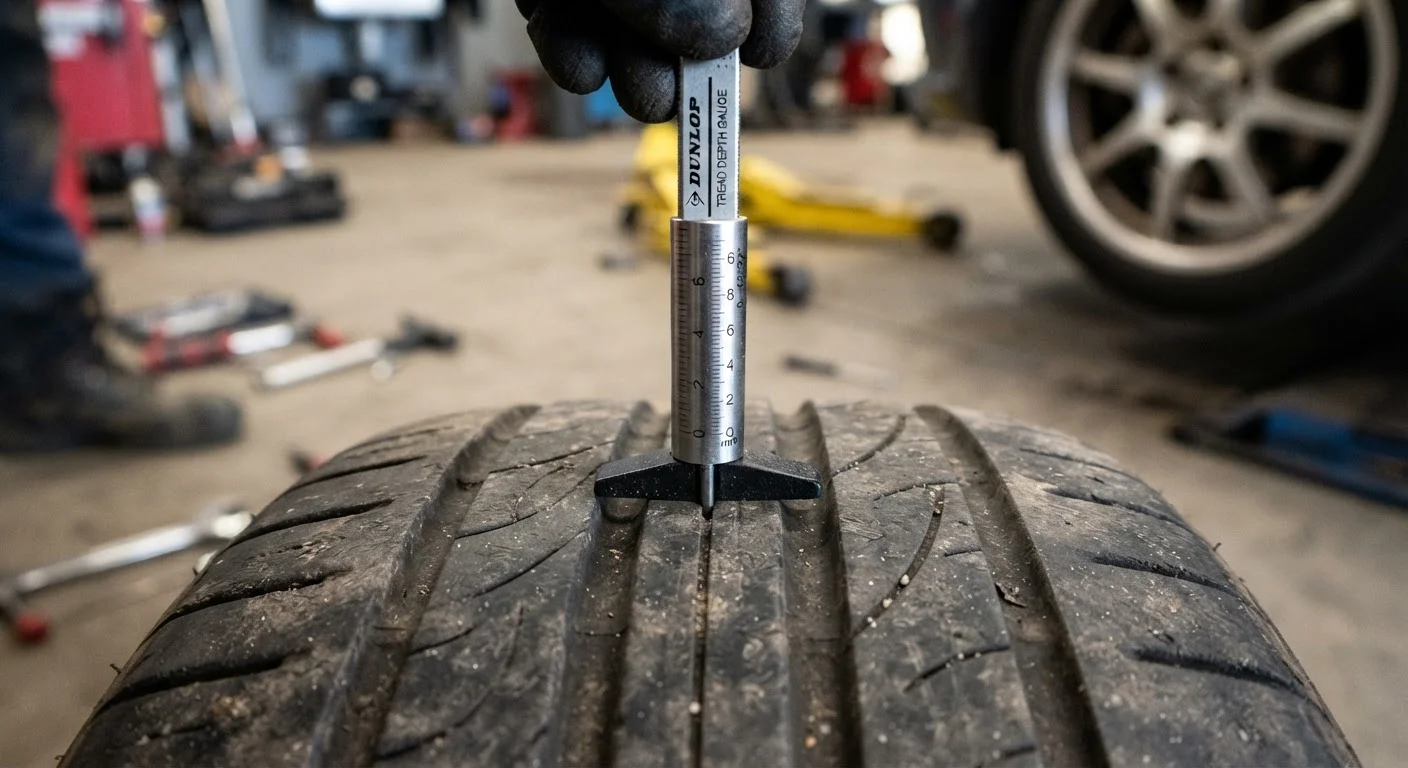
- A dedicated tread depth gauge costs a few dollars and gives a precise reading in seconds.
- Worn tread significantly increases stopping distance on wet roads, raising crash risk.
- Check all four tyres and multiple groove locations - wear is often uneven across a tyre.
What you will need
Why Tread Depth Matters More Than Most Drivers Realize
Tyre tread does one essential job: channelling water away from the contact patch so rubber maintains grip on a wet surface. As grooves wear down, their ability to displace water decreases - and braking distances grow. A vehicle travelling at 60 mph with significantly worn tyres can require noticeably more distance to stop on a wet road compared to the same vehicle with adequate tread.
Most US states set the legal minimum at 2/32 of an inch (about 1.6 mm). However, tyre performance in rain begins to decline well before that point. Many safety organizations and tyre professionals recommend planning for replacement at 4/32" (3.2 mm), especially for drivers in climates with frequent rain or where winter conditions occur.
Tread depth also matters when evaluating a used car - worn tyres on a vehicle you're considering purchasing are a real cost to factor into your offer. Pair this check with keeping tyre pressure correct, since improper inflation accelerates uneven tread wear.
Low Tread in Wet Conditions Is a Serious Safety Risk
Research consistently shows that tread depth below 4/32" measurably extends wet-road stopping distances. On a highway at speed, that additional distance can be the difference between stopping safely and a collision. Do not defer tyre replacement because the tread looks "close enough" - act before you reach the legal minimum, not after.
How to Check Your Tread Depth
You don't need to visit a shop to get a reliable tread depth reading. The methods below range from a completely free coin-based estimate to a precise gauge measurement.
What you will need
Tread Depth Gauge
Provides a precise millimetre or 32nds-of-an-inch reading directly from the tyre groove.
Penny (Lincoln Memorial side)
Used for the penny test to identify tyres at or below the 2/32" legal minimum.
Quarter (Washington head side)
Used for the quarter test to identify tyres approaching the 4/32" safety threshold.
Park on level ground and locate the tread grooves
Pull onto a flat, stable surface. The main grooves running around the circumference of the tyre are what you'll measure. Tyres also have wear indicator bars - small raised ridges moulded into the groove floor. If the tread surface is flush with these bars, the tyre has reached the 2/32" minimum and needs immediate replacement.
Run the penny test for a fast legal-minimum check
Hold a penny with Lincoln's head pointing down and insert it into the deepest groove you can find. If you can see the top of Lincoln's head, the tread depth is at or below 2/32" - that tyre is at or past the legal minimum in most states and should be replaced promptly.
Run the quarter test for an earlier safety warning
Repeat the same process with a quarter, Washington's head pointing down. If you can see the top of Washington's head, the tread is at or below 4/32". The tyre still meets the legal standard, but at this depth wet-road stopping distances begin to increase meaningfully. Plan for replacement soon rather than waiting until the penny test fails.
Use a tread depth gauge for a precise reading
Push the probe of the gauge straight down into the groove - not at an angle. Press the shoulder of the gauge flat against the tyre surface, then read the measurement on the dial or digital display. Record the result for each groove you test. Most gauges read in both 32nds of an inch and millimetres.
- 6/32" (4.8 mm) or more: Tread is in good condition.
- 4-5/32" (3.2-4.0 mm): Monitor closely; replacement approaching.
- 3/32" (2.4 mm): Replace soon.
- 2/32" (1.6 mm) or less: Replace immediately.
Check all four tyres and note any uneven wear patterns
Repeat the measurements on every tyre. Uneven wear - heavier on one shoulder, cupped patches, or a feathered surface - indicates underlying issues such as misalignment, improper inflation, or worn suspension components. These problems will accelerate tread wear even after you fit new tyres, so address the root cause.
Build Tyre Checks Into Your Seasonal Routine
Tread depth checks take less time than filling up with fuel. Adding them to a broader seasonal inspection means you'll catch wear before it becomes urgent. See the seasonal car maintenance checklist for a full pre-winter and pre-summer inspection framework.
What to Do After You've Checked
Once you have measurements for all four tyres, the next step depends on what you found:
- All tyres at 6/32" or above: No action needed beyond continuing regular checks.
- One or more tyres at 4-5/32": Schedule replacement within your next few weeks of driving.
- Any tyre at 3/32" or below: Prioritise replacement now, and avoid motorway speeds in rain.
- Any tyre at 2/32" or below: Replace before further use on public roads.
If you noticed uneven wear patterns during your inspection, have a qualified mechanic check alignment and tyre pressure before fitting replacements. Continuing to drive on misaligned wheels or incorrect pressures will wear new tyres prematurely.
Uneven Wear Signals a Deeper Problem
If one tyre wears significantly faster than the others, or wear is concentrated on one edge, the tyre itself may not be the root cause. Misalignment, under-inflation, and worn suspension parts all accelerate tread loss. Replacing tyres without fixing the underlying issue means the new tyres will wear prematurely too.
Tread checks fit naturally into broader maintenance habits. The driving and maintenance habits that protect your vehicle long-term all share the same logic: small, regular checks catch problems before they become expensive.