

Key Takeaways
- Your vehicle's correct tyre pressure is found on a door jamb sticker or owner's manual - not on the tyre sidewall.
- Underinflation is more common and more damaging than overinflation in everyday driving.
- Even correctly inflated tyres lose roughly 1 PSI per month under normal conditions.
- Checking pressure when tyres are cold gives the most accurate reading.
- Wrong tyre pressure can reduce fuel economy and shorten tyre life significantly.
Tyre Pressure
Tyre pressure refers to the amount of air inside a tyre, measured in pounds per square inch (PSI) or, in some regions, bar or kilopascals (kPa). Every vehicle has a manufacturer-recommended pressure range for both front and rear tyres. Running outside that range - whether too high or too low - causes measurable problems for safety, fuel use, and tyre longevity.
Tyre pressure is measured as gauge pressure - meaning it reads zero at atmospheric pressure, not at a true vacuum. A reading of 35 PSI means 35 PSI above ambient air pressure.
What the Numbers Actually Mean
The recommended PSI on your door jamb sticker is the pressure your vehicle's engineers determined gives the optimal balance of load capacity, fuel efficiency, handling, and tyre wear. It is specific to your car's weight distribution and suspension tuning - which is why two vehicles running identical tyres may have different recommended pressures.
The number stamped on the tyre sidewall - often labeled "Max Press" - is not a target. It is the maximum pressure the tyre structure can safely contain. Using it as your inflation guide will result in overinflation and the handling problems that come with it.
Front and rear pressures are sometimes different, especially on vehicles with rear-biased weight or performance tuning. Always check both axles separately.
TPMS Is a Backup, Not a Substitute
Most vehicles sold after 2008 are equipped with a Tyre Pressure Monitoring System (TPMS) that illuminates a dashboard warning when pressure drops significantly. However, the system typically triggers only when pressure falls around 25% below the recommended level - by which point measurable wear and efficiency losses are already occurring. Manual monthly checks remain the more reliable habit.
The Real Cost of Getting It Wrong
Underinflation is the more common problem. A tyre running significantly low flexes more with every rotation, generating excess heat. That heat degrades the rubber compound and internal structure faster than normal wear. The outer edges of the tread contact the road more heavily than the centre, creating uneven wear that shortens the tyre's usable life.
Fuel economy also suffers. An underinflated tyre has higher rolling resistance, meaning the engine must work harder to maintain speed. The effect compounds across four tyres and thousands of miles. These costs are part of the broader picture described in our article on car ownership costs beyond the purchase price.
Overinflation creates a different set of problems. The tyre becomes rigid, reducing the contact patch with the road. Centre tread wears faster than the edges, and the tyre is more vulnerable to sudden damage from road hazards.
~1 PSI
Monthly pressure loss in a normal tyre
Tyres naturally lose approximately 1 PSI per month through normal permeation, even without any puncture or leak.
1 PSI per 10°F
Pressure drop per temperature decrease
The U.S. Department of Energy notes that tyre pressure drops roughly 1 PSI for every 10-degree Fahrenheit fall in outside temperature.
~0.2%
Fuel economy loss per 1 PSI underinflation
The U.S. Department of Energy estimates fuel economy decreases by about 0.2% for each PSI drop across all four tyres.
How to Check Pressure Correctly
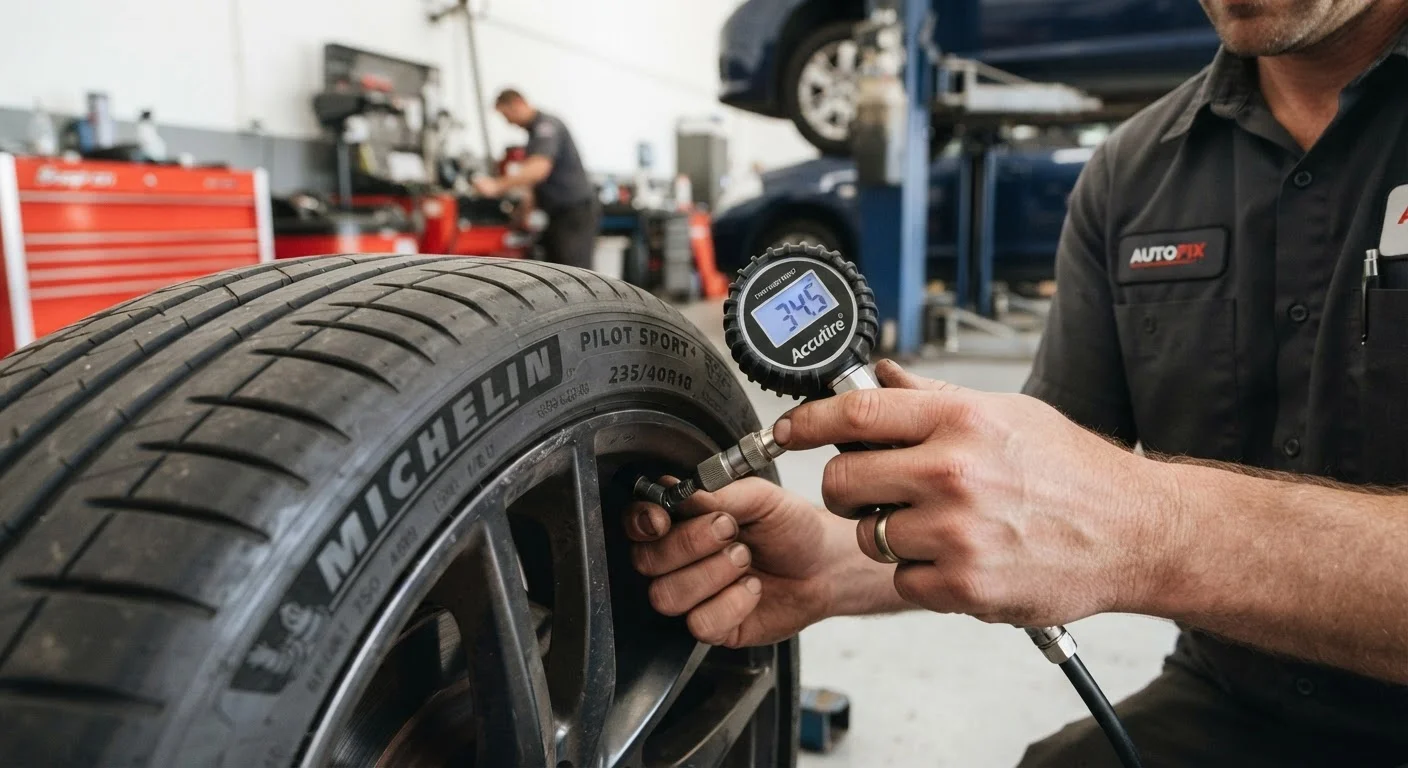
You need a tyre pressure gauge - digital models are inexpensive and straightforward to read. Analogue dial gauges also work well. Avoid the stick-type gauges commonly found at petrol stations; they are less reliable over time.
- Check when cold. Park for at least three hours before checking, or check first thing in the morning before driving.
- Remove the valve cap from the tyre stem and set it somewhere safe.
- Press the gauge firmly onto the valve stem. You may hear a brief hiss - that is normal if the seal isn't immediate.
- Read the pressure and compare it to the sticker specification.
- Add or release air as needed. Most service station air pumps allow you to add air; releasing air requires pressing the small pin inside the valve stem.
- Replace the valve cap to keep debris out.
It is also worth cross-referencing what you learn here with common car maintenance myths - several widespread beliefs about tyres turn out to be counterproductive.
Keep a Gauge in Your Glovebox
Relying on petrol station gauges introduces inconsistency - they vary in accuracy and are often mishandled. A dedicated gauge kept in your vehicle costs very little and ensures you always have a reliable tool available. Check all four tyres (and your spare, if accessible) in a single session once a month.
Temperature, Seasons, and When to Check More Often
Air contracts in cold weather and expands in heat, so tyre pressure fluctuates with the seasons even without any physical leak. A tyre properly inflated in summer may read 4-6 PSI lower when winter arrives. This is physics, not a puncture - but it still needs correcting.
Check pressure more frequently during seasonal transitions. If you switch between summer and winter tyre sets, check the stored set before fitting it - tyres lose pressure slowly in storage. And always check after any tyre has been repaired or removed.
Pair regular pressure checks with periodic tread depth checks. Pressure and tread depth together give you a complete picture of your tyres' condition. Our guide on checking your own tyre tread depth walks through the simple methods you can do at home.