

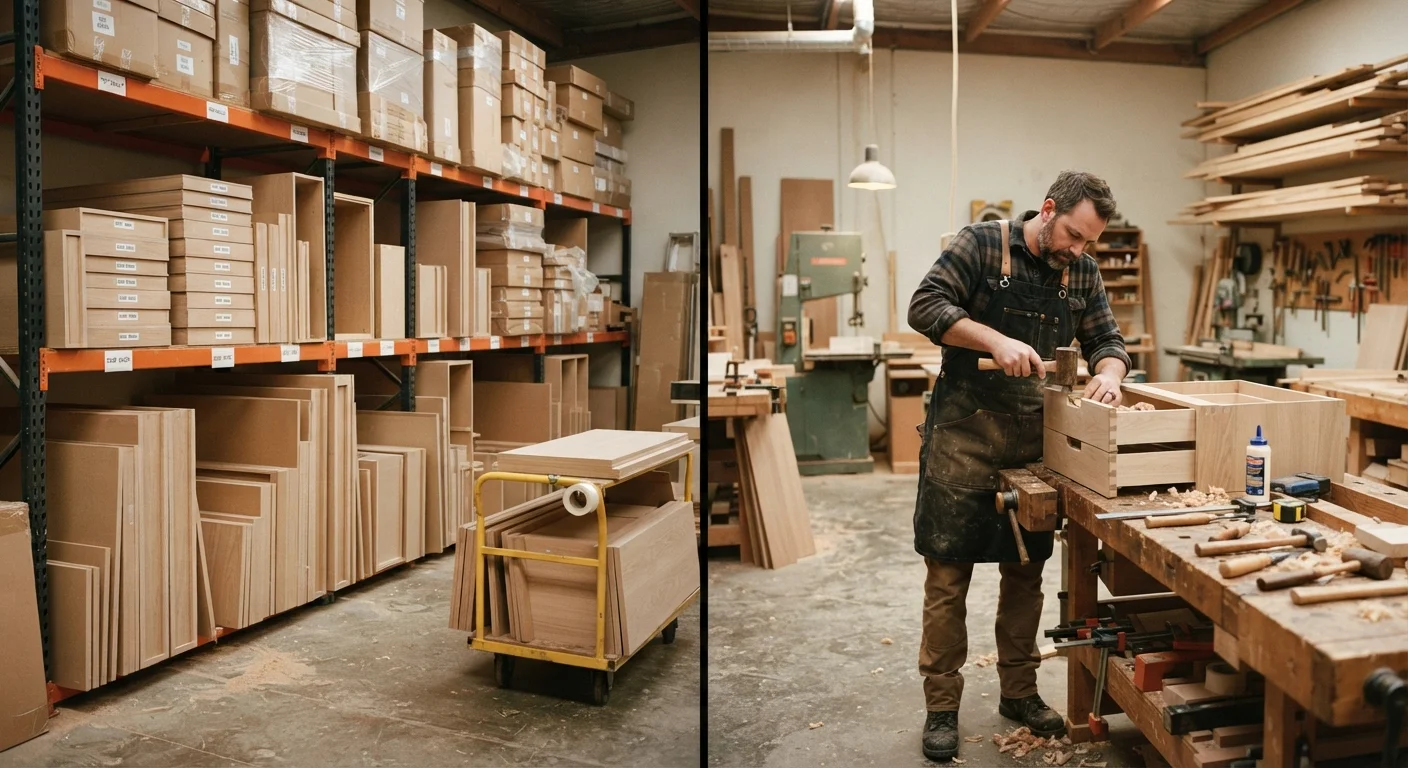
Key Takeaways
- Flat pack is significantly more affordable upfront and arrives ready to assemble within days.
- Custom joinery is made to exact dimensions, which matters most in awkward or non-standard spaces.
- Lead times for bespoke work typically run four to twelve weeks, depending on the maker and scope.
- Finish quality and material choice are far broader with custom-built options.
- Flat pack suits renters and short-term situations; custom joinery suits long-term homeowners.
- Both routes require careful planning - neither guarantees a perfect result without accurate measurements.
Option A
Flat Pack Joinery
The accessible, self-assembly route to furnished interiors.
Best for: Homeowners and renters who need affordable, quick-turnaround storage or furniture in standard-sized spaces.
Option B
Custom-Built Joinery
The tailored, trade-crafted solution for exacting spaces and finishes.
Best for: Homeowners investing in a long-term fit-out where precise dimensions, material quality, or a built-in look are non-negotiable.
If you're furnishing a rental or a temporary home
Flat Pack Joinery
Flat pack is portable, cost-effective, and replaceable without the financial loss of leaving custom work behind.
If your space has awkward alcoves, sloped ceilings, or non-standard dimensions
Custom-Built Joinery
Only bespoke work can be built precisely to fill irregular spaces without visible gaps or workarounds.
If you're working to a tight budget and a short timeline
Flat Pack Joinery
Flat pack ships quickly and costs a fraction of custom joinery, making it practical when funds or time are limited.
If you're completing a high-end renovation or preparing to sell
Custom-Built Joinery
Bespoke built-ins signal quality to buyers and integrate seamlessly with architectural details that flat pack cannot replicate.
If you want specific materials, finishes, or an integrated look
Custom-Built Joinery
Custom makers can match existing timber, paint finishes, and hardware in ways flat-pack ranges simply don't offer.
How Each Approach Actually Works
Flat pack joinery is manufactured in standardized components - panels, carcasses, doors, and fittings - that are produced at scale, packaged flat, and shipped to you for self-assembly. The parts are designed to fit together using cam locks, dowels, or screws, and most ranges are built around modular widths (typically 30 cm to 90 cm increments). The trade-off for that affordability and speed is rigidity: you work with the dimensions the manufacturer decided on, not the dimensions your room actually has.
Custom-built joinery works the opposite way. A joiner (or cabinetmaker) visits your space, takes precise measurements, designs around the specific constraints of the room, and fabricates components - usually from solid timber, MDF, or plywood - to those exact dimensions. Every joint, hinge position, and panel is made for that specific job. The finished piece is installed on-site and, in most cases, becomes a permanent fixture of the property.
Understanding this difference clarifies nearly every practical question that follows: cost, timeline, finish, and longevity all flow from whether the work is standardized or made-to-measure. For a broader framework on how to evaluate these kinds of decisions systematically, see our personal comparison framework guide.
Cost, Lead Time, and Practicalities
| Criterion | Flat Pack | Custom-Built |
|---|---|---|
| Typical cost range | Lower - mass-produced pricing | Higher - labour and materials |
| Lead time | Days to 2 weeks | 4-12 weeks typically |
| Dimension flexibility | Fixed modular sizes | Made to exact measurements |
| Primary carcass material | Particleboard / melamine | MDF, plywood, or solid timber |
| Finish options | Catalog colours and styles | Fully specifiable |
| Installation | Self-assembly or handyperson | Installed by the maker |
| Portability | Can be disassembled and moved | Typically a permanent fixture |
| Best for irregular spaces | Poor - gaps likely | Excellent - built to fit |
The cost gap between flat pack and custom joinery is substantial. For a standard kitchen, flat-pack carcasses and doors from a typical supplier might cost $2,000-$6,000 for materials alone; an equivalent run of custom cabinetry from a qualified joiner can run $10,000-$25,000 or more, depending on materials and complexity. These are general indicative ranges - actual quotes vary widely by region, scope, and specification.
Lead time is another practical dividing line. Flat-pack orders typically ship within a few days to two weeks. Custom joinery generally requires a site measure, a design sign-off period, and then fabrication - a realistic combined timeline of four to twelve weeks is common, though complex or high-demand jobs can run longer.
Installation is a further variable. Flat pack is designed for homeowner self-assembly, though many people hire a handyperson to fit it. Custom joinery is installed by the maker or their team as part of the contract, which is factored into the quote. If your project is part of a larger renovation - say, a home extension - it's worth reading our guide to extension and conversion trade-offs to understand how joinery choices interact with broader structural timelines.
Quality, Finish, and Longevity
Flat pack uses particleboard (chipboard) as the primary carcass material in most ranges, with melamine or laminate facing. It's durable under normal use but less resistant to moisture, impact, and heavy loads than solid timber or quality plywood. Higher-specification flat-pack lines use thicker boards and better hardware, which meaningfully improves durability - but the core material constraint remains.
Custom joinery typically uses MDF, moisture-resistant MDF, birch plywood, or solid timber depending on the application and budget. A skilled joiner can also specify soft-close hardware, dovetail drawer boxes, painted or stained finishes matched to your existing trim, and integrated lighting or power. The finish is limited primarily by your budget and the joiner's skill, not by a product catalog.
A Note on Mid-Range Options
There is a middle ground worth knowing about: semi-custom or 'made-to-order' joinery, offered by some specialist suppliers and kitchen retailers. These services take flat-pack components but cut panels to custom dimensions on request, often at a cost between full flat-pack and fully bespoke. Quality varies considerably by supplier, so it pays to ask specifically about the carcass material, maximum dimension tolerances, and whether installation is included.
For decisions specifically about shelving and storage configuration - regardless of which joinery route you take - our open shelving vs. closed cabinets comparison covers the practical and visual trade-offs in depth.