

Key Takeaways
- Open shelving rewards households that maintain visible order; clutter becomes immediately apparent.
- Closed cabinets reduce dust accumulation and visual noise, requiring less daily upkeep.
- Most rooms benefit from a deliberate combination of both storage types rather than an all-or-nothing approach.
- Your organizational habits - not aesthetics alone - should drive the choice between the two.
- Open shelving can make small rooms feel larger; closed cabinets help chaotic spaces feel calmer.
Option A
Open Shelving
The visually accessible, display-forward approach.
Best for: Organized households that want items within easy reach and enjoy curating how their space looks.
Option B
Closed Cabinets
The contained, low-maintenance storage standard.
Best for: Busy households that prioritize hiding clutter and reducing daily tidying effort.
If you maintain tidy habits and enjoy displaying curated items
Open Shelving
Items you genuinely organize and enjoy looking at become part of the room's character. The visibility also makes retrieval fast and intuitive.
If your household generates consistent clutter or you dislike frequent tidying
Closed Cabinets
Doors contain disorder out of sight, reducing the mental load of a visually busy space without requiring daily intervention.
If you're working with a small kitchen or compact living area
Open Shelving
Uninterrupted wall surfaces and visible depth can make a small room feel more open, provided the shelves stay organized.
If dust, grease, or humidity is a concern in your space
Closed Cabinets
Enclosed storage protects items from airborne particles and moisture, reducing cleaning frequency and protecting contents longer.
If you want flexibility without fully committing to one approach
Open Shelving
Open shelves are generally easier to install, reconfigure, or remove, making them a lower-commitment option for renters or those still working out their storage needs.
What You're Actually Deciding
Choosing between open shelving and closed cabinets isn't purely a design decision - it's a practical question about how your household actually functions day to day. Both systems store things. The difference lies in what they demand from you in return.
Open shelving puts everything on display. That visibility is an asset when your items are well-organized and deliberately chosen, but it becomes a liability the moment things slip. Every dish out of place, every random object set down temporarily, is immediately visible. Closed cabinets absorb that disorder behind a door, which is either a relief or a crutch, depending on your perspective.
Before committing to either, it helps to think honestly about your organizational habits. If you're still working through what to keep and what to let go, the difference between decluttering and organizing matters here - resolving that question first will inform which storage style actually suits you.
| Criterion | Open Shelving | Closed Cabinets |
|---|---|---|
| Visibility of contents | Fully visible at a glance | Hidden behind doors |
| Dust and maintenance | Requires frequent wiping | Contents stay cleaner longer |
| Visual calm | Depends on consistent tidiness | Contained regardless of disorder inside |
| Retrieval speed | Immediate - no doors to open | Slightly slower, especially deep cabinets |
| Installation flexibility | Generally easier to install/move | More involved installation typical |
| Cost range | Often lower upfront | Varies widely; generally higher |
| Best room fit | Kitchens, living rooms, offices | Kitchens, bathrooms, utility rooms |
The Real Advantages and Limitations of Each
Open shelving encourages intentionality. When everything is visible, most people naturally keep fewer things on those shelves - which can be a genuine organizing benefit. Retrieval is fast: no opening doors, no searching in the back of a deep cabinet. In kitchens, open shelves make frequently used items immediately accessible. In living rooms or home offices, they let books and objects become part of the room rather than hidden away.
The trade-offs are real, though. Dust settles on open shelves continuously, meaning items need regular wiping. In kitchens near a stove, grease and steam coat anything left exposed. And visual calm depends entirely on keeping things orderly - a hard standard to maintain in a busy household.
Closed cabinets offer containment. Disorder disappears behind a door, which lowers visual stress and reduces how often you need to tidy up. They also protect contents from dust, moisture, and light degradation. For items used infrequently - seasonal supplies, paperwork, cleaning products - enclosed storage is usually the more sensible choice.
The limitations are equally worth naming. Cabinets can become black holes where things get pushed to the back and forgotten. Deep cabinets in particular waste space unless fitted with pull-out organizers or thoughtful shelving. And the upfront cost of built or installed cabinetry is typically higher than open shelving, though flat-pack options exist at various price points. For a closer look at those trade-offs, flat pack vs. custom-built joinery covers the key differences in quality, flexibility, and cost.
Mixing Both Isn't a Compromise
Many well-organized homes use open shelving and closed cabinets in the same room intentionally. Keeping open shelves for items used daily and cabinets for everything else is a functional strategy, not an indecisive one. The goal is a system that supports your actual habits - not one that looks good only when company's coming.
How to Think About Room by Room
There's no single answer that applies across an entire home. Most rooms benefit from a deliberate mix of both approaches, placed according to how that space is actually used.
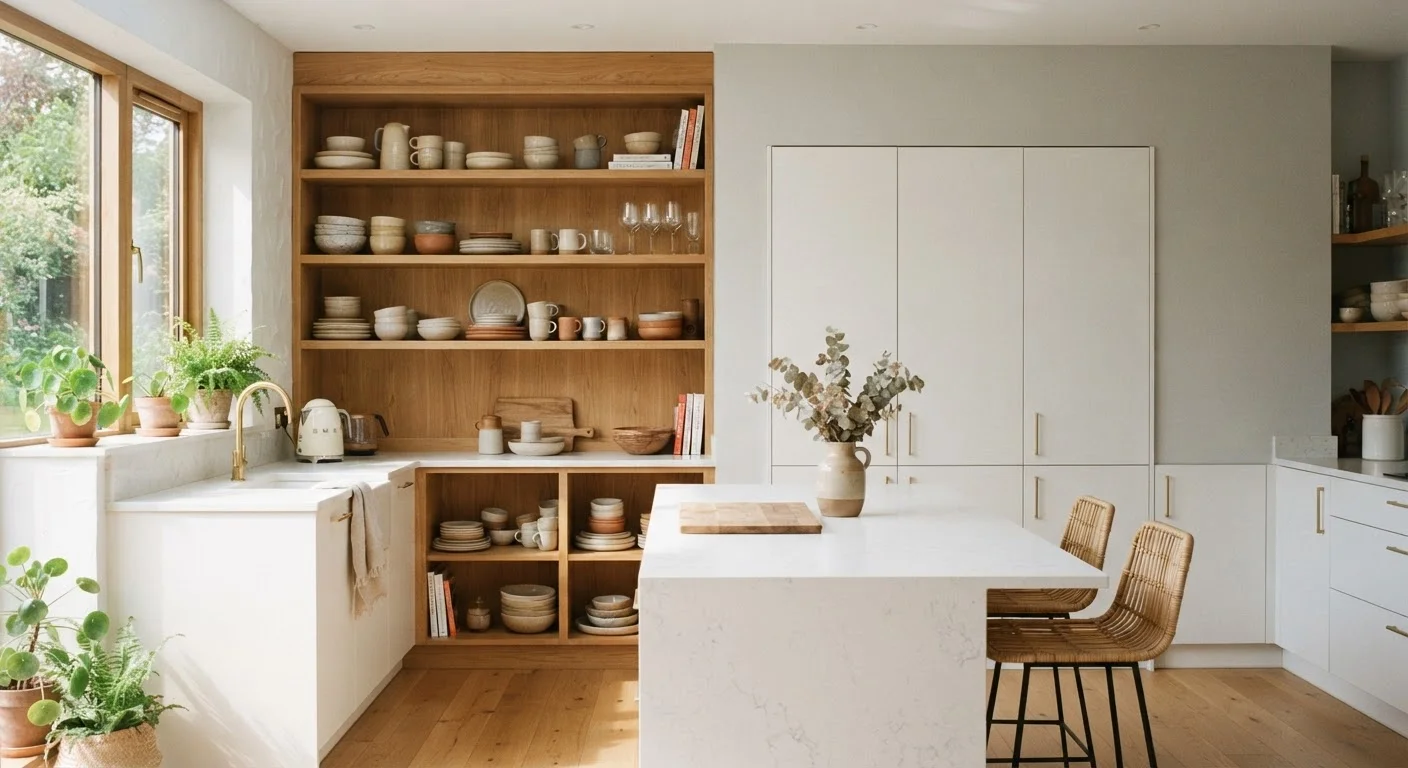
In kitchens, open shelves work well for everyday dishes, glasses, and items used multiple times a day. Closed cabinets make more sense for less-used appliances, bulk goods, and anything you'd prefer to keep clean and contained. The upper cabinets flanking a range hood are also better closed - grease travels farther than most people expect.
In living rooms, open shelving suits books, plants, and curated objects. If you have media equipment, cables, or miscellaneous items that accumulate, a cabinet with doors keeps that portion of the room visually settled.
In home offices, closed storage for paperwork and supplies reduces distraction. A shelf or two kept open for reference books or tools you use constantly can add function without chaos.
If vertical wall space is underused in any of these rooms, it's worth considering how shelving - open or enclosed - could expand your storage capacity upward. Using vertical space effectively is one of the more reliable ways to increase storage without adding floor footprint. Similarly, if your storage challenges extend beyond a single room, storage solutions for small spaces offers a broader set of approaches worth considering.
40%
Kitchen storage used for rarely accessed items
Home organization research consistently suggests a large share of cabinet space holds items used less than once a month, pointing to the value of auditing contents before choosing a storage system.
2-3x
More frequent dusting needed on open shelves
Compared to enclosed storage, open shelves in kitchens and living areas typically require significantly more frequent cleaning to keep contents presentable.