

Key Takeaways
- A perfect 5-star average often signals a small, curated, or manipulated review pool rather than universal satisfaction.
- Authentic products typically show a spread of ratings, including some 3- and 4-star reviews that reflect honest, varied experiences.
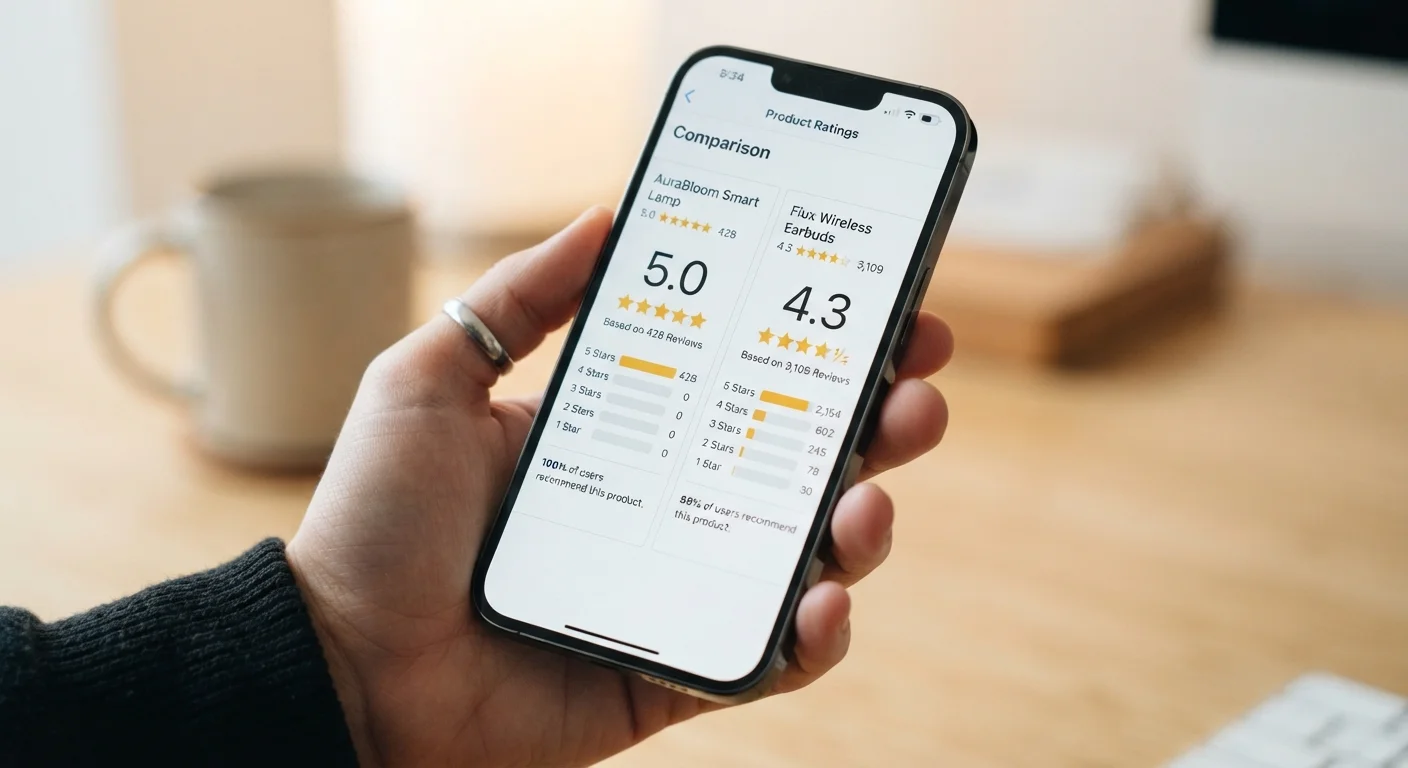
- The volume of reviews matters as much as the score - a 4.3 from 2,000 reviewers is more reliable than a 5.0 from 12.
- Review text, verified purchase badges, and distribution shape are stronger quality signals than the summary star number alone.
- One-star reviews, read critically, often reveal real product limitations that marketing copy never mentions.
Review Score Distribution
A review score distribution shows how customer ratings are spread across all possible star levels - not just the average. Instead of seeing only a 4.3 or 5.0 summary number, you can see exactly how many people gave 1, 2, 3, 4, or 5 stars. This breakdown reveals patterns that a single average number hides.
Platforms that surface distribution histograms allow users to detect rating manipulation signatures, such as an unnatural absence of 2- and 3-star reviews in an otherwise high-volume dataset.
The Problem With Perfect
When you scan search results, a 5-star rating feels like the obvious choice. But that intuition is worth questioning. In practice, a perfect score on a product with significant review volume is statistically rare for an honest reason: real customers disagree. They use products differently, have varying expectations, and encounter different quality control outcomes. Genuine satisfaction is almost never unanimous.
A product that has attracted hundreds of buyers and still holds a 5.0 average deserves scrutiny, not immediate trust. The distribution of those ratings - how many 1s, 2s, 3s, 4s, and 5s make up that average - tells the real story. An authentic high performer typically earns a 4.2-4.6 range, not a perfect score.
~4.2-4.5
Typical average for genuinely well-regarded products
Consumer research consistently finds that high-volume, authentic product ratings cluster in this range rather than at a perfect 5.0.
30%+
Online reviews estimated to be unreliable
Various independent analyses of major retail platforms have flagged substantial portions of reviews as potentially incentivized, fake, or otherwise unreliable.
What the Distribution Shape Actually Tells You
Most major retail platforms display a histogram alongside the summary star rating. This bar chart breaks down the percentage of reviews at each star level. Learning to read it takes about ten seconds and can save you from a bad purchase.
A healthy distribution for a well-regarded product typically looks like a left-skewed J-curve: most ratings cluster at 4 and 5 stars, with a modest tail of 1- and 2-star reviews. That tail is important. It means real buyers encountered real problems and reported them - which is exactly what you'd expect from an honest review pool.
A suspicious pattern looks different: an overwhelming majority of 5-star ratings, almost no 2- or 3-star reviews, and a small cluster of 1-star reviews that often describe shipping rather than the product itself. This shape suggests rating inflation, whether through incentivized reviews, selective removal, or other manipulation. For a deeper look at how platforms aggregate these numbers, see what review platforms don't tell you about how ratings are calculated.
Check the Distribution Before the Average
Before reading a single review, look at the star histogram. If 5-star ratings account for 90% or more of all reviews and there are almost no 2- or 3-star entries, treat the average with skepticism regardless of how high it is. A balanced spread is a better sign of authenticity than a high number alone.
Why Volume Changes Everything
A 5.0 average from 8 reviews and a 4.3 average from 1,400 reviews are not comparable data points. The first tells you that eight people - who may include the seller's friends, early adopters, or incentivized buyers - were satisfied. The second reflects the aggregated experience of over a thousand buyers across varied contexts.
Statistical confidence increases with sample size. A 4.3 from a large pool is a more precise estimate of what a typical buyer will experience than any small-sample perfect score. This is why researchers and consumer advocates consistently recommend looking at review count alongside rating when comparing options.
Volume also makes manipulation harder to sustain. Injecting fake 5-star reviews into a pool of 50 reviews has a dramatic effect on the average; doing the same across 2,000 reviews barely moves the needle. High-volume ratings - especially from platforms that verify purchases - are simply harder to game at scale.
For a structured framework on comparing products using these signals, the Comparing Products hub covers the full evaluation process.
How to Use Review Text Alongside the Score
The star number is a summary. The text is the evidence. Experienced shoppers treat the written reviews as primary and the average rating as a rough filter. Look for reviews that describe specific use cases, mention particular features by name, or note how the product performed over time - these signals indicate firsthand experience.
Generic phrasing like "great product, highly recommend" repeated across dozens of reviews is a warning sign. So is a flood of reviews posted within a narrow time window, or text that reads more like marketing copy than personal experience.
The anatomy of an online review breaks down each element - verified badges, reviewer history, helpfulness votes - and explains how much weight to give each one. Pairing that analysis with distribution awareness gives you a complete picture that no summary score can provide on its own.