

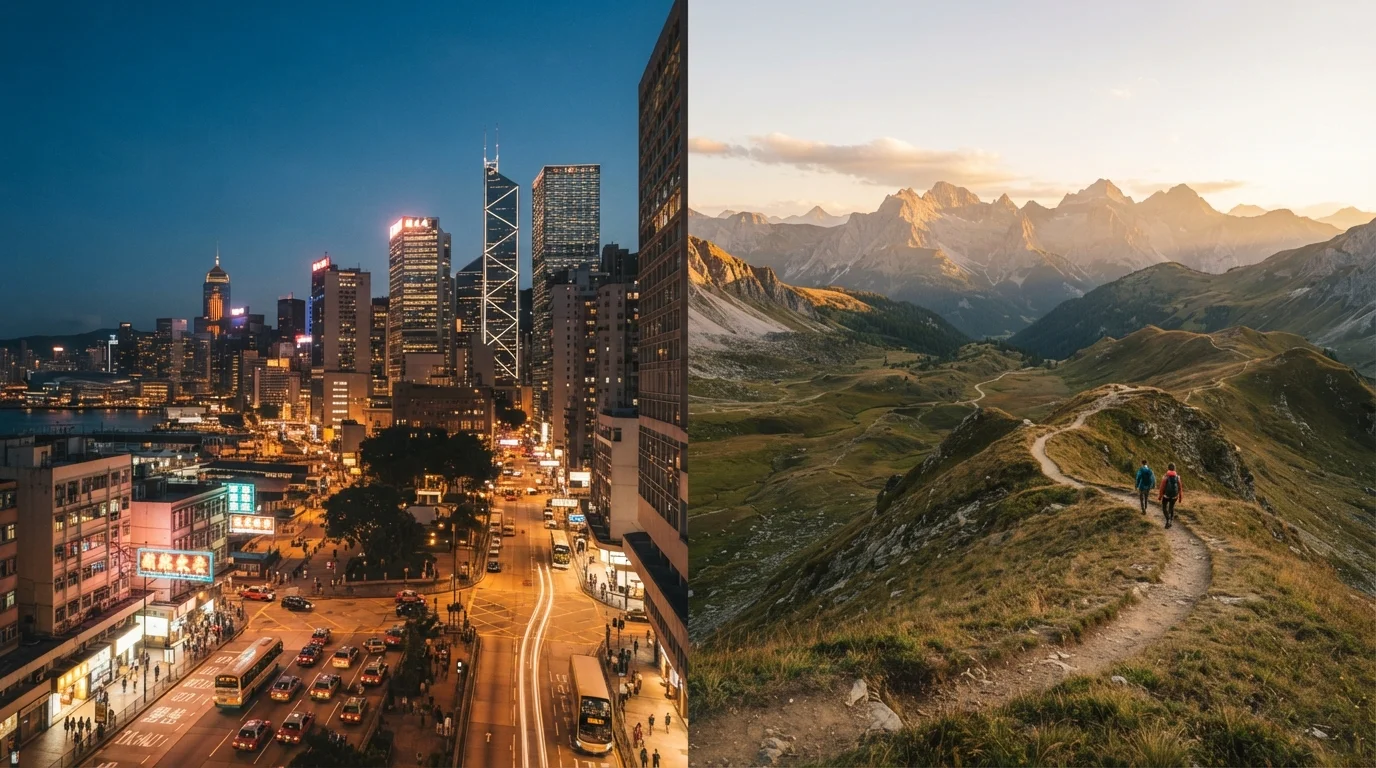
Key Takeaways
- City trips offer dense activity per square mile; nature trips require more travel time between experiences.
- Nature-based trips often demand advance permits, seasonal timing, and gear preparation that city trips don't.
- Urban travel tolerates flexible booking more easily; popular trailheads and parks may require reservations months ahead.
- Both trip types can be physically demanding - cities involve lots of walking; nature trips can involve strenuous terrain.
- Mixing both in one itinerary is possible but can dilute the rhythm of each - pacing matters.
Option A
City Trips
The dense, culturally layered urban experience.
Best for: Travelers who want museums, food scenes, architecture, and the ability to pivot plans spontaneously without logistics headaches.
Option B
Nature-Based Trips
The open-air, landscape-driven escape.
Best for: Travelers seeking physical immersion in wilderness, national parks, or coastal environments where the landscape itself is the main event.
If you have five days or fewer and want maximum variety
City Trips
Cities pack culture, food, history, and neighborhoods into walkable distances, making short trips genuinely rewarding without wasted transit time.
If rest and disconnection are your primary goals
Nature-Based Trips
Natural environments - forests, coastlines, mountains - deliver the low-stimulation, high-restoration experience that urban settings rarely can.
If you're traveling with mixed-ability companions or families with young children
City Trips
Urban infrastructure, accessible attractions, and easy food options create far fewer logistical friction points for groups with varied needs.
If physical activity and landscape exploration are central to your trip
Nature-Based Trips
Hiking, kayaking, wildlife observation, and open terrain are only available at scale in natural settings - cities can't replicate that.
If you want to understand a country's culture as deeply as possible
City Trips
Urban centers concentrate a destination's history, cuisine, art, and contemporary life in ways that rural or wilderness areas typically don't.
What Each Trip Type Actually Delivers
The clearest way to choose between a city trip and a nature-based trip is to start with what you're actually trying to feel by the end of it. Both are genuinely satisfying - but in completely different registers.
City trips deliver stimulation, variety, and cultural density. A well-planned urban itinerary lets you move from a world-class museum to a neighborhood market to a historic district in a single afternoon. The built environment does a lot of the work - signage, transit, restaurants, and accommodation are all close together. Spontaneity is low-risk: if a plan falls through, there's almost always something else within walking distance. Destinations like Tokyo or Rome reward city-focused travelers with layers of experience that take multiple trips to fully absorb - as explored in our guides to Japan's regional personalities and Italy's geography.
Nature-based trips deliver space, physicality, and the particular kind of reset that comes from sustained time outdoors. The trade-off is logistics: trailheads may be an hour from the nearest town, weather can close access routes, and the best experiences often require advance permits. The payoff - genuine solitude, wildlife, and landscapes that feel nothing like daily life - is hard to replicate anywhere else.
| Criterion | City Trips | Nature-Based Trips |
|---|---|---|
| Advance planning required | Moderate - most things bookable days ahead | High - permits and access often months ahead |
| Logistical complexity | Lower - transit and services abundant | Higher - remote access, gear, weather dependency |
| Activity density | High - many options per square mile | Lower - fewer activities, longer travel between them |
| Ideal trip length | 3-7 days workable | 5+ days recommended for meaningful access |
| Physical demand | Moderate - sustained walking on hard surfaces | Variable - can be strenuous; terrain-dependent |
| Seasonality sensitivity | Low to moderate | High - access and conditions change significantly |
| Cultural immersion | High - museums, food, history, locals | Lower - nature-focused, less cultural infrastructure |
Planning Differences That Catch People Off Guard
The logistical gap between these two trip types is wider than most people expect before their first nature-focused trip.
City travel is relatively forgiving. Most bookings can be made days or even hours in advance. Public transit handles the heavy lifting. If you overpack your schedule - a common pitfall covered in our guide to realistic trip pacing - the consequences are usually just fatigue, not a missed permit window.
Nature trips operate on harder constraints. Popular US national parks now require timed-entry reservations during peak seasons. Backcountry permits for destinations like Yosemite's Half Dome or Utah's Wave lottery can be competitive months in advance. Gear requirements add pre-trip preparation that city trips don't demand. Seasonality also matters more acutely: a mountain trail that's spectacular in September may be inaccessible or dangerous in early spring.
Permit and Reservation Timelines Vary Widely
Rules for national park entry, backcountry permits, and timed-entry reservations change regularly and differ significantly by location. Always verify current requirements directly through official park and government sources before finalizing any nature-based itinerary. Assuming last-year's rules still apply is one of the most common planning mistakes for outdoor trips.
The fixed vs. flexible booking decision looks very different depending on your trip type. Urban travelers can often stay looser; nature travelers typically need to lock in key reservations early or risk missing the experience entirely.
Pacing, Energy, and What Each Type Costs You
Both trip types are more physically demanding than many people anticipate - just in different ways.
City trips involve a lot of walking on hard surfaces. A full day of sightseeing in a dense urban center can mean 10-15 miles on foot without it feeling like exercise. Mental stimulation is high and near-constant: noise, navigation, crowds, and decision-making accumulate into a kind of tiredness that's distinct from physical exhaustion.
Nature trips shift the demand. The physical challenge is often more acute - elevation gain, uneven terrain, variable weather - but the mental load drops significantly. There's less to decide, fewer crowds to navigate, and a slower pace that many travelers find easier to sustain emotionally even when legs are tired.
10-15 mi
Daily walking distance in dense city sightseeing
Urban travel researchers and fitness tracking studies consistently find that full sightseeing days in major cities generate high step counts comparable to moderate hikes.
Months
Lead time for competitive backcountry permits
Some of the most sought-after US backcountry permits - including several in Yosemite and Zion - operate on lottery or reservation systems that open months before the travel date.
Understanding your own energy profile matters here. If you return from vacations feeling like you need a vacation, a nature trip's slower rhythm might be the better fit. If you come home energized by everything you saw and did, the density of city travel probably suits you well. For a broader look at how travel style connects to personality, our piece on adventure vs. leisure travel explores the deeper philosophical split.
Mixing both styles in one trip is appealing but requires honest itinerary discipline. A few days in a city followed by several days in nature can work well - but only if the transition is built into the schedule with enough buffer. Cramming both into a short window often means doing neither justice. The Travel by Type hub has more on matching trip structure to traveler profile.