

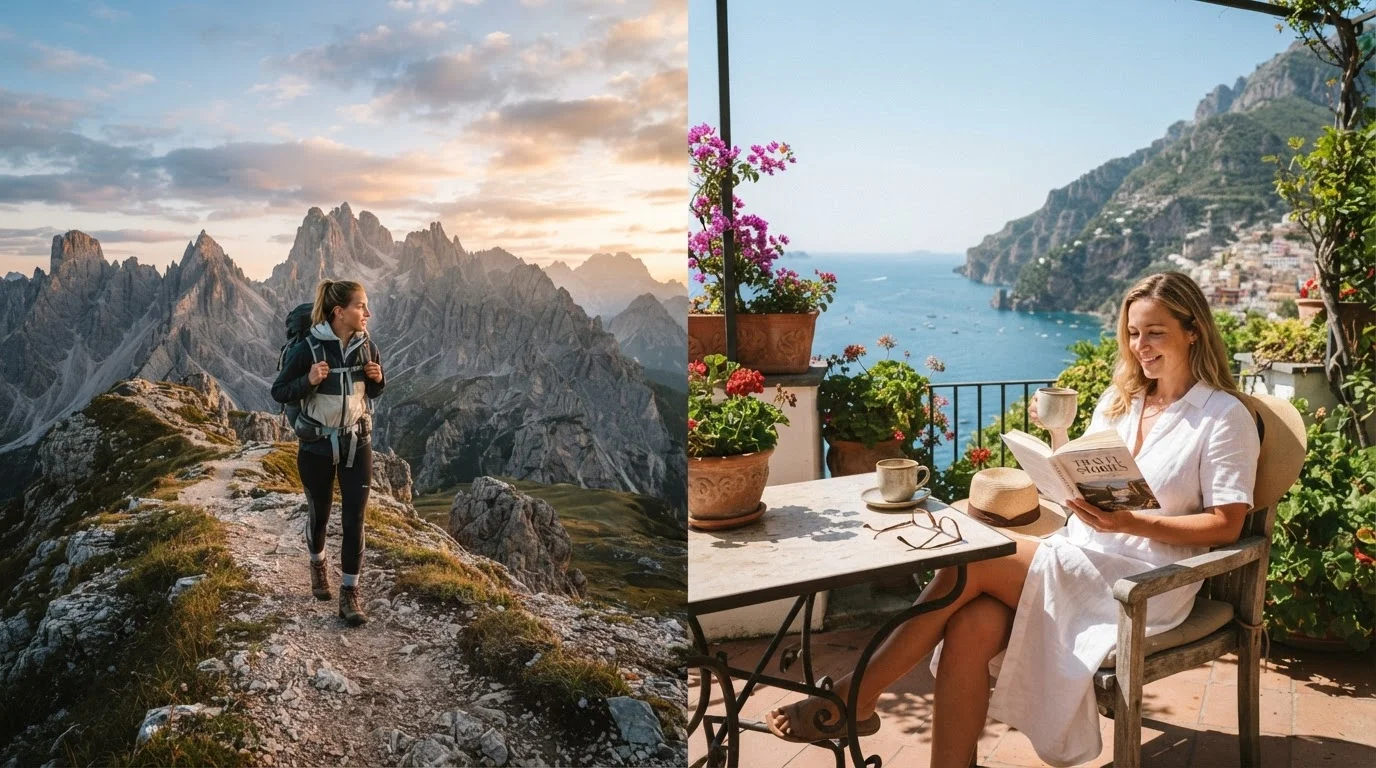
Key Takeaways
- Adventure and leisure travel differ in intent and physical demand, not just activity level.
- Many travelers naturally blend both styles within a single trip without realizing it.
- Your travel history, fitness baseline, and recovery needs should all shape your choice.
- Neither style is inherently better - fit depends on what you actually need from a trip.
- Planning requirements differ significantly: adventure trips often require more lead time and logistics.
Option A
Adventure Travel
The pursuit-driven, physically engaged approach.
Best for: Travelers who want physical challenge, immersive environments, and experiences built around doing rather than unwinding.
Option B
Leisure Travel
The restorative, discovery-paced alternative.
Best for: Travelers seeking rest, cultural immersion, and the freedom to explore at a pace that doesn't demand physical output.
If you want a trip that leaves you physically challenged and deeply immersed
Adventure Travel
Adventure travel is built around active engagement - hiking, kayaking, climbing, or remote exploration. You'll return changed, not just rested.
If you're recovering from burnout or need genuine downtime
Leisure Travel
Leisure travel prioritizes restoration. A slower pace, flexible days, and low-pressure exploration give your nervous system room to decompress.
If you want cultural depth without heavy physical demands
Leisure Travel
Food, art, architecture, and local rhythms are all accessible through leisure travel without needing physical conditioning or specialist gear.
If you travel solo and want structure that keeps you engaged
Adventure Travel
Guided adventure trips or self-planned outdoor itineraries offer built-in purpose and social connection - especially useful when traveling alone.
If your group includes mixed fitness levels or ages
Leisure Travel
Leisure travel adapts more easily to different physical needs and preferences, reducing the friction that comes with varying ability levels.
What Actually Separates These Two Travel Philosophies
The word "adventure" gets stretched in travel marketing until it covers everything from zip-lining to a mildly spicy food tour. And "leisure" is sometimes used dismissively, as if relaxing on a trip is somehow settling. Neither framing is useful. The real distinction comes down to intent and engagement mode - what you're asking a trip to do for you.
Adventure travel is organized around an activity or environment that demands something from you physically or psychologically. That might mean trekking a high-altitude route, whitewater rafting, or backpacking through remote terrain. The experience is the challenge - and the challenge is the point. Leisure travel, by contrast, is organized around discovery and restoration. The pace is self-determined, the schedule is flexible, and the goal is absorption rather than accomplishment.
Importantly, these aren't mutually exclusive. A trip to a national park might include a strenuous day hike followed by three days of scenic drives and slow meals. Slow travel in particular borrows heavily from the leisure philosophy while sometimes incorporating active elements. The useful question isn't "which one am I doing?" but rather "which mode should anchor this trip?"
| Criterion | Adventure Travel | Leisure Travel |
|---|---|---|
| Primary goal | Challenge, accomplishment, immersion | Rest, discovery, restoration |
| Physical demand | Moderate to high | Low to moderate |
| Planning lead time | Often months in advance | More flexible, shorter windows possible |
| Schedule flexibility | Often fixed by activity or guide | Highly adaptable day-to-day |
| Gear requirements | Specialist equipment common | Standard luggage typically sufficient |
| Solo-traveler fit | Strong (built-in structure via guides) | Good (freedom, but less scaffolding) |
| Group adaptability | Requires matched fitness/risk tolerance | Accommodates varied needs more easily |
| Best recovery context | Physically fit, low-stress life period | Burnout, recovery, or mixed-fitness groups |
Planning Demands: Where the Two Styles Really Diverge
One of the most practical differences between adventure and leisure travel shows up before you ever leave home. Adventure trips typically require significantly more lead time. Guided expeditions book out months in advance. Physical preparation - conditioning, gear acquisition, altitude acclimatization - may need to start weeks or months before departure. Permits for popular routes can be competitive and non-refundable.
Leisure travel is generally more forgiving. While popular destinations still reward earlier planning (especially for accommodation), the day-to-day schedule can remain loose. You can decide over breakfast whether to visit a museum or wander a market. That flexibility is itself part of the value. A well-built itinerary for a leisure trip often has anchoring bookings but open middles - intentional white space rather than gaps.
For adventure travel, deciding between self-planned and guided formats is a major early decision. Guided trips handle logistics and safety infrastructure, but cost more and require fitting your schedule to theirs. Self-planned adventure travel offers more freedom but demands more research, especially for remote or technical terrain.
72%
Travelers who mix activity types on one trip
According to the Adventure Travel Trade Association's research, a majority of adventure travelers also incorporate rest and cultural elements into their trips.
3-6 months
Typical advance planning for guided expeditions
Popular guided adventure routes - particularly in high-altitude or permit-controlled areas - commonly require booking three to six months ahead.
Matching Trip Style to Your Actual Situation
The most useful lens here isn't preference in the abstract - it's your current life context. Fitness baseline matters: adventure travel at altitude or on multi-day treks requires genuine physical preparation, not just general health. If you're coming off a period of low activity or recovering from anything physically taxing, leisure travel gives your body a more appropriate ask.
Mental load matters too. High-stakes professional periods often call for trips that don't add cognitive demands. An adventure trip with gear lists, route navigation, and weather contingencies can feel like more work - even when it's work you enjoy. Leisure travel tends to carry lower decision fatigue once you're in destination.
Your travel companions shape the equation significantly. Group dynamics interact directly with trip style - mixed fitness levels, different risk tolerances, and age ranges all push toward leisure travel's adaptability. Solo travelers, on the other hand, often find that adventure travel's built-in structure (guided groups, shared itineraries) provides social scaffolding that pure leisure trips don't. Solo travel takes many forms, and the style you choose should reflect both your comfort with solitude and your appetite for challenge.
Finally, consider what you're actually hoping to come home with. A sense of accomplishment and physical transformation? Adventure travel delivers that. A deeper sense of a place - its food, culture, rhythm? Leisure travel, especially in destinations with distinct regional character, tends to go deeper there. Whether you're drawn to cities or nature is often an early signal of which mode suits your goals.
Neither Style Requires a Label
You don't need to declare yourself an "adventure traveler" or a "leisure traveler" before planning a trip. Most experienced travelers shift between both depending on where they are in life. The framework here is meant to help you identify what you need from a specific trip - not to categorize your entire travel identity. When in doubt, exploring destination-specific planning resources can help clarify what a given place naturally lends itself to.