

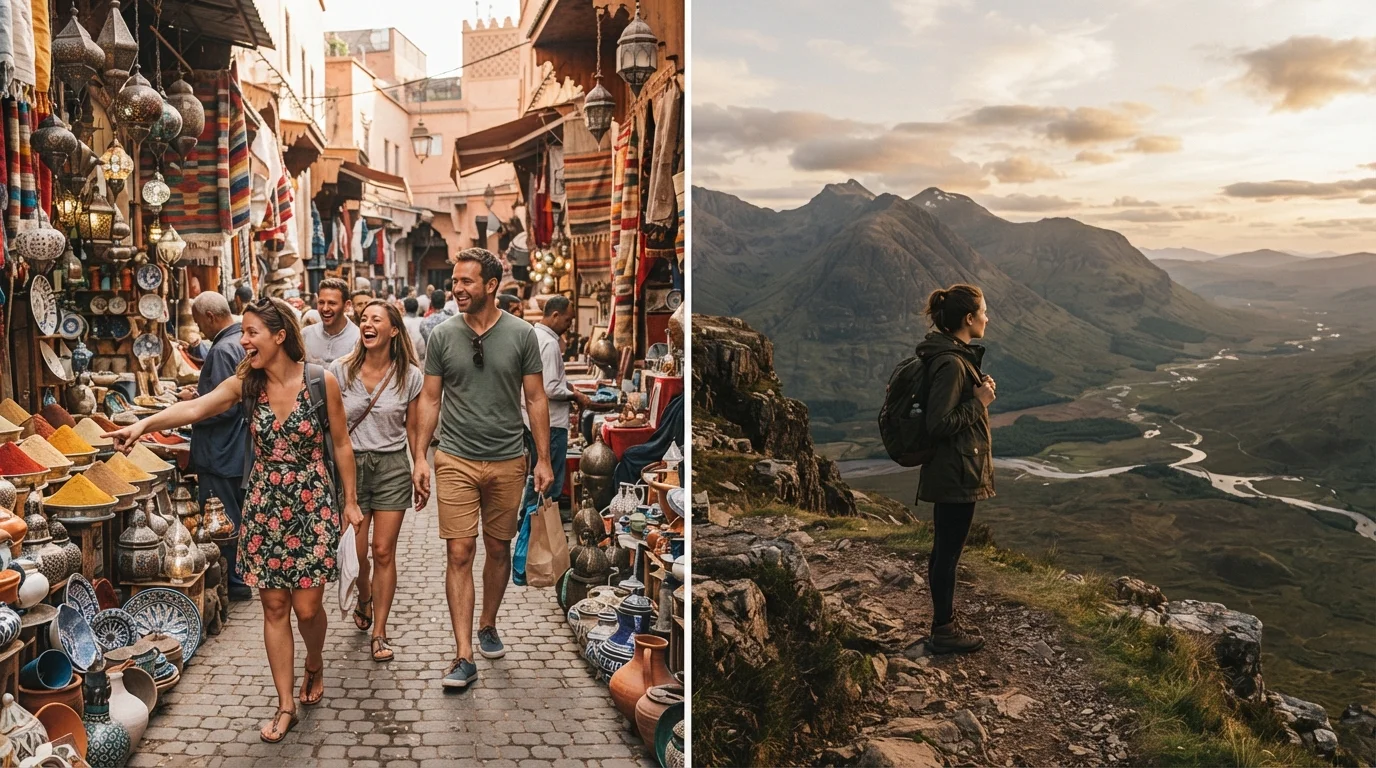
Key Takeaways
- Group travel reduces logistical burden but requires compromise on schedules, pace, and preferences.
- Solo travel offers maximum flexibility but demands more personal planning and self-reliance.
- Neither style is inherently safer, cheaper, or more rewarding - context and personality matter more.
- Hybrid formats exist that combine solo autonomy with built-in social opportunities.
- Your choice may legitimately vary by trip type, destination, and life stage.
Option A
Group Travel
The shared-experience, built-in-community approach.
Best for: Travelers who recharge through social connection, prefer shared logistics, or want a ready-made structure around them.
Option B
Solo Travel
The self-directed, fully autonomous alternative.
Best for: Travelers who value flexibility, want to move at their own pace, and are comfortable with independent decision-making.
If you thrive on shared experiences and find energy in social interaction
Group Travel
Built-in companionship means more spontaneous moments and shared memories, with far less pressure on any one person to drive every decision.
If you strongly dislike compromising on itinerary or pace
Solo Travel
Solo travel puts every call entirely in your hands - when to leave, where to eat, how long to linger. No negotiation required.
If you're new to international travel and want support structures
Group Travel
Traveling with others - or on an organized group tour - provides built-in guidance, shared problem-solving, and reduced exposure to unfamiliar logistics.
If personal reflection, independence, or specific niche interests drive the trip
Solo Travel
Solo travel makes it easy to spend three hours in a bookshop or change destinations on a whim - without justifying it to anyone.
If you want social connection without full group commitment
Solo Travel
Formats like group tours, hostel stays, or skills-based retreats let solo travelers connect with others while still controlling their own journey.
What Each Style Actually Involves
Group travel and solo travel aren't just different headcounts - they represent genuinely different relationships with how a trip is planned, experienced, and remembered. Understanding what each actually demands day-to-day cuts through the romanticism that surrounds both.
Group travel means traveling with at least one other person whose needs, preferences, and pace matter. That could be a partner, family unit, friend group, or a structured tour with strangers. Logistics are shared; so is every decision point. The upside is real: divided costs on accommodation, shared navigation duties, built-in company at every meal. The trade-off is compromise - someone in the group will want to leave earlier, spend more, or skip the thing you came specifically to see.
Solo travel means you are the sole author of the trip. Every choice, from flight times to the dinner table, is yours alone. That creates extraordinary freedom, but it also means every problem lands on you. Missed connections, language barriers, a bad hotel - solo travelers solve these without a safety net of companions. What solo trip planning actually involves is worth understanding before assuming independence means simplicity.
| Criterion | Group Travel | Solo Travel |
|---|---|---|
| Flexibility | Requires group consensus | Fully self-directed |
| Logistics burden | Shared across travelers | Falls entirely on you |
| Built-in social connection | Always present | Must be sought actively |
| Accommodation cost | Often lower per person | Full cost, no splitting |
| Decision-making | Collaborative, compromised | Sole authority |
| Problem-solving support | Shared, distributed | Independent, self-reliant |
| Pace control | Negotiated with group | Entirely your own |
| Local interaction depth | Often filtered through group | Frequently more direct |
The Real Trade-Offs: Flexibility, Cost, and Connection
The group-vs-solo question often comes down to three practical axes: flexibility, cost, and social experience.
Flexibility: Solo travelers can pivot without friction - sleep in, change cities, abandon a plan that isn't working. Group travelers negotiate every change. Even two people with good communication will find that aligning schedules takes energy. The larger the group, the more pronounced this becomes. Traveling with friends as an adult often surfaces mismatched expectations that were invisible at the planning stage.
Cost: Group travel can reduce per-person costs on accommodation and transport through splitting, but group dynamics can also push spending upward - group dinners, group activities, and keeping pace with higher spenders all add up. Solo travelers pay full rates everywhere, though they also have complete control over where money goes.
Connection: This is where group travel has a genuine edge for many people - built-in company is comforting, especially in unfamiliar places. Solo travel, by contrast, often drives deeper interactions with locals and fellow travelers precisely because you're not insulated by a ready-made social bubble. Neither result is guaranteed; both are possible in either style. If you're concerned about loneliness, trip formats designed for solo travelers who dislike being alone offer practical middle-ground options.
~25%
US adults who traveled solo in the past year
Survey data from the American Travel Survey indicates roughly one in four American adults has taken at least one trip alone, suggesting solo travel is mainstream rather than niche.
2-3x
Higher group conflict rate on trips of 5+ people
Travel researchers and group dynamics studies consistently note that coordination friction scales significantly once group size exceeds four travelers.
Personality Fit: The Question Most People Skip
Travel style preferences aren't random - they correlate with how you process stimulation, make decisions, and handle uncertainty. Genuinely introverted travelers often find group trips exhausting, even enjoyable ones, simply because continuous social navigation depletes energy. Conversely, some people feel anxious or flat when left to entirely self-direct for weeks at a time.
It's also worth separating trip type from travel identity. Someone who identifies as a seasoned solo traveler might choose group travel for a specific destination - a remote wilderness region, for example - because the logistical or safety case is strong. And a self-described group traveler might take a solo weekend trip to decompress. Adventure versus leisure travel philosophies is a related lens: the type of trip shapes what style works best, not just who you are in general.
Ask yourself honestly: When things go sideways on a trip, do you prefer having someone to problem-solve with, or do you want to handle it your way without input? That one question often cuts to the heart of which style fits.
For those considering solo travel for the first time, the different shapes solo travel can take shows that the category is far broader than backpacker hostels or extreme independence - there's a version that fits most comfort levels.
Solo Doesn't Have to Mean Isolated
A common misconception is that solo travel equals solitary travel. In practice, solo travelers frequently join day tours, shared transport, and social accommodation that creates plenty of human connection. The difference is that the connection is chosen on your terms, not built into a pre-existing group structure. If full independence feels daunting, starting with a structured destination - one with easy infrastructure and traveler-heavy areas - can ease the transition considerably.