

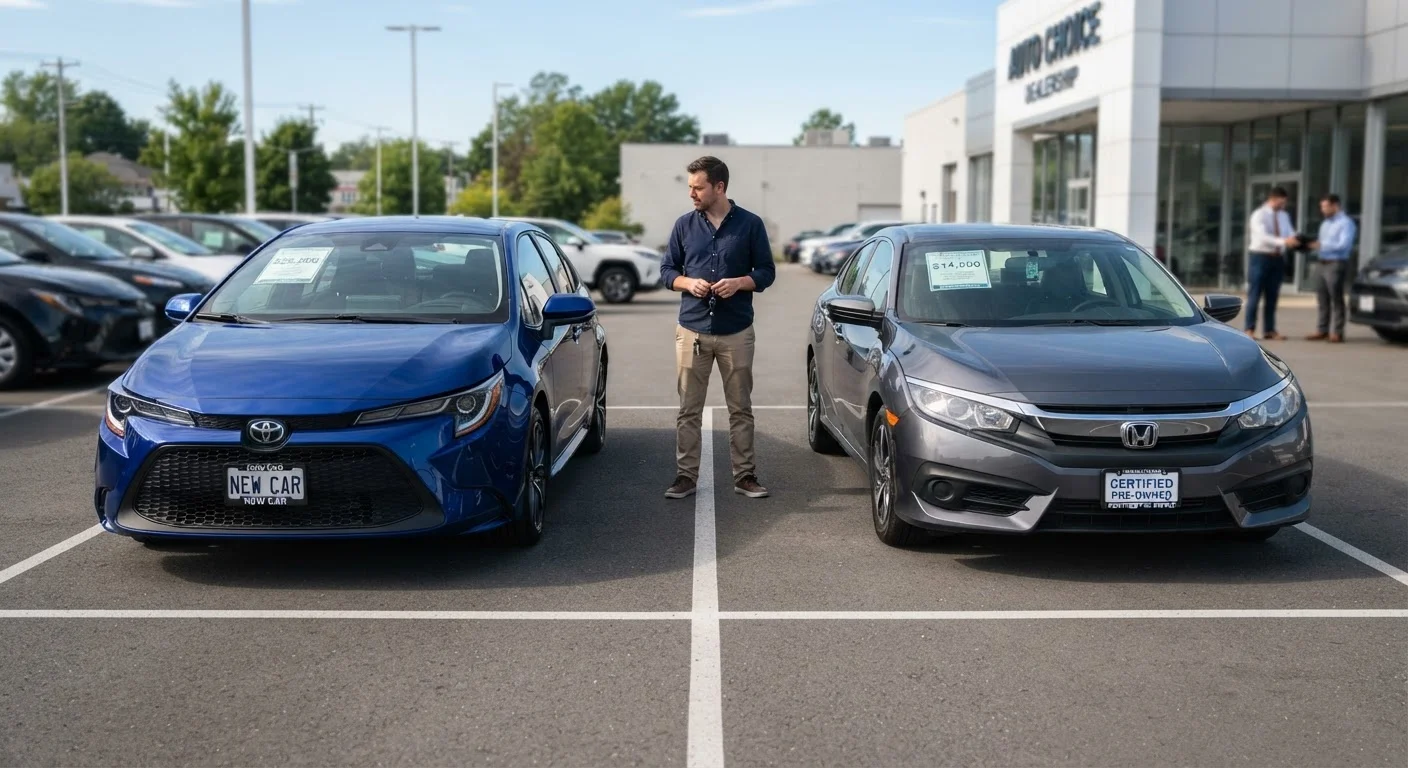
Key Takeaways
- New cars lose a significant portion of their value in the first one to three years - used buyers avoid that hit.
- New cars typically come with manufacturer warranties; used car coverage varies widely by age and seller type.
- Financing rates for new cars are often lower, but the higher purchase price may offset that advantage.
- Certified Pre-Owned programs can bridge the gap between new and used, but coverage details vary by manufacturer.
- Total ownership cost - not just sticker price - is the most useful figure to compare across both options.
Option A
New Car
The full-warranty, latest-features option.
Best for: Buyers who prioritize warranty coverage, the latest safety technology, and predictable early ownership costs.
Option B
Used Car
The lower-entry-cost, depreciation-avoided alternative.
Best for: Budget-conscious buyers willing to research vehicle history in exchange for significant savings on purchase price.
If you want comprehensive warranty protection and the latest safety features
New Car
New vehicles include full manufacturer warranties and current driver-assistance technology, reducing early repair risk and maximizing safety coverage.
If minimizing upfront cost and avoiding early depreciation is the priority
Used Car
A used car purchased after the steepest depreciation window has already passed can deliver substantially lower total cost over the same ownership period.
If you want used-car pricing with some warranty reassurance
Used Car
A Certified Pre-Owned vehicle may offer a middle path - lower entry cost than new, with manufacturer-backed inspection and limited warranty coverage.
If you plan to keep the vehicle for ten or more years
New Car
The depreciation disadvantage of buying new diminishes significantly over a long ownership period, and you benefit from the full service life of the vehicle.
If you're financing and want the lowest possible interest rate
New Car
Manufacturers and lenders generally offer lower APR on new vehicles, though the higher loan principal means you should calculate total interest paid, not just the rate.
Depreciation: The Biggest Financial Variable
Depreciation is the single largest cost most drivers never see itemized on a bill. New vehicles typically lose a meaningful share of their value within the first few years of ownership - the exact rate varies by make, model, and market conditions, but the general pattern is consistent: the sharpest drop happens early.
When you buy used, a previous owner has already absorbed that initial decline. You're entering the vehicle's value curve at a more gradual slope. That's a genuine financial advantage - provided the vehicle's condition and history support the asking price.
For buyers planning to trade in or sell within three to five years, the depreciation math strongly favors used. For those keeping a vehicle for a decade or more, the gap narrows considerably. The true cost of ownership across both options - including insurance, fuel, and maintenance - is a more complete picture than sticker price alone.
~20%
Typical first-year new car depreciation
Industry estimates commonly place new vehicle value loss at roughly 15-20% in the first year, though rates vary by model and market conditions.
3 yrs
Steepest depreciation window for most vehicles
Most automotive analysts identify the first one to three years as the period of sharpest value decline for new vehicles.
Warranty and Reliability: What Each Option Actually Covers
New cars come with factory warranties - typically a bumper-to-bumper coverage period and a longer powertrain warranty, though terms differ by manufacturer. This coverage provides a known ceiling on repair costs during the early ownership window, which matters for budgeting.
Used cars present a wider range. A vehicle still within its original warranty period may carry transferable coverage. A Certified Pre-Owned (CPO) vehicle goes through a manufacturer-defined inspection process and typically includes extended limited warranty protection - though what CPO actually covers varies significantly by brand. An older used car sold as-is carries no such safety net.
Reliability itself isn't solely a new-vs-used question. Model-specific reliability data - available through sources like owner surveys and independent testing organizations - is more predictive than age alone. A well-maintained three-year-old vehicle from a historically reliable model line may present lower repair risk than a poorly maintained new one at the end of its warranty.
| Criterion | New Car | Used Car |
|---|---|---|
| Purchase price | Higher | Lower (varies by age and condition) |
| Depreciation exposure | Buyer absorbs initial drop | Prior owner absorbed early decline |
| Warranty coverage | Full manufacturer warranty | Varies - none, CPO, or residual |
| Financing rate | Generally lower APR | Generally higher APR |
| Technology / safety features | Current generation | Depends on model year |
| Insurance cost | Typically higher premiums | Often lower premiums |
| Inspection burden | Minimal - dealer responsible pre-delivery | Buyer responsible - history + physical check |
| Customization options | Factory order possible | Limited to available inventory |
Financing Rates and Total Cost
Lenders and manufacturers generally offer lower interest rates on new vehicle loans than on used ones. Manufacturer-subsidized financing promotions can push rates even lower. On the surface, that looks like a strong argument for buying new.
The complication: a lower rate on a larger loan balance doesn't automatically mean lower total cost. A used car financed at a modestly higher rate but at a purchase price thousands of dollars below a comparable new vehicle may result in lower total interest paid and lower monthly obligations. The comparison requires actual numbers, not just rate headlines.
It's also worth factoring in insurance costs. New vehicles - especially those with higher replacement values and advanced technology components - can carry higher comprehensive and collision premiums. Working through the full purchase process with realistic cost estimates at each stage helps avoid surprises after signing.
What to Inspect and Where to Buy
Buying new simplifies the inspection question: the vehicle is untouched, and any pre-delivery issues are the dealer's responsibility. Buying used shifts that burden to the buyer. A vehicle history report is a starting point, not a substitute for a physical inspection - and ideally a pre-purchase inspection by an independent, qualified mechanic.
Evaluating a used car in person requires attention to condition indicators that history reports don't capture: signs of prior bodywork, wear patterns inconsistent with reported mileage, and mechanical behavior during a test drive.
Where you buy also affects your protections. Dealer and private sales carry different consumer protections and negotiation dynamics. CPO programs are dealer-exclusive. Private sales typically offer lower prices but no recourse if problems emerge after purchase.
For buyers still mapping the overall process, comparing leasing and buying may also be worth reviewing before committing to either a new or used purchase.
High-Mileage Used Cars: A Different Calculation
Vehicles with substantial mileage introduce a separate set of trade-offs beyond the new-vs-used question. Maintenance needs, remaining component life, and repair cost exposure all shift as mileage increases. If you're considering an older vehicle with significant mileage, understanding the specific trade-offs of high-mileage ownership before committing is worth your time.