

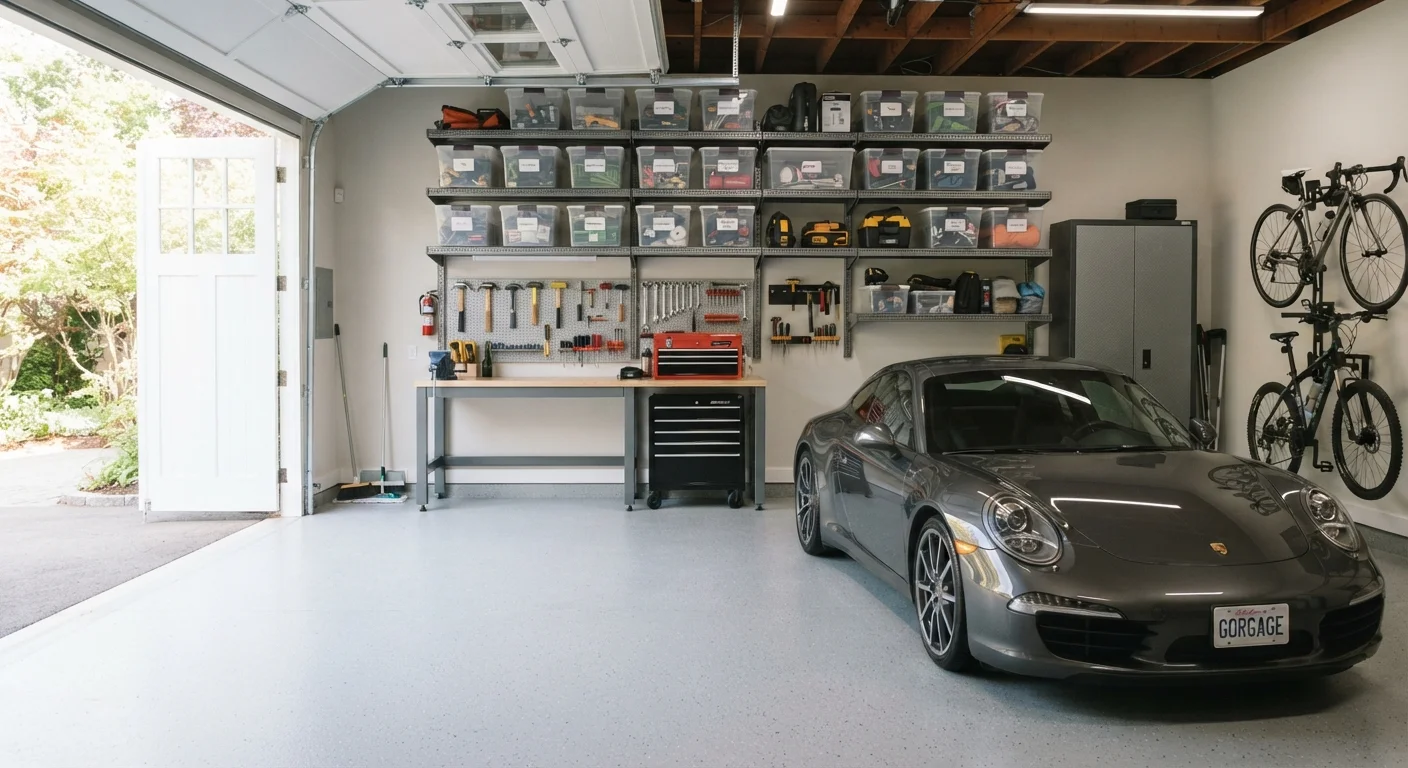
Key Takeaways
- Garages offer substantial storage capacity, but temperature extremes can damage certain items.
- Converting garage space to storage can free up living areas, but may limit parking convenience.
- Good shelving systems and categorization are essential to making garage storage work long-term.
- Security, pest exposure, and humidity are real concerns that require deliberate mitigation.
- The right approach depends on your climate, household needs, and how you actually use the garage.
Adds significant storage capacity outside living areas
A standard two-car garage offers several hundred square feet of potential storage, meaningfully relieving pressure on interior closets, utility rooms, and bedrooms without requiring renovation.
Suited to bulky, utilitarian items
Lawn equipment, bicycles, power tools, and seasonal gear are awkward to store indoors. The garage handles these naturally, keeping them accessible without intruding on living spaces.
Allows seasonal rotation without clutter
Storing off-season items - holiday decorations, winter sports equipment, summer furniture - in the garage keeps them out of the way while remaining retrievable when needed.
Can be organized cheaply with modular systems
Wall-mounted shelving, pegboards, and freestanding metal racks are widely available and relatively affordable, making it possible to create an organized system without a major renovation budget.
Separation from living space reduces visual clutter
Keeping utilitarian and infrequently used items in the garage preserves the calm and order of interior rooms, which can meaningfully improve daily quality of life at home.
Temperature extremes damage sensitive items
Most US garages are uninsulated and unheated, exposing stored items to temperature swings that can warp wood, degrade electronics, and cause paint or adhesives to fail over time.
Higher vulnerability to pests and moisture
Garages typically have more gaps and entry points than interior rooms, making them more susceptible to rodents, insects, and dampness that can ruin stored belongings.
Easy to become disorganized overflow space
Without a deliberate system, garages attract items that haven't been properly decided on - leading to crowded, hard-to-navigate spaces that negate the storage benefit.
Security is generally lower than interior rooms
Garage doors and side entrances are common points of entry for theft. Items of significant value stored in garages may be at greater risk than those kept inside the home.
Reduces or eliminates vehicle parking
Prioritizing storage often means displacing one or both vehicles to the driveway or street, which may be impractical depending on climate, neighborhood, or homeowner association rules.
Our Verdict
Using a garage for storage is a genuinely practical solution for many households, particularly those dealing with seasonal equipment, tools, or bulky items that don't belong inside. However, the space comes with meaningful trade-offs - environmental exposure, security gaps, and the easy slide into disorganized overflow - that require honest assessment before committing. With a clear plan and appropriate storage systems, a garage can meaningfully extend your home's functional capacity.
Homeowners with moderate to large garages, a mild or manageable climate, and a clear system for what gets stored - rather than anyone treating the garage as a catchall for items they haven't decided to keep or discard.
Why Garages Attract Storage (And Whether That's a Good Thing)
The garage is often the first place households turn when interior space fills up. It's physically separate, easy to access, and - critically - out of sight. That combination makes it a natural overflow zone. But defaulting to the garage without a plan tends to create a second problem: a space so packed and disorganized it becomes difficult to use for anything, including parking.
A more useful framing is to treat the garage as intentional storage, not incidental storage. That distinction changes how you evaluate its trade-offs. See our complete home organization starting point for context on how the garage fits into a whole-home strategy.
Adds significant storage capacity outside living areas
A standard two-car garage offers several hundred square feet of potential storage, meaningfully relieving pressure on interior closets, utility rooms, and bedrooms without requiring renovation.
Suited to bulky, utilitarian items
Lawn equipment, bicycles, power tools, and seasonal gear are awkward to store indoors. The garage handles these naturally, keeping them accessible without intruding on living spaces.
Allows seasonal rotation without clutter
Storing off-season items - holiday decorations, winter sports equipment, summer furniture - in the garage keeps them out of the way while remaining retrievable when needed.
Can be organized cheaply with modular systems
Wall-mounted shelving, pegboards, and freestanding metal racks are widely available and relatively affordable, making it possible to create an organized system without a major renovation budget.
Separation from living space reduces visual clutter
Keeping utilitarian and infrequently used items in the garage preserves the calm and order of interior rooms, which can meaningfully improve daily quality of life at home.
The Real Downsides: What Often Goes Wrong
Garage storage sounds straightforward in theory, but several recurring problems trip up even well-intentioned households.
Temperature extremes damage sensitive items
Most US garages are uninsulated and unheated, exposing stored items to temperature swings that can warp wood, degrade electronics, and cause paint or adhesives to fail over time.
Higher vulnerability to pests and moisture
Garages typically have more gaps and entry points than interior rooms, making them more susceptible to rodents, insects, and dampness that can ruin stored belongings.
Easy to become disorganized overflow space
Without a deliberate system, garages attract items that haven't been properly decided on - leading to crowded, hard-to-navigate spaces that negate the storage benefit.
Security is generally lower than interior rooms
Garage doors and side entrances are common points of entry for theft. Items of significant value stored in garages may be at greater risk than those kept inside the home.
Reduces or eliminates vehicle parking
Prioritizing storage often means displacing one or both vehicles to the driveway or street, which may be impractical depending on climate, neighborhood, or homeowner association rules.
Temperature fluctuation is among the most underestimated issues. Garages in most US climates experience wide swings between summer heat and winter cold - conditions that accelerate the degradation of electronics, wooden furniture, canned goods, photographs, and many adhesives. If you're storing anything sensitive to heat or humidity, a climate-controlled garage is worth considering, though it adds cost and complexity.
Pest intrusion is another common failure point. Garages typically have more entry points than interior rooms - gaps around doors, utility penetrations, and vents - making them more vulnerable to rodents and insects. Items stored in cardboard boxes or fabric bags are especially at risk.
Making Garage Storage Work: Key Principles
The households that make garage storage work well share a few consistent habits. First, they distinguish between items that belong in the garage and items that have simply ended up there. Tools, seasonal sports gear, lawn equipment, and automotive supplies are logical garage residents. Sentimental items, important documents, and anything heat-sensitive generally are not.
Second, they use the vertical dimension effectively. Wall-mounted shelving and ceiling-mounted racks dramatically increase usable capacity without shrinking the floor footprint. Our guide to using vertical space for home storage covers this in detail.
~60%
US homeowners who use garage primarily for storage
A widely cited survey by the US Department of Energy found that roughly three in five American homeowners with garages use the space primarily for storage rather than vehicle parking.
400-800 sq ft
Typical storage capacity of a two-car garage
A standard two-car garage in the US generally offers between 400 and 800 square feet of floor space, representing substantial potential storage when organized vertically and systematically.
Third, they apply consistent categorization - grouping items by season, function, or frequency of use - so the garage remains navigable rather than becoming a black hole for forgotten objects. Open shelving versus closed cabinets is a related decision worth making deliberately rather than by default.
A Note on Permits and Structural Changes
If you're considering adding permanent storage structures to your garage - such as built-in cabinetry anchored to walls, a loft storage platform, or any changes that affect the structure - local building codes and permit requirements may apply. Requirements vary significantly by municipality. Always check with your local building department before undertaking modifications beyond freestanding furniture and shelving.
Alternatives Worth Comparing
If your garage has real limitations - climate issues, security concerns, or the household simply needs to park two vehicles - it's worth knowing what other options exist before committing to a garage-centric storage approach.
Interior storage solutions, particularly for small homes, can be surprisingly effective when vertical space and underutilized zones are properly leveraged. Our article on storage solutions for small spaces addresses this directly. For households considering more significant expansions - adding a dedicated storage room or converting existing space - single-story extensions versus loft conversions represent larger but sometimes worthwhile investments. The trade-off mindset explored in making deliberate trade-offs applies just as well to how you allocate space as to how you spend money.