

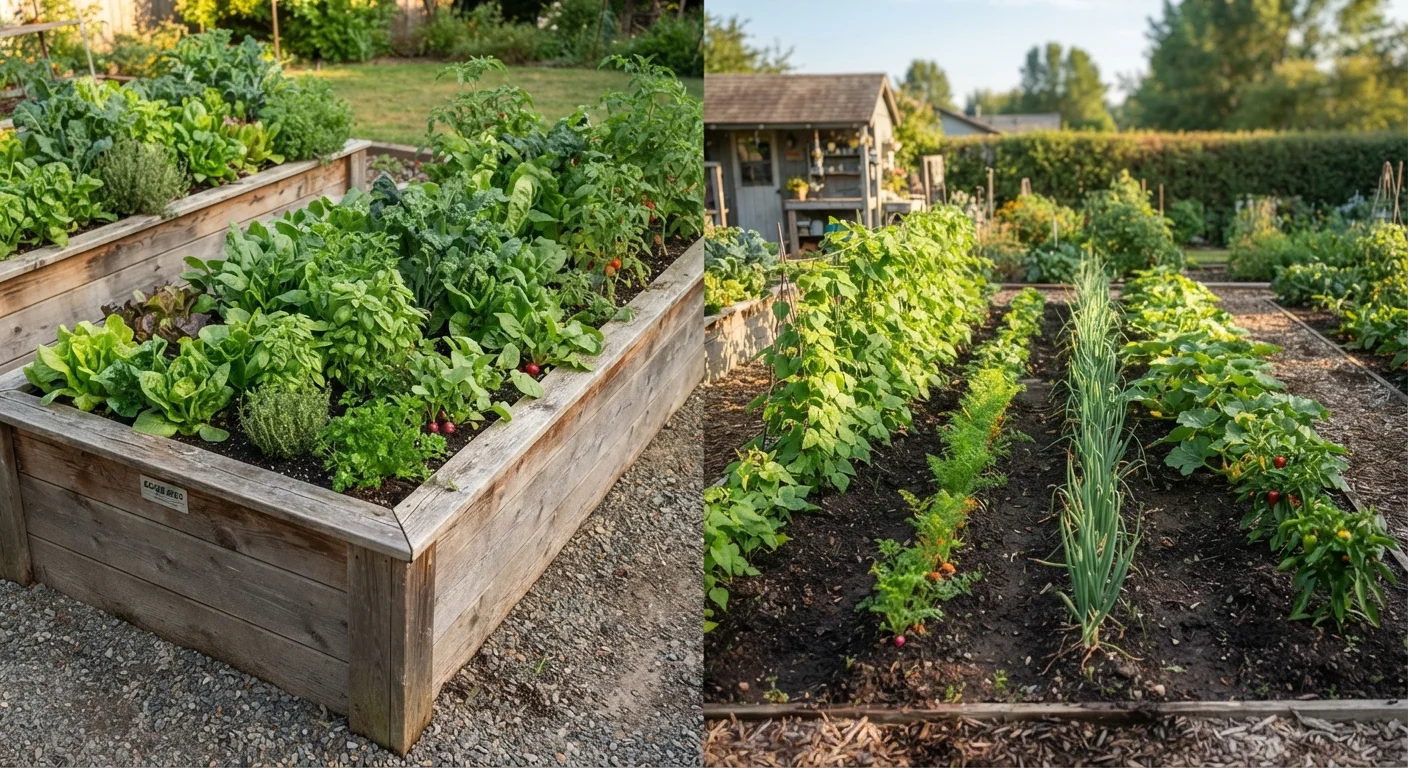
Key Takeaways
- Raised beds give you full control over soil quality, making them ideal where native soil is poor or contaminated.
- In-ground planting costs less to start and scales more easily to large growing areas.
- Raised beds typically drain better and warm up faster in spring, extending your planting window.
- In-ground gardens support deeper root systems, which suits large crops like corn, squash, and fruit trees.
- Your choice should factor in upfront budget, physical accessibility, and the soil conditions you're starting with.
- Both methods can be highly productive when matched to the right plants and properly maintained.
Option A
Raised Beds
The controlled, accessible growing environment.
Best for: Gardeners dealing with poor native soil, limited mobility, or defined planting zones who want a clean, manageable setup.
Option B
In-Ground Planting
The traditional, scalable approach to garden growing.
Best for: Homeowners with good existing soil who want to grow across a larger area with lower upfront cost.
If your native soil is compacted, rocky, or contaminated
Raised Beds
Raised beds let you bypass problem soil entirely by filling with a custom growing mix. This is often the most practical path when ground conditions are poor.
If you want to grow a large garden on a limited budget
In-Ground Planting
In-ground gardens require no structural materials and can expand to any size without added cost per square foot.
If physical accessibility or bending is a concern
Raised Beds
A raised bed built at a comfortable working height reduces strain on your back and knees, making gardening more sustainable long-term.
If you're growing deep-rooted crops like corn, squash, or fruit trees
In-Ground Planting
In-ground beds allow unlimited root depth, which large or vigorous plants need that a shallow raised box cannot always provide.
If you're renting or want a garden you can reconfigure later
Raised Beds
Raised beds are modular and leave the underlying ground largely undisturbed, making them easier to move, remove, or redesign.
Understanding the Core Difference
At their core, raised beds and in-ground planting differ in one fundamental way: where your plant roots live. In-ground planting means working directly with your native soil, amending and improving it over time. Raised beds create a contained growing environment above ground level, filled with a controlled soil mix of your choosing.
That distinction cascades into real differences in drainage, soil temperature, weed pressure, cost, and physical effort. Neither method is inherently superior - the right choice depends on what you're starting with and what you're trying to achieve. If you're building your first garden from scratch, see our complete first-timer's roadmap for grounding context before you commit to either approach.
| Criterion | Raised Beds | In-Ground Planting |
|---|---|---|
| Upfront cost | Higher (materials + fill soil) | Lower (minimal materials needed) |
| Soil control | Full control over mix | Dependent on native soil |
| Drainage | Excellent, free-draining | Varies by native soil type |
| Warm-up in spring | Faster - soil heats quickly | Slower in cool or clay soils |
| Weed pressure | Lower initially | Higher, especially from perennials |
| Root depth | Limited by bed depth | Unrestricted |
| Scalability | Modular but cost increases | Easily expanded at low cost |
| Accessibility | Can be built to any height | Requires bending to ground level |
| Portability/flexibility | Removable and reconfigurable | Fixed; disturbs ground if changed |
Soil Quality and Control
This is where raised beds hold a clear practical edge. Many US yards have native soil that is either compacted from construction, heavy with clay, sandy with poor water retention, or - in older urban properties - potentially contaminated with lead or other residues. Building a raised bed lets you sidestep all of that. You fill it with a custom blend of compost, topsoil, and other amendments suited to what you're growing.
In-ground planting requires you to work with what's there. That can be an advantage if your soil is already healthy - good loam with organic matter will support a wide range of crops without the upfront investment. But improving poor native soil takes consistent effort across multiple seasons. Incorporating compost, adjusting pH, and managing compaction is a long-term process, not a quick fix.
Understanding how mulch choices interact with both approaches is worth your attention. Our article on mulch types and soil effects explains how different materials behave depending on your setup.
A Note on Soil Testing
Before committing to either approach, consider having your native soil tested. Many US cooperative extension services offer low-cost testing that reveals pH, nutrient levels, and in some cases, contamination. That information changes the calculus significantly - knowing what you're working with prevents you from investing time in soil improvement that may not be sufficient, or from building raised beds you may not actually need.
Cost, Setup, and Scalability
In-ground planting wins on upfront cost. If your soil is workable, you can begin with little more than a shovel, compost, and seeds. There are no structural materials to buy, no lumber to source, no hardware to assemble.
Raised beds require an investment in materials - wood, galvanized metal, or composite boards - plus the soil volume to fill them. A single 4×8-foot bed can cost anywhere from moderate to significant depending on the materials and fill chosen. That cost per square foot is higher than in-ground planting, especially at the start.
Where in-ground gardens scale easily - you simply expand the area you're working - raised beds involve adding more structures and more fill. That said, raised beds are modular. They're easy to reconfigure, and because they leave underlying ground largely intact, they're a sensible option for renters or homeowners who may want flexibility later. Container gardening is a related alternative worth considering if space is particularly limited.
6-12 in
Minimum raised bed depth for most vegetables
Most cooperative extension guidelines recommend at least 6 inches of quality growing medium for shallow-rooted crops, and 12 inches or more for root vegetables.
4 ft
Recommended maximum raised bed width
A 4-foot width allows most gardeners to reach the center from either side without stepping into the bed, protecting soil structure from compaction.
Drainage, Season Length, and Weed Pressure
Raised beds drain more freely than in-ground beds, which reduces the risk of waterlogged roots - a common issue in clay-heavy soils. They also warm up faster in spring because the soil mass is elevated and exposed to air on multiple sides. This can give you a meaningful head start on the growing season. Our guide on extending the growing season covers additional strategies like row covers and cold frames that pair well with raised beds.
Weed management also tends to be easier in raised beds, at least initially. Because you're working with imported soil rather than native ground, you bring in far fewer weed seeds from the start. Over time, wind-borne seeds will arrive regardless, but the baseline is cleaner. In-ground gardens are more susceptible to persistent weeds from surrounding areas and established root systems beneath the soil surface.
Watering needs are similar across both methods, though raised beds can dry out more quickly in summer heat. A targeted approach helps - our comparison of drip irrigation vs sprinkler systems is a useful next read for whichever direction you go.
Matching Your Method to Your Plants
Most vegetables, herbs, and annual flowers thrive equally well in raised beds or in-ground settings, provided the soil is appropriate. Where the method matters more is with deep-rooting or large-scale crops. Corn, sprawling squash, melons, asparagus, and fruit trees need room for root systems that a standard 10-12 inch deep raised bed may not fully accommodate. These crops are better suited to in-ground planting where root depth is unrestricted.
For intensive vegetable growing - salad greens, tomatoes, peppers, herbs, carrots, and root vegetables in well-amended soil - raised beds are often genuinely productive. The controlled environment allows for high-density planting. Pairing plant varieties thoughtfully also matters in either setting. The principles in our guide on companion planting apply regardless of your chosen method and can meaningfully improve your yields.
If a more naturalistic planting approach appeals to you, in-ground beds integrate well with native plant communities. See our piece on the case for native plants for how that approach can reduce maintenance while supporting local ecosystems.